The name of the god
Emitaï is a Senegalese historical drama set in the Diola region of Casamance during the Second World War, made under French co-production conditions but directed and written by Ousmane Sembène as an act of anti-colonial testimony. It seeks not to reconstruct history as archive but to render it as lived resistance: the film centres on a village’s refusal to surrender its rice harvest to Vichy authorities, then its continued defiance when Free French forces replace them. Sembène treats colonial administration not as policy but as physical presence — uniforms, rifles, posters, orders barked in French — and frames the Diola response not as rebellion in the European sense but as ritualised stewardship of land and lineage. The title refers to a Diola deity associated with transition and renewal, and the film’s purpose is to assert that such transitions are neither granted nor mediated by colonial power. It is a work of counter-history, built from silence, withheld grain, and untranslatable prayer.
The look of it
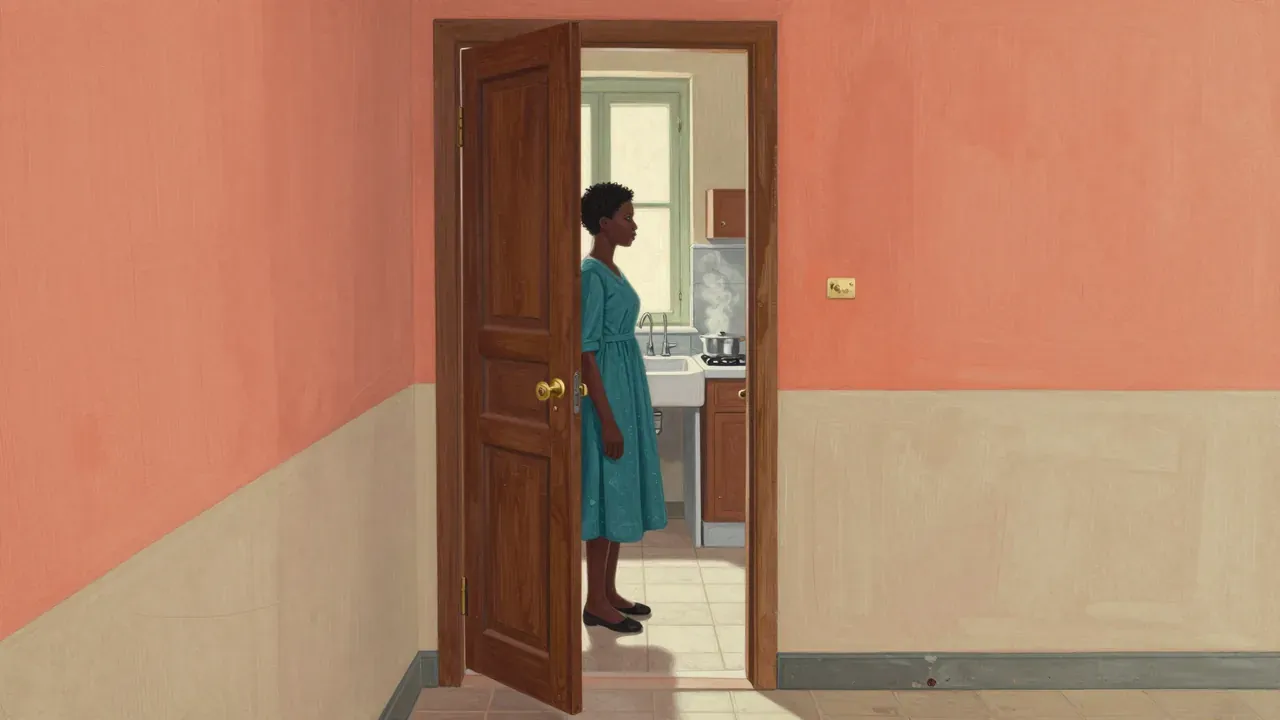
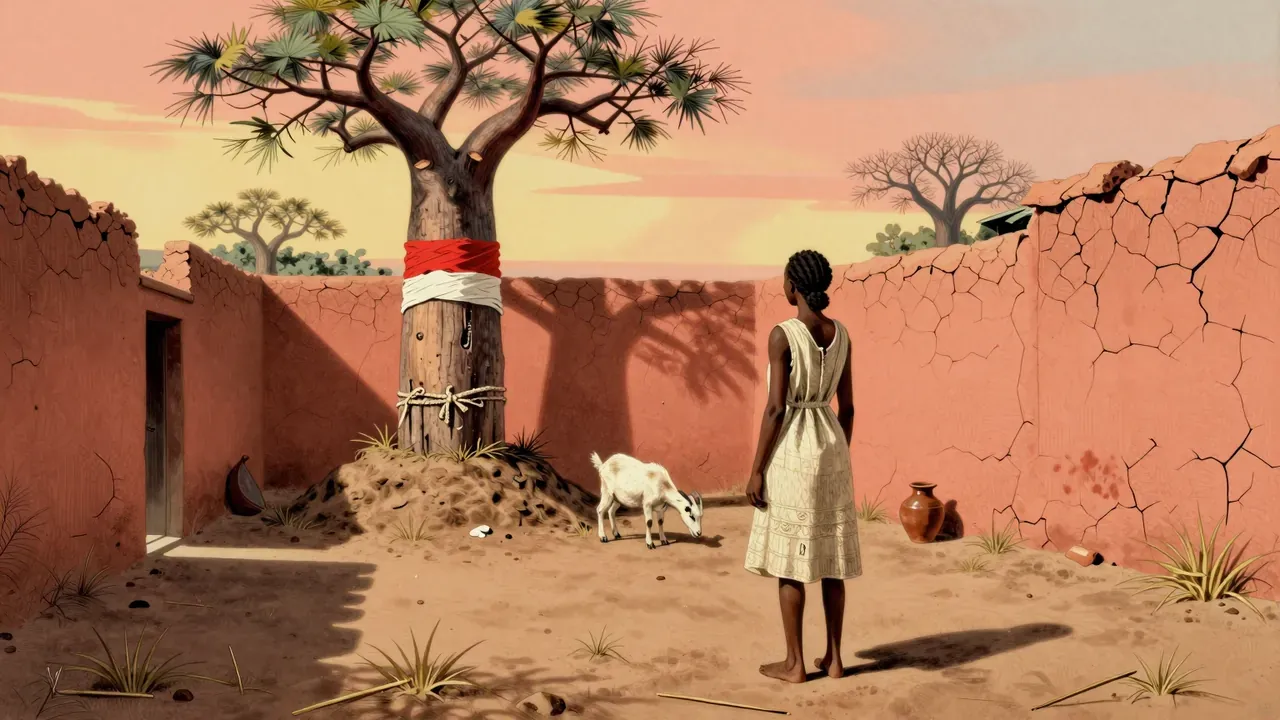
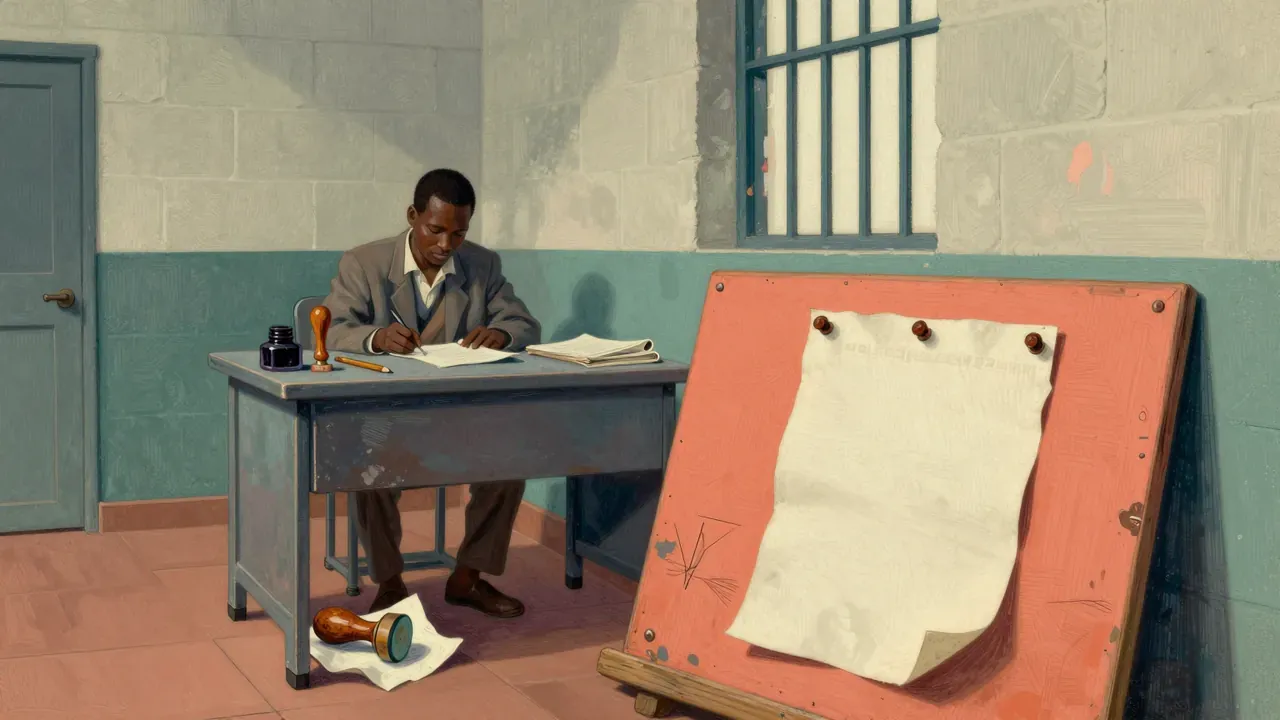
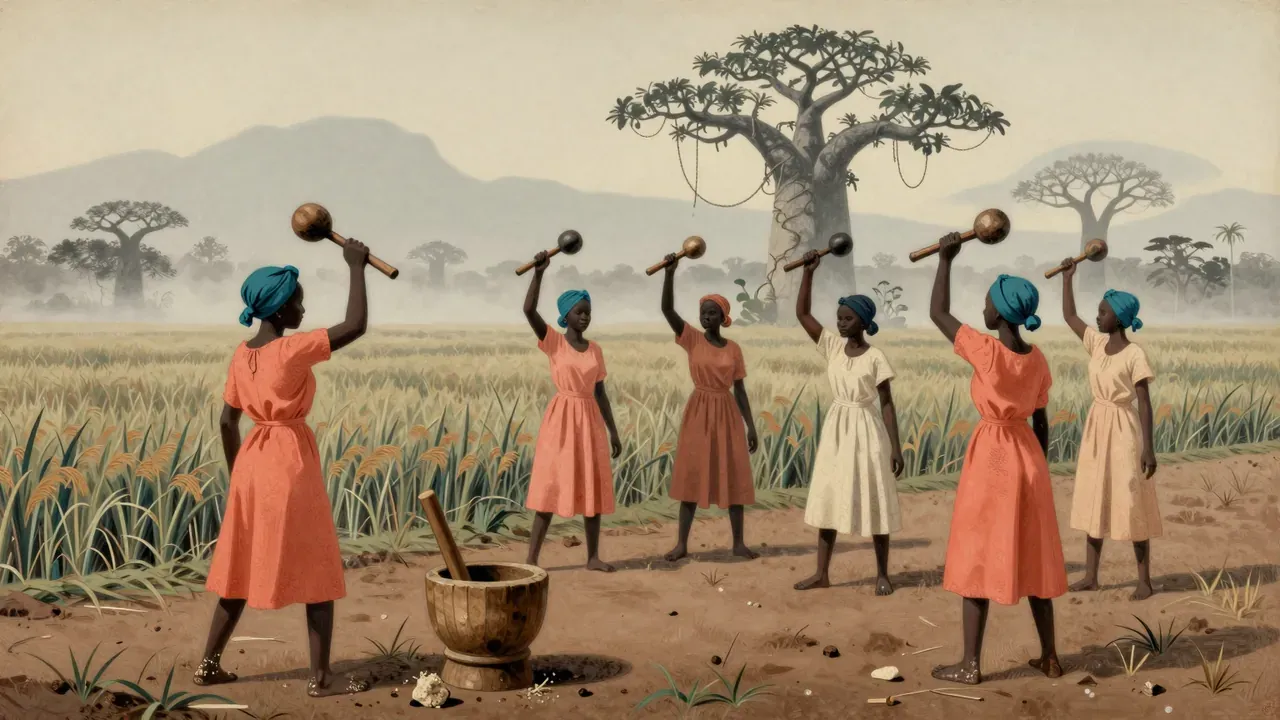
The narrative unfolds through restrained exposition and cumulative gesture: women threshing rice in tight formation, elders debating beneath a baobab, soldiers tearing down Vichy placards only to paste up de Gaulle’s face. Robert Fontaine as Commandant delivers authority without caricature; his French is bureaucratic, not theatrical. Mbissine Thérèse Diop’s presence as a village elder anchors the film’s moral weight in stillness and duration. Sembène avoids flashbacks or voiceover, trusting composition and rhythm — long takes hold faces in medium close-up, while wide shots show fields receding into misted horizons. Editing is deliberate, often withholding reaction shots to let consequence settle. The sound design favours diegetic texture: wind, mortar and pestle, distant gunfire muffled by distance. There is no score beyond sparse, ceremonial drumming. Lighting is naturalistic, favouring overcast daylight and interior gloom, with no attempt to flatter or dramatise suffering. This is craft deployed as discipline, not decoration.
What holds the silence
What lands most firmly is the film’s refusal to resolve tension into catharsis. The massacre arrives without warning music or slow motion — just abrupt cuts, falling bodies, and a sudden absence of dialogue. That restraint makes it more legible as systemic violence than as spectacle. The Diola’s consultation of Emitaï is not rendered as superstition but as protocol: the camera watches rituals without explanation, treating them as self-evident forms of knowledge. The shift from Vichy to Free France is shown through posters, uniforms, and tone of command — not ideology, but continuity of coercion. This visual literacy extends to the women’s labour: their collective harvesting, hiding, and guarding of rice is presented as political action, not background. The film’s quiet insistence on Diola time — seasonal, cyclical, unbroken by French calendars — lands with accumulating force. It does not ask for empathy but for recognition: this is not tragedy, but testimony.
Where the men stand
What does not land is the structural thinness of certain male characters beyond Fontaine’s Commandant and Pierre Blanchard’s Colonel. Several Diola leaders speak in near-identical cadences, their debates lacking distinct ideological shading or personal stakes beyond duty. The film assumes familiarity with Diola social structure — elders, initiates, gendered roles — without offering enough contextual signposting for viewers unfamiliar with Casamance cosmology or pre-colonial governance. Some scenes of ritual preparation feel suspended rather than integrated, their symbolic weight clear but their narrative function diffuse. The French officers, though never cartoonish, remain functionally anonymous: their motivations are administrative, not psychological, which works for Sembène’s thesis but limits dramatic friction. There is no betrayal, no defection, no internal fracture — the unity is absolute, and that rigour, while politically coherent, narrows emotional range.
The rhythm of the rice
The themes that matter are sovereignty over subsistence, the violence of administrative continuity, and the erasure of indigenous temporality by colonial time. Rice is not crop but covenant: its concealment is both material resistance and spiritual fidelity. The film treats taxation not as fiscal policy but as ontological violation — the seizure of grain is the seizure of future. The replacement of Pétain with de Gaulle posters signals not liberation but rebranding: the same troops, same rifles, same demand for yield. Emitaï as deity embodies transition, yet the film insists that colonialism blocks passage — it arrests life at the threshold. Ritual here is not escapism but calibration: aligning human action with cosmic rhythm against the imposition of foreign clocks and quotas. These are not abstract ideas but embodied practices — the way hands move in threshing, the angle of a bowed head before a shrine, the silence after gunfire stops.
Who watches with whom
This film is for viewers who accept that history is told through omission as much as record, and who value formal austerity as ethical stance. It rewards patience with sustained attention to gesture, silence, and landscape. It is not for those who require character arcs, exposition, or narrative closure — there is no redemption, no survivor’s testimony, no archival footnote to soften the ending. Those expecting a conventional war film will find its pacing glacial, its conflict understated, its violence deferred then delivered without commentary. A viewer seeking psychological realism or moral ambiguity may leave frustrated: the film’s moral architecture is fixed, its sympathies unwavering. Its power depends on accepting that some truths do not need elaboration — they need repetition, presence, and refusal to look away.
How long it stays
Yes, it is worth your evening — not as entertainment but as reckoning. Its 103 minutes pass with gravity, not drag, because every shot serves the central question: what does it mean to hold ground when the map has already been drawn over you? It asks more of the viewer than passive consumption: it requires sitting with discomfort, with untranslated speech, with unresolved grief. Those who dismiss it as ‘slow’ mistake deliberation for inertia. Others may argue it lacks the visceral immediacy of later African war films — but that is precisely its point: violence is not always loud, and resistance is not always armed. What would change the verdict? A restoration with clearer audio for the Diola dialogue, or subtitles that attend to linguistic register rather than literal translation, would deepen access without altering the film’s essential terms.