A fugitive, not a hero
Sword of the Beast is a 1965 Japanese jidaigeki — a period drama set in the final years of the Tokugawa shogunate — co-written and directed by Hideo Gosha. It follows Gennosuke, a samurai fugitive who has killed his clan’s senior counsellor under false pretences, and now moves through marginal spaces: forests, mountain trails, abandoned huts, the fringes of official authority. The film does not aim to mythologise bushidō or rehearse heroic codes; instead, it treats the samurai as a compromised figure, stripped of rank, loyalty, and narrative certainty. Its ambition is structural and moral: to stage parallel betrayals across class and clan, and to ask whether justice can exist outside institutional sanction. It works within tight formal constraints — an 85-minute runtime, minimal exposition, no flashbacks that do not directly reframe present action — and uses those limits to sharpen its inquiry into complicity, motive, and consequence. Gosha’s approach is not revisionist spectacle but quiet, cumulative pressure: each scene tightens the knot between personal agency and systemic rot.
The look of it
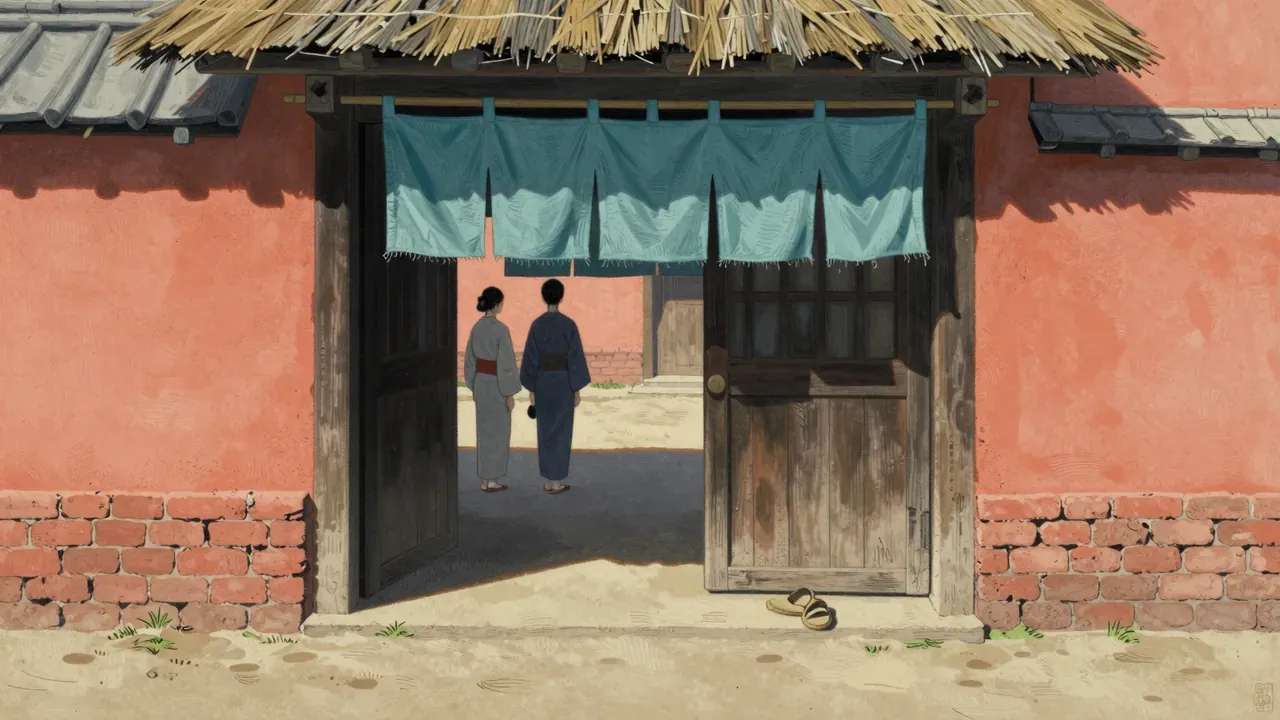
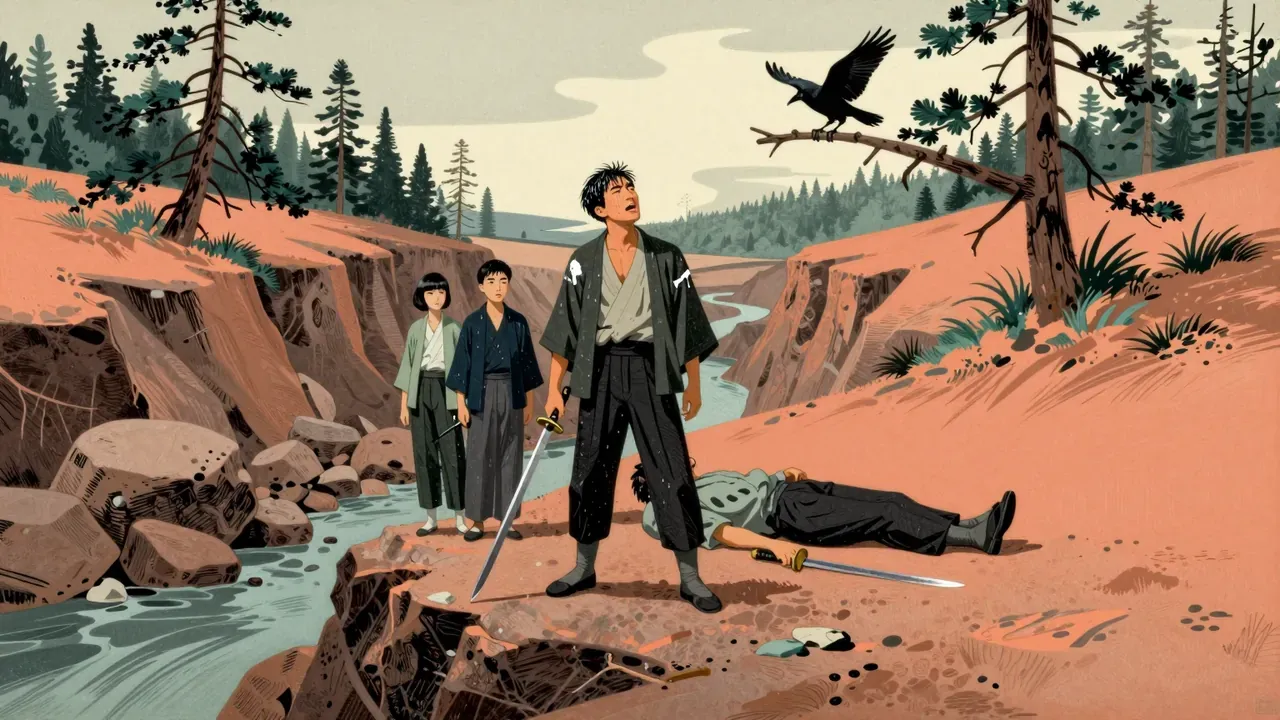
The story unfolds in lean, cause-and-effect strokes: Gennosuke’s flight, his alliance with the farmer Gundayu, their gold-poaching venture, the encounter with Jurota and Taka, then the convergence of all parties at the mountain’s edge. Mikijirō Hira plays Gennosuke with physical economy — his swordsmanship is decisive, never flamboyant; his silence carries weight without mystique. Shima Iwashita’s Taka is given little dialogue but precise gesture: a glance, a hand on her husband’s arm, the way she grips her knife. Toshiaki Tsushima’s score avoids leitmotif; strings and biwa punctuate rather than narrate. Gosha and cinematographer Kazuo Miyagawa keep compositions uncluttered: wide shots emphasise isolation, mid-shots fix on faces during moral pivots, and interiors are lit with low contrast, letting shadow pool around eyes and hands. Editing is rhythmic but unsentimental — cuts land where intention shifts, not where emotion swells. There are no establishing shots of Edo, no crowd scenes, no ceremonial framing. Every choice serves the film’s central question: what remains when duty is exposed as fraud?
The weight of the blade
What lands is the film’s refusal to grant catharsis through violence. The climactic battle is brief, brutal, and devoid of triumph — Gennosuke wins not because he is stronger, but because he arrives last, after betrayal has already done its work. His vengeance is reactive, almost perfunctory, and the real resolution comes in stillness: Daizaburo and Misa lowering their swords not out of mercy, but recognition — they see their own clan’s logic reflected in Jurota’s fate, and choose disengagement over repetition. The film also lands its depiction of economic desperation: gold poaching is not romanticised, but shown as backbreaking, risky, and morally porous — a shared condition across classes. Gundayu’s pragmatism, Jurota’s obedience, Gennosuke’s disillusionment: these are not archetypes but converging vectors of collapse. The pacing sustains this — 85 minutes feels neither rushed nor truncated, but calibrated to the rhythm of pursuit and pause. Even the silences have texture: wind in pine, gravel underfoot, the scrape of a scabbard on stone.
What stays silent
What does not land is the thinness of some secondary characters’ motivation — particularly Daizaburo, whose shift from pursuer to abstainer hinges on a single, unspoken realisation that lacks sufficient groundwork. Kantarō Suga gives him presence, but the script gives him no internal counterpoint to Gennosuke’s arc. Similarly, the Minister (Eijirō Tōno), though imposing in stature and bearing, functions only as a distant symbol of authority, never as a character with stakes or contradiction. The film’s compression works against its political dimension: the 1857 setting — just eight years before the Meiji Restoration — is historically significant, but Gosha does not dramatise the tremors of change beyond individual disillusionment. There is no sense of wider unrest, no rumour of foreign ships or shifting alliances — the world feels contained, almost hermetic. This focus is deliberate, but it means the film’s critique of feudal hierarchy remains personal rather than systemic. A viewer expecting historical texture beyond the interpersonal may find the backdrop too sparse.
The shape of loyalty
The themes that matter are betrayal as structure, not event; loyalty as performance; and honour as a tool of extraction. Gennosuke is not undone by weakness but by his willingness to believe in promotion, reform, legitimacy — all promises issued by men who treat ideology as cover for ambition. The film treats the clan not as community but as apparatus: a machine that consumes lower-ranking members to sustain upper ones. Gold functions as both literal and metaphorical currency — something stolen from the shōgun, yes, but also something extracted from labour, trust, and life. The mountain is not a refuge but a mirror: its dangers are externalised versions of the social terrain below — bandits stand in for rival clans, authorities for the state, poachers for the disenfranchised. Even gender is rendered through this lens: Taka’s competence is practical, not symbolic; Misa’s pursuit is framed not as filial duty alone, but as inheritance of a poisoned mandate. There is no redemption arc, no return to order — only a temporary suspension of violence, earned not by virtue but by exhaustion and insight.
Who it meets
This film is for viewers who value precision over pageantry, moral ambiguity over moral clarity, and restraint over exposition. It suits those accustomed to Japanese cinema of the 1960s — particularly the work of Kurosawa or Kobayashi — but also those drawn to tightly wound political dramas like Le Trou or The Battle of Algiers, where systems are exposed through individual fracture. It is not for viewers who require psychological backstory, emotional exposition, or narrative closure — there is no epilogue, no voiceover, no gesture toward future reconciliation. Those who expect swordplay as spectacle, or jidaigeki as folklore, will find it withholding. A viewer who values thematic density over plot momentum, or who reads silence as substance, will find it rich. Someone who needs clear antagonists, rising action, or cathartic resolution would likely leave dissatisfied — and that dissatisfaction is part of the film’s design, not a flaw in execution.
Where it leaves you
Yes, it is worth your evening — provided you watch it without expectation of uplift or resolution. Its 85 minutes pass with the weight of consequence, not the drag of austerity. It repays attention not through revelation but through accumulation: each scene adds a shard to the same fractured mirror. You need no prior knowledge of Tokugawa politics or samurai ethics — the film assumes no expertise, only willingness to follow cause and effect. That said, viewers who associate ‘classic Japanese cinema’ with lush visuals or philosophical monologue may find Gosha’s approach too lean, too dry. The film’s power lies in its refusal to flatter the audience with meaning — it offers pattern, not answer. To call it ‘difficult’ would misstate it: it is direct, even blunt. Its difficulty is ethical, not formal. If you are willing to sit with that discomfort, and to let its final image — a man walking away, not toward anything — settle without explanation, then it earns its time fully.