What it is for
Toothache is a 16mm educational short made in 1980 at Iran’s Institute for the Intellectual Development of Children and Young Adults (Kanoon), written and directed by Abbas Kiarostami. Its stated purpose is pedagogical: to teach Iranian schoolchildren the necessity of daily tooth brushing and regular dental care. It belongs to a series of twelve instructional films Kiarostami produced between 1970 and 1982, all commissioned by Kanoon as part of its mandate to foster intellectual and ethical development in youth. Unlike his later feature work, this film operates within strict institutional parameters — it has no narrative ambiguity, no open-endedness, no evasion of message. The film’s structure is didactic first, cinematic second: a boy’s physical decline from neglect serves as illustration; a dentist’s monologue forms the core exposition; animation and diagrams reinforce cause and effect. It is not disguised as fiction but presented as instruction — a public health intervention rendered in moving image. Its urgency is literal, not metaphorical: teeth hurt, decay spreads, prevention is simple. Word count: 148.
How it is built
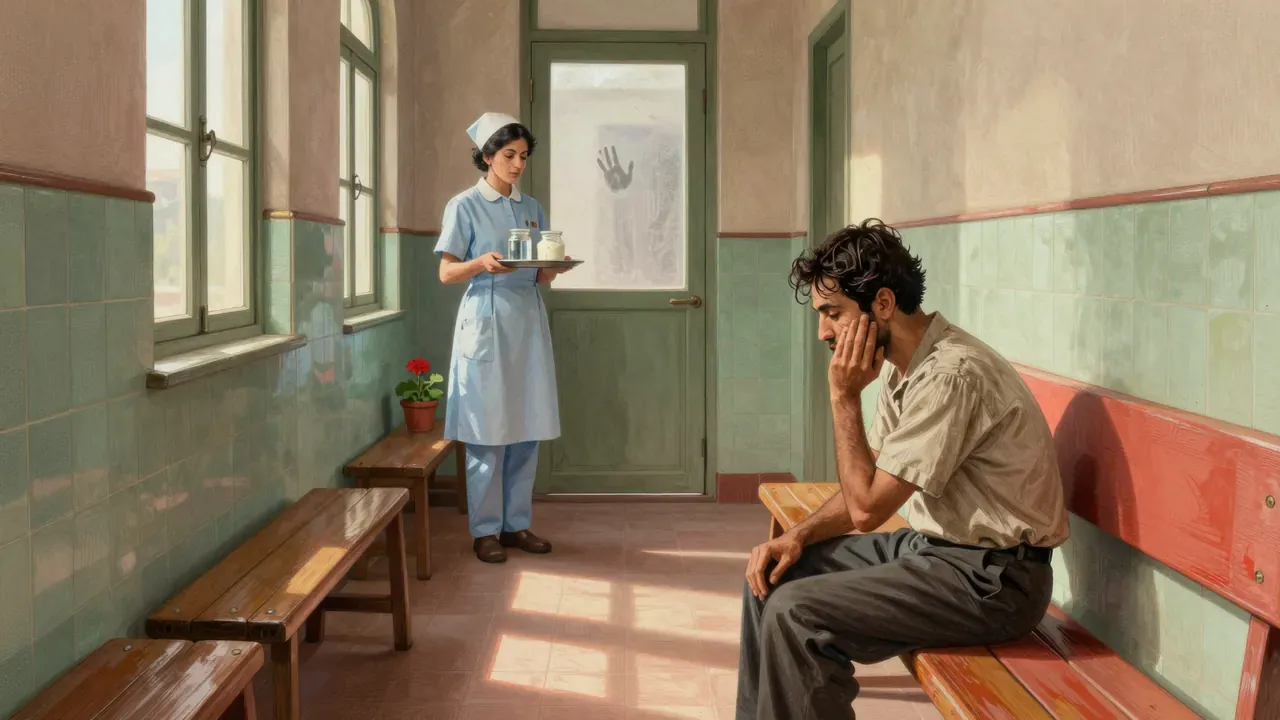
The film follows Mohammad-Reza Askari, a schoolboy whose routine neglect of oral hygiene leads to escalating pain, social exclusion, and eventual incapacity. His performance is unselfconscious, grounded in documentary-style observation rather than scripted delivery. Kiarostami shoots in natural light, mostly on location — classrooms, corridors, a public dental clinic — with static or minimally reframed compositions. Gordon Willis is not involved; the cinematography is functional, unadorned, prioritising legibility over texture. Ten animated interludes, credited to Abdollah Alimorad and Mehdi Samakar, depict green ‘tooth trolls’ drilling cavities — a blunt visual metaphor that punctuates the dentist’s thirteen-minute direct-to-camera lecture. That lecture dominates the middle third: factual, unsparing, delivered without irony or softening. Off-camera screams and close-ups of the boy’s contorted face anchor the abstraction in bodily consequence. Editing is rhythmic but uninflected — cuts serve exposition, not rhythm or mood. There are women present, briefly: a nurse, a teacher — the first appearance of female figures in Kiarostami’s Kanoon shorts, though they occupy strictly functional roles. Word count: 156.
What holds true
What lands is the film’s unflinching alignment of form and function. The dentist’s monologue works because it is uninterrupted, unvarnished, and delivered with clinical authority — it feels like overhearing real instruction, not watching staged persuasion. The animation, while crude, achieves its aim: making microbial decay legible to children through grotesque personification. The boy’s physical deterioration — from breath-based ostracism to immobility — accumulates with quiet inevitability, avoiding melodrama yet sustaining gravity. The contrast between the boy’s suffering and the calm, procedural efficiency of the clinic grounds the lesson in lived consequence, not abstract warning. Even the dentures worn by his father and grandfather register not as props but as quiet indices of intergenerational neglect — a detail that lingers without commentary. The film’s refusal to flatter its audience, its resistance to narrative diversion or aesthetic compromise, gives it a rare kind of integrity: it does exactly what it says it will do, and does it thoroughly. Its power lies in its lack of ornament — the message is the medium. Word count: 152.
What stays fixed
What does not land is any attempt to read the film as psychologically nuanced or emotionally expansive. Its characters exist solely as vessels for instruction: Mohammad-Reza has no interiority beyond his symptoms; the dentist has no biography beyond his expertise; the classmates are silhouettes of judgment, not individuals. The animation, while effective as diagram, lacks the wit or surreal charge that might elevate it beyond utility — it is illustrative, not imaginative. The film’s rigidity becomes a limitation when viewed outside its original context: without the institutional framework of Kanoon’s curriculum, or without the immediacy of public health need in post-revolutionary Iran, its pacing feels protracted, its repetitions redundant. The thirteen-minute monologue, essential to its purpose, tests attention spans divorced from pedagogical necessity. Its formal refusal of convention — no music, no narrative release, no character arc — reads less as radical austerity and more as functional constraint when encountered today as standalone cinema. It resists interpretation not as provocation, but as obligation. Word count: 154.
What it insists on
The themes that matter are discipline, consequence, and the material reality of care. Not abstract morality, but the tangible cost of omission: pain, isolation, incapacity. The film treats hygiene not as habit but as infrastructure — as vital as clean water or vaccination. Dentures recur not as symbols of age but as evidence of systemic failure: they are the endpoint of avoidable neglect, passed down like inheritance. This quietly implicates intergenerational responsibility — the boy’s father and grandfather model absence of prevention, not wisdom. The film also engages with mediation itself: live action, animation, charts, voiceover, and off-screen sound coexist without hierarchy, each assigned a precise epistemic role. There is no privileging of ‘realism’ — the green trolls are as valid a truth-telling device as the X-ray image. What emerges is a layered conception of knowledge: scientific, somatic, social, and visual — all necessary to grasp the full shape of a single, small, painful fact. Word count: 150.
Who it speaks to
This film is for viewers interested in the mechanics of pedagogy, in how instruction becomes image, and in Kiarostami’s early, unvarnished craft before he turned to elliptical features. It rewards those who attend to institutional cinema — films made for schools, clinics, ministries — and who value functional clarity over expressive flourish. It is not for viewers seeking character-driven drama, tonal ambiguity, or aesthetic self-reference. Those expecting the poetic restraint of Close-Up or Taste of Cherry will find Toothache stubbornly literal, even dry. Scholars of Iranian cinema, medical humanities, or animation history will find it indispensable; casual viewers may mistake its rigour for dullness. Its value depends on willingness to meet it on its own terms: as a tool, not a text. To dismiss it as ‘just educational’ is to ignore how rarely education is rendered with such structural honesty. Word count: 149.
What it costs
Yes, it is worth your evening — but only if you watch it with intention, not distraction. Ninety minutes is enough time to absorb its logic, witness its precision, and register how much it achieves within absolute constraint. It repays attention not with pleasure, but with insight into how images instruct, how bodies speak before language, and how care is both personal act and collective infrastructure. Some will argue it is too narrow, too dated, too bound to its moment — and they are right, if judged as entertainment. But as a document of committed, unglamorous filmmaking, as a marker in Kiarostami’s evolution, and as a rare surviving example of state-funded children’s pedagogy rendered without condescension, it holds quiet, enduring weight. Its worth lies not in what it offers, but in what it refuses to waste: time, gesture, frame, or word. Word count: 148.