The timing of it
The Steel Helmet is a Korean War film made in October 1950, ten days after the war began, and released in January 1951 — the first American feature to depict that conflict. Samuel Fuller wrote, produced and directed it as an independent production on a budget of $104,000, shooting exteriors in Griffith Park with student extras. It is not a strategic or political account but a compressed, ground-level study of survival, hierarchy and moral erosion among a small group of U.S. soldiers cut off behind enemy lines. Fuller intended to bypass wartime propaganda and romantic cliché, instead presenting war as disorienting, morally ambiguous and physically gruelling. The film’s opening — a lone survivor bound and bleeding after a massacre, saved by a Buddhist boy — establishes its tone: unsentimental, immediate, stripped of ceremony. Its urgency is structural: no exposition, no flashbacks until the final sequence, no establishing shots of Seoul or Pyongyang. It treats the war not as a theatre of victory but as a series of contingent, often arbitrary encounters where discipline frays, loyalty shifts and ideology is tested in real time by exhaustion and proximity to death. (158 words)
The look of it
The story follows Sergeant Zack, a hardened World War II veteran, as he gathers stragglers — a Black medic, a Japanese American sergeant, a green lieutenant — into a temporary unit holed up in a Buddhist temple. Ernest Miller’s cinematography keeps the frame tight and the lighting flat, favouring medium shots and shallow focus that emphasise enclosure and claustrophobia rather than battlefield scale. Gene Evans plays Zack with minimal inflection, his face weathered and eyes guarded; Robert Hutton’s Driscoll is all nervous energy and untested authority; James Edwards’ Corporal Thompson carries quiet dignity without rhetorical emphasis. Fuller avoids musical underscoring during dialogue, letting silence and ambient sound — wind, distant artillery, the clink of dog tags — carry weight. Paul Dunlap’s score appears only in transitions and battle sequences, sparse and percussive. Editing by Philip Cahn maintains rhythm without flourish: cuts are functional, often abrupt, reinforcing the sense of fractured continuity. There are no heroic slow-motion charges or orchestral swells — just men moving, arguing, reloading, reacting. The performances do not seek empathy so much as recognition: these are people shaped by circumstance, not archetypes waiting for redemption. (159 words)
The weight of it
What lands is the film’s refusal to resolve its contradictions. Zack’s racism toward Tanaka, his contempt for Driscoll’s inexperience, his grief over Short Round’s death — none are smoothed over or redeemed. The scene where the North Korean major cites Japanese American internment is delivered without editorialising, making it land with historical precision rather than dramatic convenience. The temple setting works as both literal refuge and symbolic stage: its statues remain impassive while men argue about democracy, duty and survival beneath them. The low-budget constraints become assets — the limited locations force concentration on character dynamics, and the absence of studio polish prevents detachment. When Zack swaps helmets with Driscoll at the end, it is not closure but quiet acknowledgement: a gesture stripped of triumph, weighted with loss and continuity. The film’s most effective moments are those where ideology and action collide without resolution — Thompson treating the enemy major despite Zack’s rage, Tanaka killing snipers while being called ‘Jap’ minutes earlier. These are not set pieces but accumulations: small choices that build a portrait of endurance without heroism. (157 words)
The strain of it
What does not land is the attempt to sustain realism through artifice. The Griffith Park exteriors, though resourceful, lack topographic specificity — hills look like backlot slopes, foliage feels generic. Dialogue occasionally veers into exposition disguised as argument, particularly in the temple scenes where characters articulate positions Fuller wants heard rather than ones they would naturally voice under stress. Some performances strain against the script’s didactic turns: Richard Loo’s North Korean major delivers lines with theatrical gravity that clashes with the film’s otherwise restrained register. The flashback to Normandy feels abrupt and undermotivated — less a psychological rupture than a narrative pivot inserted to signal trauma. The budgetary limits also show in sound design: gunfire lacks physical weight, and the tank assault relies on stock effects that undercut tension. Crucially, the film’s moral clarity — its insistence on democratic principle embodied by Thompson and Tanaka — sits uneasily beside Zack’s extrajudicial killing of a prisoner, which is presented as grim necessity but never interrogated within the unit’s chain of command. That ambiguity is intentional, but the film does not give it enough space to breathe. (156 words)
The truth of it
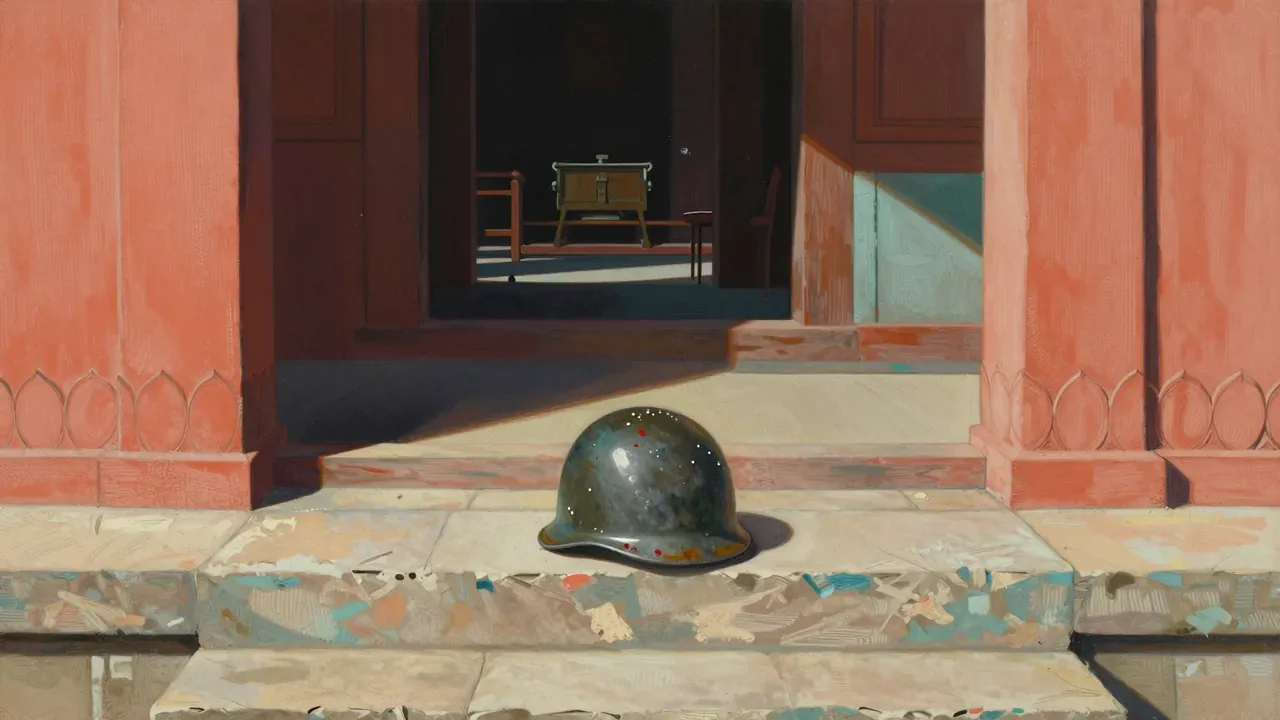
The themes that matter are not patriotism or sacrifice but the corrosion of procedure under pressure, the persistence of racial hierarchy within institutions meant to uphold equality, and the way war collapses distinctions between enemy, ally and civilian. Fuller treats racism not as individual prejudice but as systemic fact: Thompson is labelled a ‘straggler’ before he speaks; Tanaka is distrusted despite proven competence; the North Korean major weaponises both truths. Buddhism appears not as exotic backdrop but as quiet counterpoint — Short Round’s prayer, the unmoved statues — suggesting values outside militarised logic. The helmet itself functions as both relic and symbol: it saves Zack’s life, becomes a bargaining chip, then a grave marker. The film’s central tension lies between institutional loyalty and personal conscience, dramatised through Zack’s shifting relationship to command — he refuses Driscoll’s request to swap helmets early on, but does so at the end, not as submission but as reluctant inheritance. There is no grand statement about war’s futility, only repeated evidence of its capacity to exhaust meaning, leaving only the next decision, the next step, the next breath. (159 words)
The audience for it
This film is for viewers who value formal economy, historical immediacy and moral discomfort over narrative comfort or visual spectacle. It suits those familiar with Fuller’s later work — or with the stripped-down intensity of early post-war Italian neorealism — and those interested in how cinema registers political reality before official consensus forms. It is not for viewers who require clear protagonists, resolved arcs or cinematic polish; nor for those seeking either patriotic affirmation or anti-war polemic, since it offers neither. A viewer expecting immersive world-building or technical verisimilitude will find it thin. Those who reject films that foreground race or colonial history as ‘didactic’ may resist its directness. But the verdict changes if viewed as a document: shot while the war was unfolding, it reflects not hindsight but urgency — and that urgency remains legible, even when the staging falters. Its value lies in its timing, its voice, and its refusal to wait for permission to speak. (158 words)
The reason for it
Yes, it is worth your evening — not as entertainment but as encounter. Seventy-eight minutes is enough time to absorb its rhythms, register its silences, and sit with its unresolved questions. It demands attention but repays it with density: every line, every glance, every empty corridor in the temple carries implication. Its brevity prevents fatigue; its lack of ornament prevents distraction. Some will find it dated in pacing or blunt in messaging, particularly those accustomed to contemporary war films’ layered soundscapes and psychological granularity. Others may object to its narrow focus — no Korean civilians beyond Short Round, no North Korean soldiers beyond the major — seeing it as another American-centred view. But its power resides precisely in that limitation: it is one man’s urgent, imperfect, fiercely independent response to a war still unnamed in most newspapers. To skip it is to miss a hinge point in American film history — not because it is flawless, but because it is necessary. (159 words)