The shape of consequence
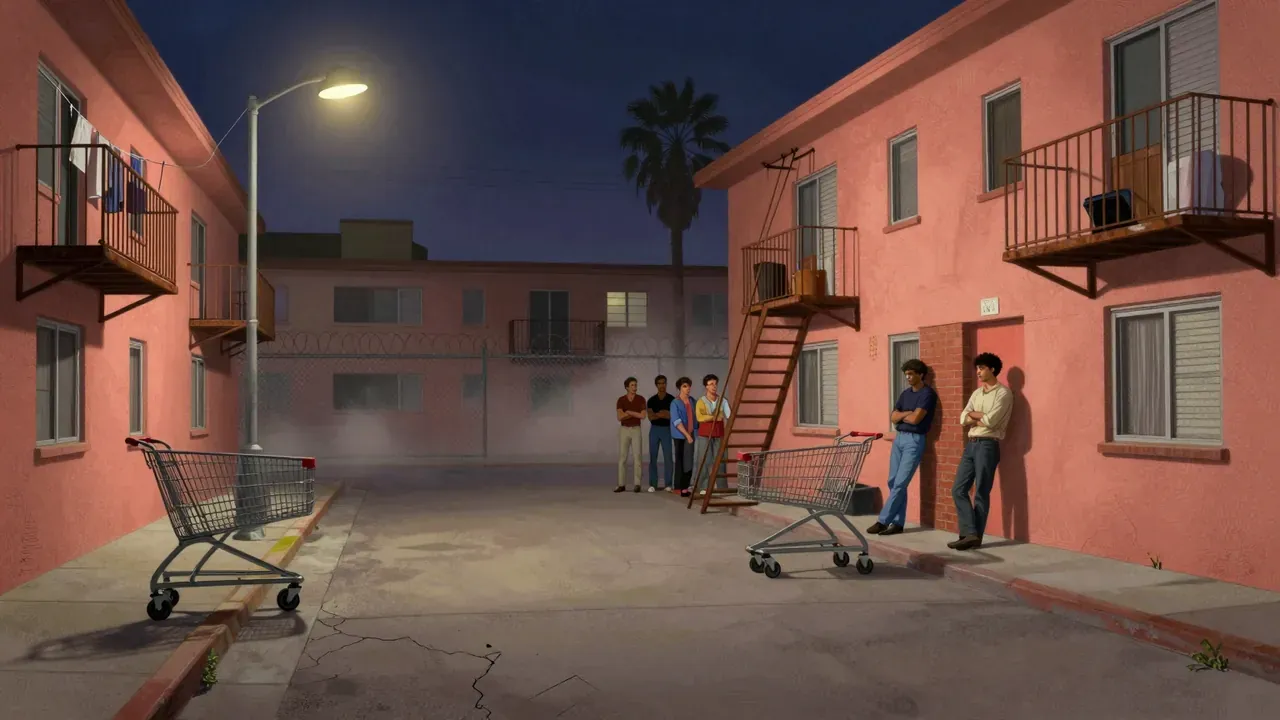
Menace II Society is a crime film set in Watts and Crenshaw, Los Angeles, following Caine Lawson from adolescence into early adulthood as he navigates gang affiliation, inherited trauma, and the narrowing of exit routes from systemic violence. It aims to render that world without moral framing — not as cautionary parable nor uplift narrative, but as lived chronology: cause and consequence unspooling in sequence, with no editorial voiceover, no redemptive arc, no off-ramp disguised as choice. The Hughes brothers treat the setting not as backdrop but as causal agent: geography shapes opportunity, language encodes allegiance, silence carries threat. This is not realism as aesthetic — it is realism as structural condition, where every decision emerges from prior constraint, and every act of violence echoes an earlier one, often unseen. The film’s ambition is documentary rigour in fictional form: to show how a life like Caine’s is assembled, not from character flaws, but from accumulated exposures — to loss, to surveillance, to economic abandonment, to the casual brutality of institutions and peers alike. Word count: 142.
The look of it
The story unfolds in tight chronological blocks, anchored by Caine’s perspective but refusing psychological exposition; motivation is shown through action, not monologue. Tyrin Turner’s performance holds the film: his Caine is watchful, physically contained, emotionally recessive — a quiet counterpoint to Larenz Tate’s volatile, grinning O-Dog. Jada Pinkett Smith, in her first feature role, grounds Ronnie in practical tenderness and unspoken exhaustion. Lisa Rinzler’s cinematography avoids stylisation: she uses available light in Jordan Downs apartments, handheld shots during chases, static frames during confrontations — never embellishing, always locating. Quincy Jones III’s score blends funk, soul, and hip-hop without underscoring emotion; it sits beside the action, not beneath it. Dialogue is sparse, functional, often interrupted or left hanging. The editing, by Pamela Martin, maintains rhythm without urgency — scenes breathe, even when tense. There are no flashbacks for exposition; memory appears only as sensory fragments: a smell, a sound, a glance. The craft serves restraint, not flourish. Word count: 153.
What sticks
What lands is the cumulative weight of consequence. The liquor-store murder does not trigger a crisis of conscience in Caine — it triggers a slow recalibration of risk tolerance, then habituation, then participation. His hospitalisation after the carjacking feels less like turning point than pause in momentum. The drive-by killing at the end does not shock because it arrives suddenly, but because it arrives inevitably — the logical terminus of every prior escalation, every unchallenged norm, every withheld intervention. The film’s power lies in its refusal to isolate violence as aberration: it shows how it spreads through social contagion, economic logic, and intergenerational transmission. Even minor characters — Chauncey, A-Wax, Doc — behave with internal consistency, their choices legible within the film’s moral topography. The final image of Caine shielding Anthony while dying is not sentimental; it is the first time he acts without calculation, and the film lets it register as both rupture and confirmation. Word count: 150.
Where it thins
What does not land is the underwritten role of Sharif. His conversion to Islam is presented as fact, not process — we see its effect on behaviour but not its genesis, and his death arrives without prior emotional investment. Mr. Butler and Caine’s grandfather function more as thematic anchors than fully realised figures; their advice reads as authorial insertion rather than earned dramatic presence. The subplot involving Ilena’s pregnancy collapses under its own abruptness: her call, Caine’s denial, and the subsequent confrontation with her cousin happen in rapid succession without sufficient grounding in their relationship. The film’s commitment to austerity occasionally crosses into omission — moments that require context or quiet duration are truncated, leaving gaps where empathy might otherwise settle. Some viewers will find the pacing uneven: long stretches of stillness punctuated by sudden, brutal action, with little transitional texture between. Word count: 152.
What it’s really about
The themes that matter are inheritance and containment. Not just bloodline, but the inheritance of posture, speech, suspicion, and survival tactics — passed from Tat to Caine, from Pernell to Anthony, from O-Dog to his younger peers. Containment operates spatially (Jordan Downs, the parking garage, the police station), temporally (Caine’s graduation is not a threshold but a checkpoint), and linguistically (the slang is precise, exclusionary, self-policing). The film treats religion, education, and migration not as solutions but as contested territories: Kansas is never seen, Atlanta remains hypothetical, Islam is a private discipline, not a public platform. Class is rendered materially — the difference between a stolen car and a bus pass, between crack sold by the gram and crack sold by the ounce — not as abstraction. Race is ambient, structural, unremarked upon except where enforced: by the Korean shopkeeper’s slur, by the cops’ deliberate dumping in a Hispanic neighbourhood, by the absence of institutions that serve rather than surveil. Word count: 154.
Who it’s for
This film is for viewers who accept that some stories have no resolution beyond cessation, and who value formal discipline over catharsis. It suits those familiar with the grammar of 1990s American independent cinema — its rejection of music-video pacing, its preference for ambient sound over score-led emotion, its trust in actors’ physical presence over exposition. It is not for viewers seeking moral clarity, narrative symmetry, or psychological explanation. Those who require protagonists to evolve, antagonists to be named, or systems to be indicted will find it withholding. It is also unsuited to younger audiences without context for its historical specificity — the film assumes knowledge of the 1992 LA uprising, the crack epidemic’s infrastructure, and the real-world presence of gangs like the Grape Street Watts Crips, who appear as extras. A viewer who expects ‘message’ over method may leave frustrated. Word count: 150.
Is it worth your time?
Yes, it is worth your evening — but only if you meet it on its terms: as a forensic account, not a fable. Its ninety-seven minutes accumulate like evidence, not entertainment. It repays attention not through surprise but through precision: the way Caine’s hands move before he strikes, the shift in lighting when he enters Pernell’s cell, the exact cadence of the detective’s interrogation. Those who prefer films that guide interpretation will find it austere; those who trust their own reading of gesture and silence will find it rich. It is not timeless in subject — its Los Angeles is geographically and historically fixed — but its structure remains instructive: how to build tension without music, how to convey consequence without commentary, how to make inevitability feel earned rather than fatalistic. Its value lies in its refusal to soften. Word count: 150.