The launch
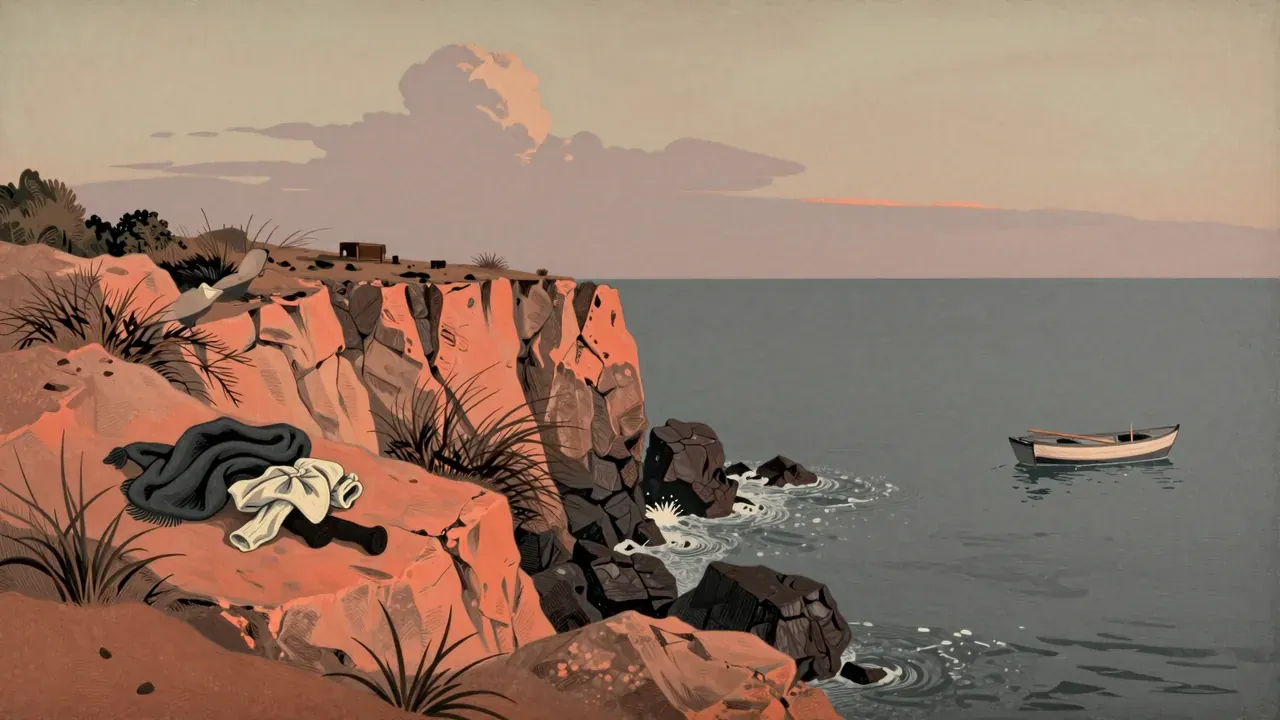
Paddle to the Sea is a 28-minute Canadian short film made by the National Film Board of Canada in 1966, adapted from Holling C. Holling’s 1941 children’s book. It follows a hand-carved wooden figure — an Indigenous boy in a canoe — as it journeys from inland waters near Lake Nipigon down through the Great Lakes and Saint Lawrence River to the Atlantic Ocean. The film is not a narrative drama but a quiet, observational voyage: its aim is geographical literacy, ecological awareness and quiet reverence for waterways as living systems. Bill Mason, who directed, wrote, shot and edited it, treats the journey as both literal and symbolic — a way to map Canada’s hydrology while embedding ethical concerns about stewardship. Though framed for children, it avoids instruction or personification; the canoe has no voice, no thoughts, no named owner. Its purpose is not to entertain with incident but to invite attention — to the flow, the obstacles, the scale and the quiet persistence of small things moving through vast natural systems. It assumes patience, rewards stillness, and asks the viewer to follow without hurry.
The current
The story unfolds entirely through location footage, minimal narration and Louis Applebaum’s restrained, folk-tinged score. There are no actors: only the carved canoe, water, weather, forest, industry and human infrastructure. Bill Mason’s cinematography is unhurried and precise — long takes on drifting currents, low-angle shots of rapids, close-ups of waterlogged wood and silted shores. He filmed across Ontario and Quebec, including unauthorised sequences at Niagara Falls, staged fire scenes at Meech Lake and polluted stretches of Lake Superior near Marathon. Mason carved the canoes himself, replacing them when lost — a detail that grounds the film’s craft in physical labour and repetition. The narration, spoken plainly, names places and processes without embellishment. Editing is rhythmic but unobtrusive: cuts follow the logic of current and gravity, not dramatic beats. Sound design is sparse — wind, water, distant trains — never overdubbed or dramatised. This is documentary discipline applied to a fictional object: the canoe is real, the journey real, the geography real, but the ‘character’ exists only as vessel and symbol.
The stain
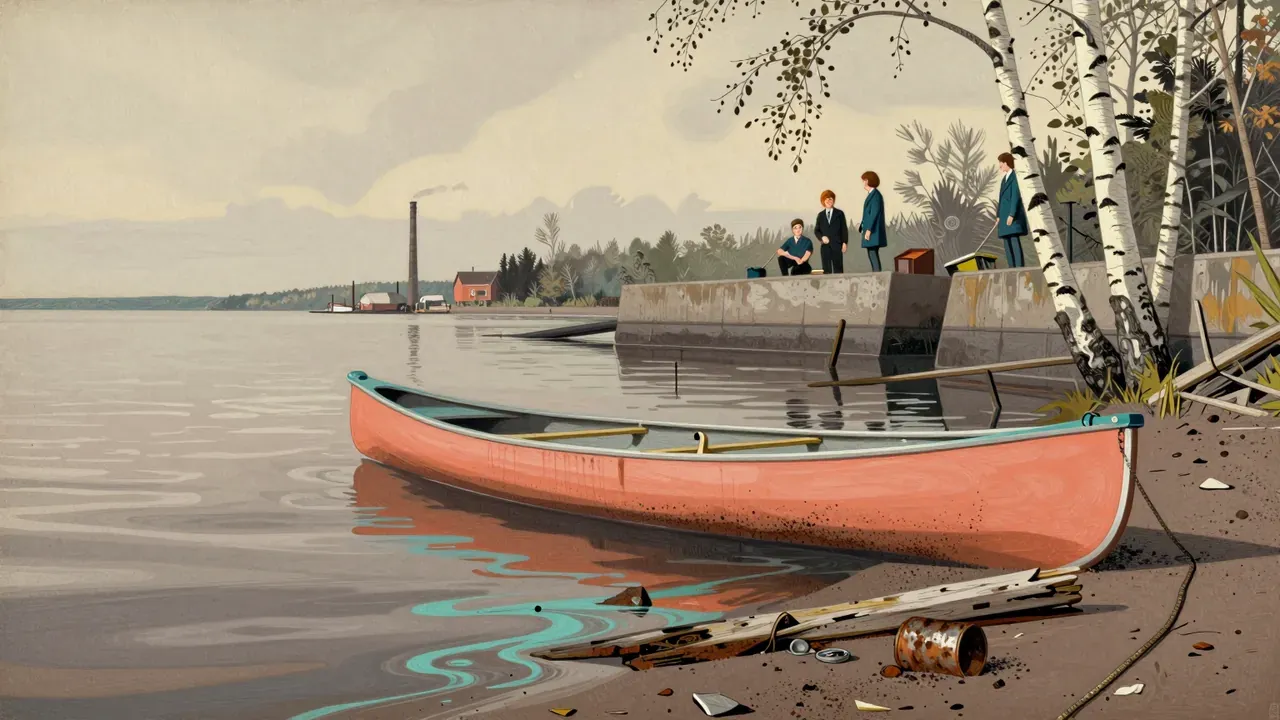
What lands is the cumulative weight of place. Over twenty-eight minutes, the film builds a tactile sense of Canada’s inland water network — not as abstraction on a map but as lived terrain: the cold clarity of northern lakes, the murk of industrial effluent, the roar and mist of Niagara, the slow salt-tide pull near the Gulf. The pollution sequence, added by Mason and absent from Holling’s 1941 book, lands with quiet force because it is shown, not told — oil slicks shimmering on still water, the canoe bobbing amid debris, no commentary beyond factual naming. The film’s restraint makes its moral note more durable: it does not scold, but lets the eye register what the water carries. Similarly, the final arrival at sea feels earned not by climax but by duration — the viewer has travelled the distance alongside the canoe, measured in light shifts, seasonal hints and changing water textures. Even the Academy Award nomination feels appropriate: this is live-action filmmaking used not for spectacle but for sustained, attentive witnessing.
The fall
What does not land is any attempt to animate the canoe as a character with interiority or agency. Children expecting a ‘story’ with intention or emotion may find it remote. The narration, though clear, never interprets motive or feeling — it names rivers, notes locks, observes factories — and offers no psychological anchor. Some viewers will miss warmth, humour or human presence beyond fleeting glimpses of workers or firefighters. The film’s refusal to anthropomorphise extends to its treatment of Indigenous representation: the carved figure is drawn from Holling’s book, which itself draws on stereotyped mid-century illustration, and the film neither critiques nor contextualises this. It presents the figure as artefact, not person — a choice that avoids condescension but also avoids reckoning. The absence of Indigenous voices, perspectives or contemporary context means the figure remains a silent prop in a settler geography. That silence is deliberate, but it is also a limit — one the film does not acknowledge, and cannot overcome within its form.
The passage
The themes that matter are movement, scale and responsibility. Movement is literal — the canoe’s drift — but also geological and historical: water as the oldest transport system, carrying not just objects but memory, sediment, consequence. Scale emerges in contrast: the tiny canoe against Niagara’s drop, against shipping lanes, against the open gulf — a reminder that human-made things are transient within natural timeframes. Responsibility is woven into the pollution sequence, not as polemic but as observation: the water does not distinguish between runoff and rain, between waste and wilderness. The film implies that care begins with attention — noticing where the water goes, what it carries, how it changes. It also treats craft as ethics: Mason carving each canoe, filming without permits, learning forestry and fire control to stage sequences — all reflect a hands-on relationship to material and place. This is ecology not as data but as practice: making, watching, waiting, returning.
The gulf
It is for viewers who value slowness, geography, and non-verbal storytelling — teachers using it in classrooms, parents seeking screen time with texture and silence, filmmakers studying observational craft, or anyone curious about mid-century Canadian public filmmaking. It is not for those needing plot, dialogue, character development or rapid pacing — the film gives nothing to viewers who expect narrative propulsion or emotional payoff on demand. Those who dislike didacticism may still find its pedagogy too implicit; those who require cultural specificity may find its Indigenous imagery under-examined. A viewer who values ecological messaging but expects explicit advocacy will be disappointed — the film’s power lies in its reticence. To watch it expecting a children’s adventure is to misread its rhythm; to watch it as pure documentary is to miss its poetic scaffolding. Its audience is narrow by design — not because it lacks merit, but because it refuses to widen its terms.
The sea
Yes, it is worth your evening — provided you set aside the expectation of event and accept duration as meaning. Twenty-eight minutes is less than a commute; the film asks only that you attend to water, light and motion without distraction. It repays rewatching: details emerge on second viewing — how the canoe tilts in current, how light changes over granite, how industrial smoke stacks recede into mist. Its value is cumulative, not instantaneous. Those who dismiss it as ‘slow’ or ‘simple’ mistake economy for emptiness. It is not for everyone — but for those willing to let pace match process, it offers rare coherence between form, subject and intent. To call it ‘just a children’s film’ is to ignore its structural rigour and quiet political layering. Its endurance — in festivals, classrooms and even a 2020 television series — testifies not to nostalgia but to functional timelessness: it works because it does not try to work hard.