What it is trying to do
49th Parallel is a British wartime propaganda film made in 1941, commissioned by the Ministry of Information to influence neutral American opinion before Pearl Harbor. It follows six German sailors stranded in Canada after their U-boat is destroyed, as they attempt to cross the 49th parallel into the United States. The film’s purpose is explicit: to expose Nazi ideology not through battlefield spectacle but through sustained confrontation with Canadian and Indigenous civilians, Hutterite pacifists, and eccentric English settlers — each representing a distinct moral position. Michael Powell and Emeric Pressburger chose Canada not for logistical convenience but because its geography and plural society offered a stage where fascism could be tested against democracy, conscience, and quiet resistance. The title names the border, but the film’s real subject is the line between ideological certainty and human doubt. It avoids caricature by giving the Germans agency, language, and internal logic — even as it refuses them legitimacy. This is not a film about victory, but about the conditions under which ideas are accepted or rejected.
How it works
The story unfolds episodically, with each encounter stripping away another member of the crew until only one remains. Emeric Pressburger’s script structures this like a moral inventory: the Inuit, the Hutterites, the Winnipeg underworld, the Banff crowd, the artist’s camp, and finally the border itself. Performances are calibrated to function as arguments — Laurence Olivier’s French-Canadian trapper speaks with sardonic precision; Anton Walbrook’s Hirth delivers his ideology with chilling fluency; Raymond Massey’s Hutterite elder counters dogma with scripture and silence. David Lean’s editing sustains momentum across disparate locations without smoothing over disjunctions — cuts between Hudson Bay ice and Denham Studios’ soundstages remain palpable. Ralph Vaughan Williams’ score avoids militarism, favouring austere brass and folk-inflected strings that underscore moral weight rather than action. Gordon Willis did not shoot this film; the cinematographer was Georges Périnal, whose deep-focus compositions in Banff and Manitoba hold landscape and character in equal, unflinching regard.
What lands
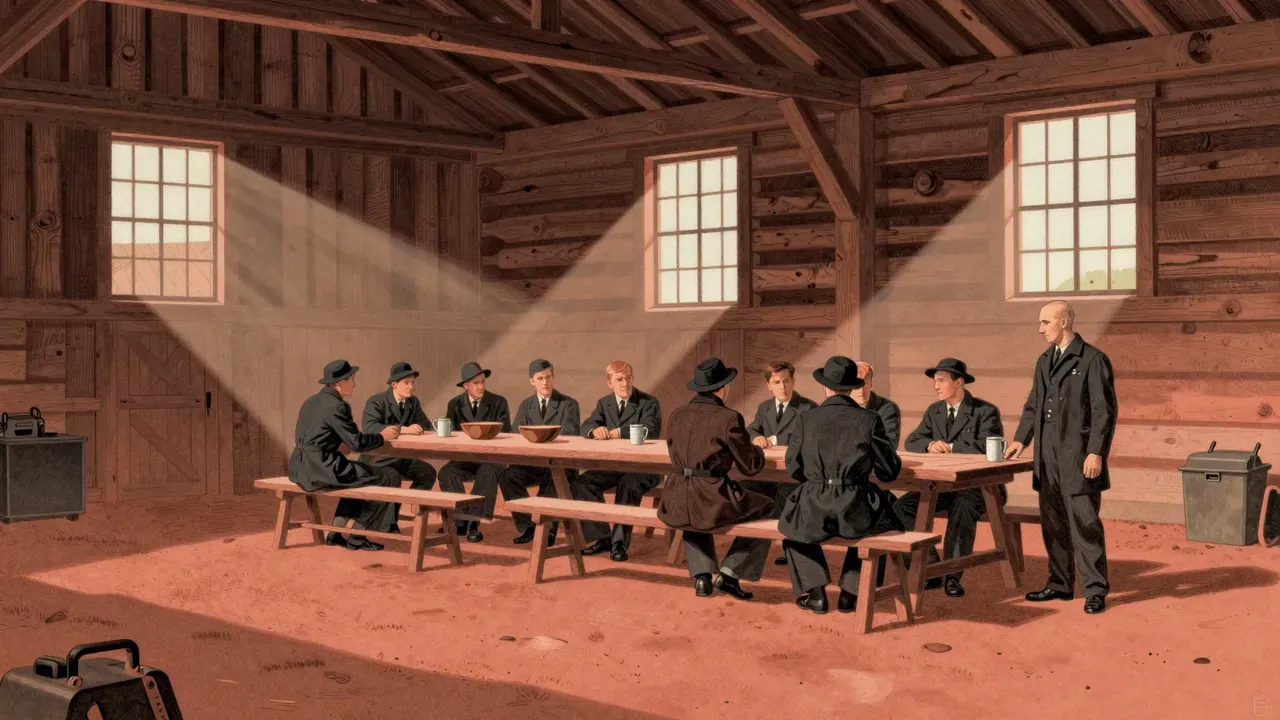
What lands most firmly is the film’s refusal to let fascism speak unchallenged. Each sequence builds a counterpoint: the Inuit’s silent competence under fire, the Hutterites’ collective calm in the face of fanaticism, Philip Armstrong Scott’s brittle erudition turning into physical courage. These are not passive victims but interlocutors — and the film trusts the audience to register the difference between persuasion and coercion. The pacing, though deliberate, accumulates pressure: the floatplane crash feels chaotic and wet; the Hutterite barn interior is hushed and sunlit; the train crossing at Niagara Falls is tense not because of violence but because of bureaucratic exactitude. Even the American ending — where Brock exploits a customs technicality — works because it rests on law, not luck. The film’s moral architecture holds because its characters act within consistent frameworks: faith, art, duty, community, or self-interest. There is no deus ex machina, only consequence.
What does not
What does not land is the framing device of Vincent Massey’s uncredited narration, which opens the film with a stiff, official tone that clashes with the rest’s lived texture. The early submarine scenes suffer from studio-bound stiffness, particularly the lifeboat sequence, where the merchant seamen’s authenticity cannot overcome flat lighting and static blocking. Some transitions feel abrupt — the shift from the Hutterite farm to Winnipeg lacks spatial or emotional continuity, as if the script prioritised ideological contrast over narrative flow. Glynis Johns’ Anna, though capably played, remains underwritten; her presence serves plot function more than psychological depth. The American censors’ excision of Hirth’s racist speech weakened the film’s original polemic, and while the UK cut retains it, the rhetoric risks sounding dated rather than damning without fuller context. The film’s ambition to be both urgent and timeless occasionally strains its register — moments meant to feel immediate instead read like period pieces before their time.
The themes that matter
The themes that matter are sovereignty of conscience, the violence of abstraction, and the fragility of neutrality. The film treats ideology not as belief but as practice — Hirth does not merely espouse Nazism; he enforces it, executes it, and is ultimately undone by its inflexibility. The 49th parallel is less a line on a map than a threshold between systems: between command and consent, between doctrine and dialogue, between the state and the individual. The Hutterite rejection of Hirth is theological but also procedural — they hold a trial, hear testimony, apply precedent. Philip Armstrong Scott’s destruction is personal, not political; his outrage is aesthetic and proprietary, yet it becomes ethical action. The film insists that resistance need not be uniform: it can be silent, legal, artistic, communal, or even accidental. Its deepest concern is how ordinary people sustain moral coherence when confronted with totalising claims — and why some choose to uphold boundaries while others erase them.
Who should watch it
This film is for viewers who value moral clarity without simplification, and who accept that wartime cinema can be both urgent and formally precise. It rewards attention to subtext, patience with exposition, and tolerance for mid-Atlantic accents delivered with clipped authority. It is not for those who require continuous plot propulsion, visual spectacle, or character arcs defined by internal change — Vogel’s desertion is stated, not dramatised; Lohrmann’s rebellion arrives late and without backstory. Viewers expecting Powell’s later colour-saturated romanticism will find the monochrome palette austere, even withholding. Those put off by overt propaganda — especially when it names racism, colonialism, and religious persecution directly — may resist its confrontational tone. The film assumes familiarity with 1941 geopolitics; without that baseline, some exchanges lose their sting. But its argument remains legible: that ideology must be tested in the world, not just declared in bunkers.
Is it worth your evening
Yes, it is worth your evening — not as escapism, but as calibration. At 123 minutes, it moves deliberately, but every scene earns its length by refusing to resolve moral questions prematurely. Its power lies in accumulation: the weight of each refusal, each arrest, each act of quiet defiance. It does not flatter the viewer with easy answers, nor does it exhaust with despair. A modern viewer might object to its British framing of Canadian space, or to the absence of Indigenous voices beyond visual presence — but the film’s own logic invites that critique. Those who dismiss it as dated propaganda miss how precisely it diagnoses the mechanics of authoritarian appeal: the substitution of certainty for inquiry, hierarchy for reciprocity, mission for mercy. If you watch it expecting a thriller, you’ll leave restless. If you watch it as a study in how ideas travel — and why some fail to cross borders — you’ll leave unsettled, clarified, and quietly energised.