The look of it
Medium Cool is a hybrid film: part scripted drama, part documentary record of the 1968 Democratic National Convention in Chicago. Haskell Wexler conceived it as an inquiry into television’s role in shaping perception — not as a neutral conduit but as an active, often complicit, participant in political events. The title references Marshall McLuhan’s idea of ‘cool’ media, requiring viewer engagement to fill gaps; Wexler literalises this by embedding fiction within real unrest, forcing the audience to hold both narrative and documentary layers at once. He does not ask whether news is objective, but demonstrates how its framing — what is filmed, who holds the camera, when the lens turns away — constitutes a moral choice. The film was shot in summer 1968, with Wexler and crew filming on location during actual protests and police confrontations, then weaving those sequences into a fictional storyline about a TV cameraman confronting his own detachment. Its ambition is structural and ethical: to make the medium itself the subject, not just the messenger.
The line between them
The story follows John Cassellis, played by Robert Forster with a watchful stillness that avoids both charisma and caricature. His arc is less psychological than procedural: he moves from professional disengagement — filming car crashes without intervening — to reluctant involvement, then to catastrophic consequence. Verna Bloom gives Eileen a grounded weariness; her performance resists sentimentality, especially in scenes where she speaks plainly about abandonment and survival. Wexler’s cinematography is unadorned, favouring available light and handheld movement; he keeps focus shallow and framing tight, making interiors feel cramped and streets claustrophobic. Verna Fields’ editing intercuts scripted scenes with raw footage so seamlessly that the boundary blurs without fanfare. Mike Bloomfield’s score uses blues-inflected guitar motifs and fragments of Frank Zappa and Love, underscoring tension without melodrama. There are no establishing shots or expository voiceovers; exposition arrives through overheard dialogue or off-screen radio reports.
The weight of the frame
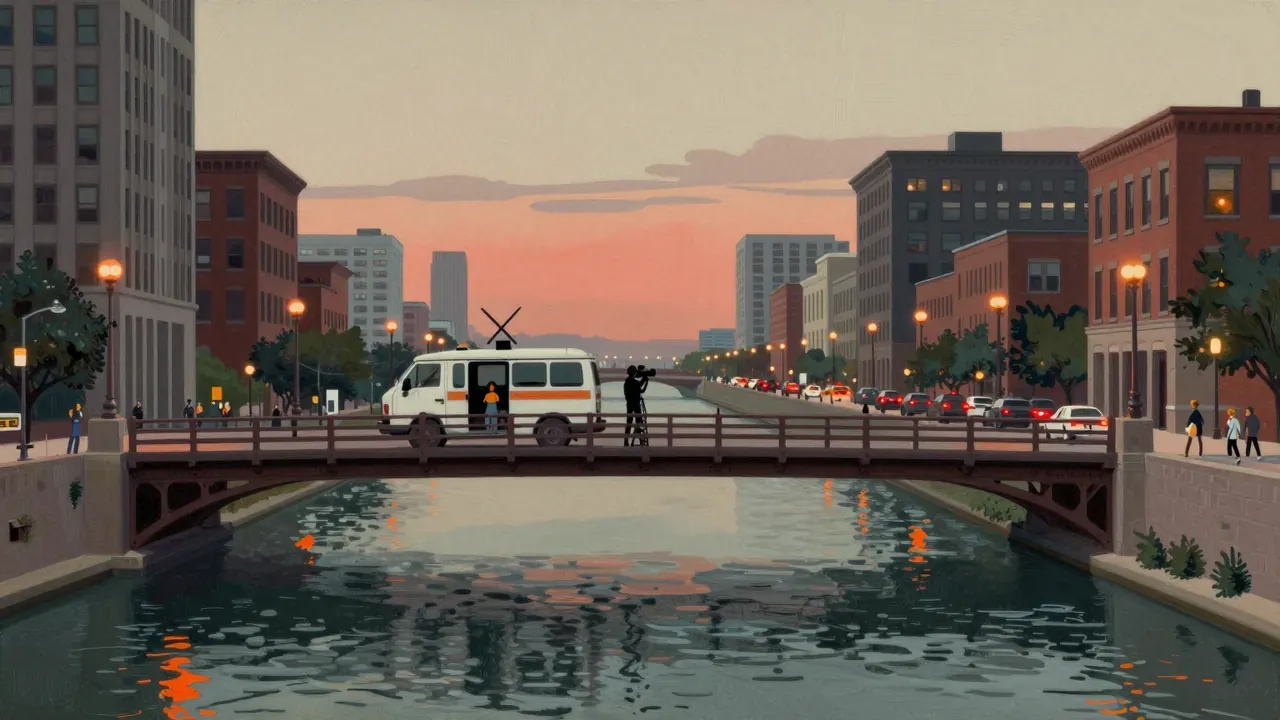
What lands is the cumulative weight of juxtaposition: a child’s voice describing his absent father cuts across footage of police dragging demonstrators; a love scene dissolves into a tracking shot of a news van rolling toward the convention site. The film’s most effective moments are quiet ones — Cassellis watching Eileen wash dishes, then turning to frame her in the viewfinder; Harold staring blankly at a television screen showing footage of himself. These do not resolve emotionally but linger as unresolved tensions between observation and responsibility. The final car crash is not dramatised for shock but presented as a blunt, almost bureaucratic event — a camera capturing wreckage, then walking away. That refusal of catharsis is deliberate and persuasive. The documentary footage does not feel illustrative; it feels like evidence, and the fiction does not feel like diversion but like a necessary vessel for asking what happens when personal ethics meet institutional power. The film’s urgency remains intact because its questions — about complicity, access, and the cost of neutrality — have not been settled.
What is left unsaid
What does not land is the romantic thread between Cassellis and Eileen. Their connection is sketched in gestures and glances rather than developed, and the script offers little beyond functional exposition about her past or his motives. The character of Peter Boyle’s FBI contact appears only once, delivering exposition that feels grafted on rather than earned. Some transitions between fiction and non-fiction rely too heavily on coincidence — Harold wandering into the convention zone just as Eileen arrives — and strain credulity without gaining thematic ground. The film’s commitment to ambiguity works against emotional clarity: we never learn what Cassellis thinks after firing, or why he chooses freelance work over protest. This is not negligence but design; yet it leaves certain relationships feeling under-anchored, particularly the bond with Harold, which carries the film’s moral weight but receives minimal interior space. A viewer seeking narrative cohesion or psychological payoff will find these omissions frustrating rather than provocative.
The medium is the message
The themes that matter are surveillance, mediation, and the erosion of private life in public crisis. Wexler treats the television camera not as a tool but as a character — one that records violence while remaining untouched by it, that frames suffering as content. The film interrogates how race, class, and geography determine who is seen and how: West Virginia migrants appear in Chicago as outsiders, their stories filtered through Cassellis’ lens and then the station’s broadcast. The FBI’s use of news footage as intelligence underscores how documentation becomes data — and how data enables control. The convention riots are not backdrop but counterpoint: they expose the limits of journalistic objectivity when institutions demand compliance. The film also probes masculinity in crisis — Cassellis’ profession demands emotional restraint, yet his failure to act decisively leads directly to Eileen’s death. There is no grand theory here, only accumulated detail: a microphone boom dipping into frame, a reporter adjusting his tie before interviewing a demonstrator, a newsroom wall covered in wire-service photos. These details build a portrait of a system that normalises harm.
Who it is for
This film is for viewers who value formal rigour over narrative comfort, who can sit with unresolved endings and distrust tidy moral binaries. It rewards attention to texture — the grain of 16mm film, the hum of street noise beneath dialogue, the way light falls on a brick wall in a Chicago alley. It is not for those who require clear protagonists, causal plotting, or emotional resolution. Anyone expecting a conventional drama about the 1968 convention — or a biographical portrait of protest — will find Medium Cool withholding. Its resistance to explanation is central to its purpose, and that will alienate viewers accustomed to exposition or closure. A viewer who prefers documentaries with narration or argument-driven essays may find its method opaque. But for those willing to treat the film as a historical artefact and a formal experiment — one that asks how images circulate, who controls them, and what silence between shots implies — it remains indispensable. Nothing in it would change if the plot were tighter; its power lies elsewhere.
Where it leaves you
Yes, it is worth your evening — not as entertainment but as calibration. Watching it now recalibrates expectations of what film can do when it refuses to separate form from function. Its 111 minutes pass without hurry, yet nothing feels extraneous: every cut, every pause, every unmotivated zoom serves the central question of agency. You do not need to know 1968 politics to feel the weight of the camera’s gaze, nor to recognise the contemporary echo of newsrooms feeding footage to law enforcement. Those who dismiss it as dated miss how its techniques — embedded shooting, diegetic sound, porous genre boundaries — prefigure modes now common in streaming documentaries and hybrid series. Its pacing may test patience, but that test is part of its point: attention is effort, and effort is ethical. A viewer who finds it slow is not wrong — it is slow — but the slowness is structural, not incidental. To skip it is to miss a pivot point in American film language, one that still shapes how truth is framed, contested, and consumed.