The absence at the centre
Once Upon a Time in China IV is the fourth entry in the Hong Kong martial arts series, made without Jet Li and with Tsui Hark stepping back from directing to produce and write. It attempts continuity through character and setting — Beijing, 1900, Qing dynasty collapse — while shifting focus from Wong Fei-hung’s moral authority as physician-teacher to his role as national symbol in a lion dance competition staged by the Eight-Nation Alliance. The film tries to sustain the franchise’s blend of historical texture, folk-hero mythmaking, and choreographed spectacle, but does so under altered conditions: lower budget, new lead actor, and a director known for action staging rather than narrative cohesion. Its ambition is not reinvention but recalibration — keeping the iconography intact while testing whether Wong Fei-hung can function as a figurehead without Li’s embodied gravitas or Hark’s visual orchestration. It leans on genre conventions — cult antagonists, foreign villains, ritualised combat — to fill structural gaps left by reduced authorial control. Word count: 132.
The grammar of rope and lantern
The story moves between lion dance preparation, Red Lantern Sect violence, and German military aggression, but connects these strands loosely: Wong’s late arrival at the competition follows directly from rescuing his friends, yet that rescue feels unmoored from earlier cause. Vincent Zhao plays Wong with physical precision but less vocal weight or stillness than Li; his performance registers competence more than conviction. Max Mok’s Leung Foon and Hung Yan-yan’s Clubfoot retain their comic-relief functions but lack the layered loyalty of earlier iterations. Arthur Wong’s cinematography favours medium shots and steady framing, avoiding the chiaroscuro depth of earlier films; interiors are lit evenly, fights staged in open courtyards rather than layered spaces. Yuen Bun’s choreography prioritises weapon variety — rope, bow, ether lanterns — over rhythmic escalation, and the lion dance sequences treat movement as display rather than dialectic. The editing sustains pace but rarely builds tension across scenes. Word count: 147.
What holds its shape
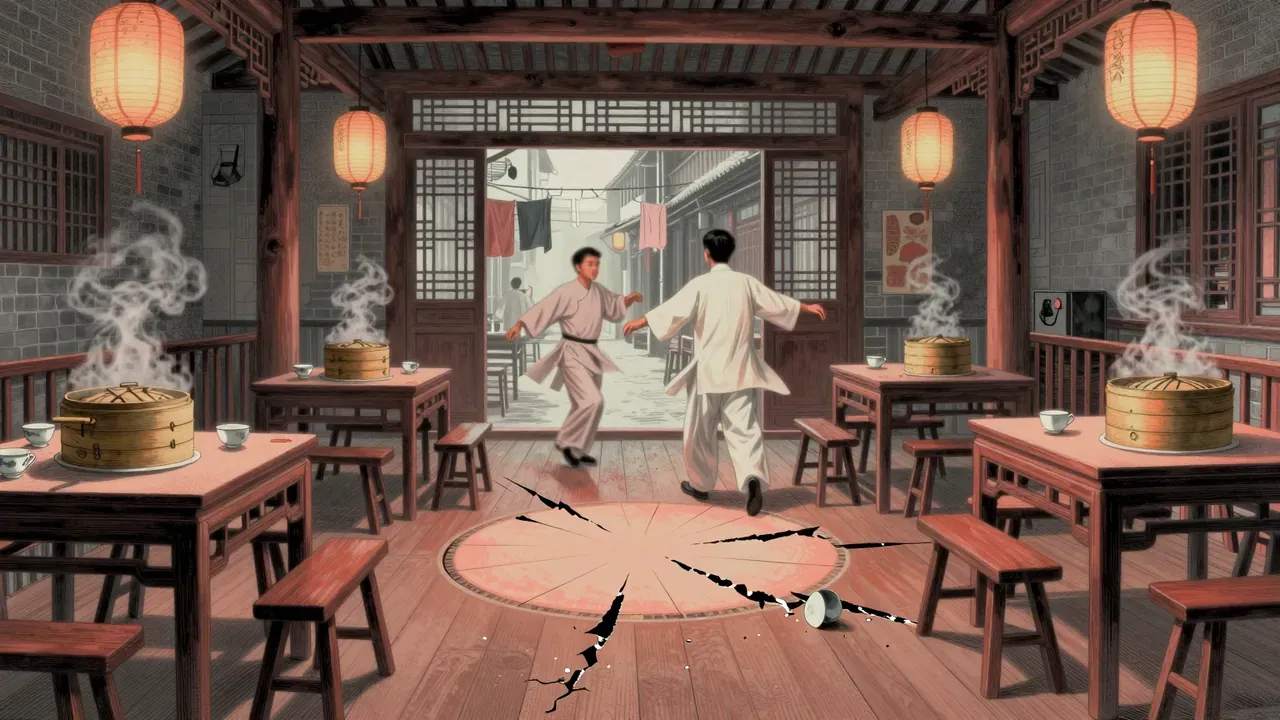
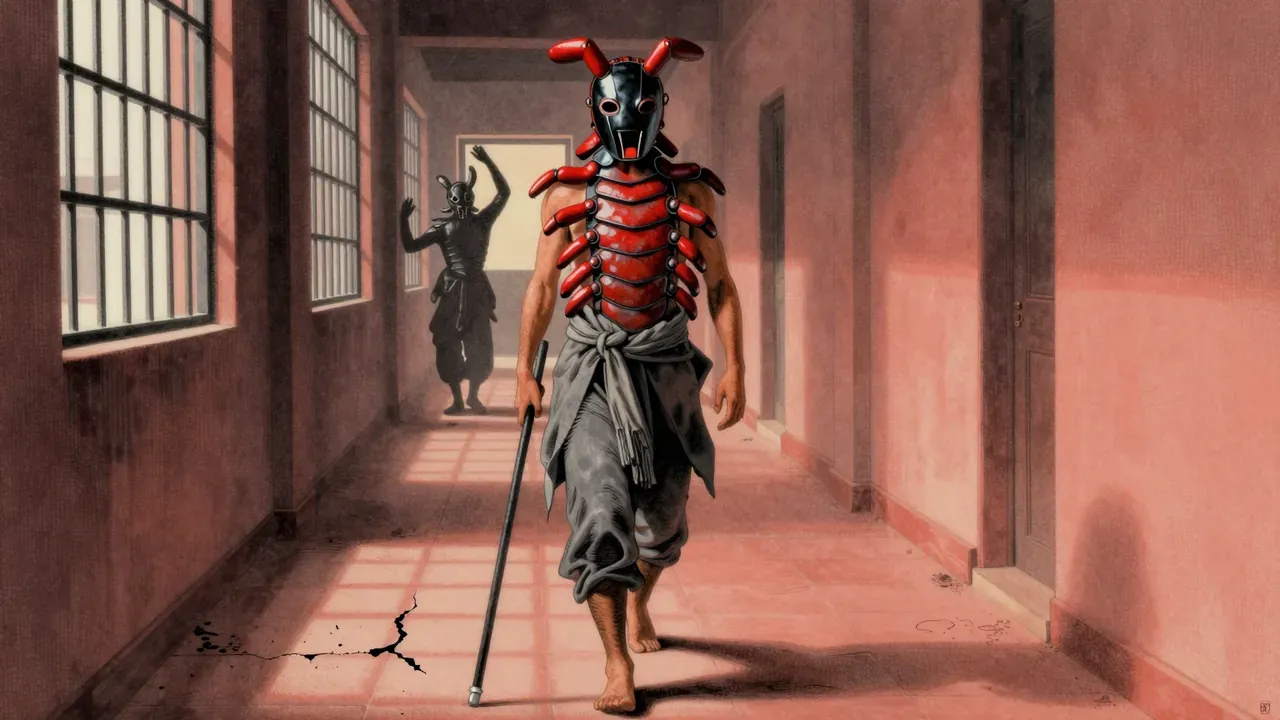
What lands is the physical specificity of the martial arts: the rope-whip recoil, the staggered timing of the centipede mask’s segmented attack, the way Clubfoot’s limp becomes tactical advantage in tight corridors. The Red Lantern Sect’s aesthetic — monochrome robes, lantern smoke diffusing light, all-female ranks moving in unison — gives the film its strongest visual motif and clearest ideological counterpoint. Wang Jinghua’s Miao Sanniang carries quiet moral ambiguity: her defection is shown in glances and withheld blows, not speeches. The final lion dance victory is brief but cleanly executed, its triumph undercut not by irony but by immediate news of Beijing’s fall — a structural pivot that works because it refuses catharsis. Father Thomas’s presence avoids caricature; his aid is practical, not proselytising. These moments land because they rely on craft choices — blocking, costume, pacing — rather than exposition or star power. Word count: 146.
Where the scaffolding shows
What does not land is the political scaffolding. The Eight-Nation Alliance’s challenge is framed as sport, but the film never clarifies why a lion dance contest would serve imperial diplomacy — nor why China’s sovereignty hinges on winning it. The Red Lantern Sect’s xenophobia is presented as fanaticism, but its critique of foreign medical clinics and churches lacks context or counter-argument; it reads as plot device, not ideology. Alan Chengdu’s death arrives without emotional weight — Chen Jiming appears late, speaks little, and dies off-centre in the frame. The German general remains a cipher: no motive, no voice, no face beyond uniform and machine gun. Wong’s rage at the occupation feels unearned, his decision to return to Foshan unexamined. The romance with 14th Aunt exists in glances and proximity, never dialogue or consequence. These absences aren’t omissions — they’re structural: the script assumes audience familiarity with prior entries’ world-building, but offers no re-entry points. Word count: 152.
Substitution as structure
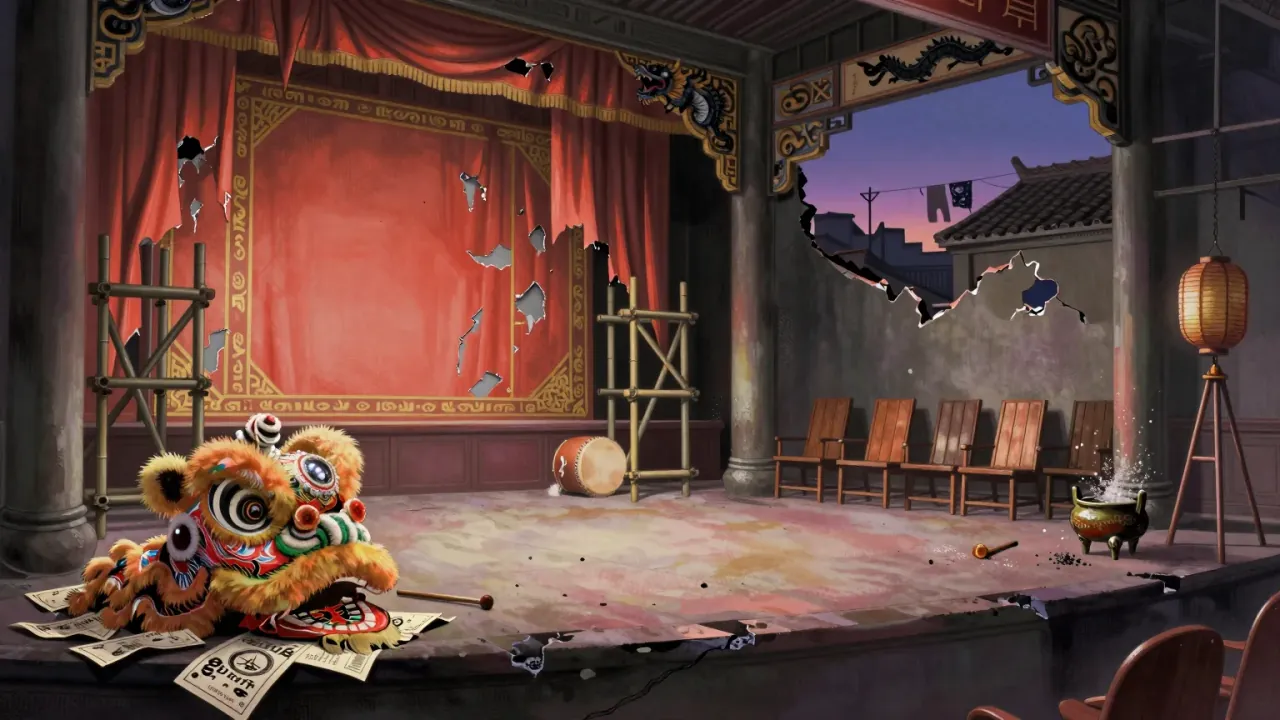
The themes that matter are substitution and scale. Wong Fei-hung is substituted — first by Zhao, then by the lion dance team, then by Clubfoot and Leung when he is absent. Sovereignty is substituted too: the competition stands in for battlefield defeat, the medal for territory, the dance for resistance. The film asks what survives when symbols outlive their referents — when lion masks replace lions, when rope weapons stand in for rifles, when Wong’s name carries authority he no longer commands. It also examines scale mismatch: individual skill versus mechanised war, ritual precision versus colonial violence, folk tradition versus international spectacle. These tensions are clearest in the arena sequence, where handmade masks meet mounted machine guns — not as contrast but as coexistence. The film does not resolve them. It holds them in suspension: the train out of Beijing is neither retreat nor surrender, but transit — a frame holding space between symbol and substance. Word count: 143.
Who it serves, and who it passes by
This film is for viewers who value martial arts choreography as craft rather than spectacle, and who approach franchise entries as variations on a theme rather than chapters in a single arc. It rewards attention to costume detail, weapon logic, and spatial rhythm in fight scenes. Those who expect Tsui Hark’s layered mise-en-scène or Jet Li’s grounded charisma will find it thin — not broken, but stripped down. It is not for viewers who require psychological consistency in protagonists, clear cause-and-effect plotting, or thematic resolution. A viewer seeking historical nuance on the Boxer Rebellion or feminist dissent in late-Qing China will find only surface treatment. What would change the verdict? A tighter script that anchors ideology in character choice, or a director willing to let silence and hesitation carry as much weight as kicks and leaps. Word count: 140.
What the train carries out
It is worth your evening if you watch it as a document of transition — not just in the franchise, but in Hong Kong action cinema’s shift from auteur-led mythmaking to producer-driven continuity. Its value lies in what it reveals about craft under constraint: how Arthur Wong lights a courtyard when funds are low, how Yuen Bun stages rope work when stunt budgets shrink, how Zhao holds a pose when the script gives him little to say. It is not worth your evening if you need narrative propulsion, emotional payoff, or ideological clarity. Those who found the third film diffuse may find this one more so; those who welcomed Zhao’s casting in the fifth may see here the first hesitant steps toward his version of the role. It earns its time not by satisfying expectations, but by exposing the mechanics beneath them. Word count: 141.