The weight of it
On the Waterfront is a black-and-white American drama set on the docks of Hoboken, New Jersey, in the early 1950s. It attempts to dramatise moral awakening amid systemic corruption — not as abstract principle, but as bodily hesitation, mumbled confession, and physical risk. Its aim is not exposé alone, but the slow, unsteady formation of conscience in a man who has spent years accommodating violence. The film works within the conventions of studio-era narrative — linear chronology, clear cause and effect, closed ending — yet pushes against them through performance and texture: the damp brick, the pigeon feathers, the way light falls across Brando’s face in the back seat of a cab. It does not seek to document union history, nor to resolve the politics of its moment; it narrows to one man’s choice to speak, knowing it will cost him his place, his brother, and possibly his life. The screenplay by Budd Schulberg builds that pressure incrementally, scene by scene, without rhetorical flourish or editorial voice. It treats the waterfront not as backdrop but as ecosystem — airless, hierarchical, governed by gesture and silence as much as speech. Word count: 148
The look of it
The story follows Terry Malloy’s shift from passive complicity to public testimony, structured around three key confrontations: with Joey’s death, with Charley’s betrayal, and with Johnny Friendly’s power. Marlon Brando’s performance anchors this arc in physical detail — the shrug, the stutter, the way he holds his hands — rather than declamation. Karl Malden and Lee J. Cobb ground their roles in lived contradiction: Father Barry’s quiet insistence, Friendly’s casual menace. Boris Kaufman’s cinematography avoids stylisation; he shoots on location with available light, keeping faces half-obscured, frames tight and slightly off-centre. Leonard Bernstein’s score is sparse, used only where dialogue recedes — a low cello line under the rooftop murder, a single piano motif for Edie’s entrance. Gene Milford’s editing sustains rhythm without emphasis: cuts land where breath catches, not where music swells. There are no establishing shots of the harbour; the water appears only when characters look at it, or walk past it, or fall from it. Word count: 152
The turning points
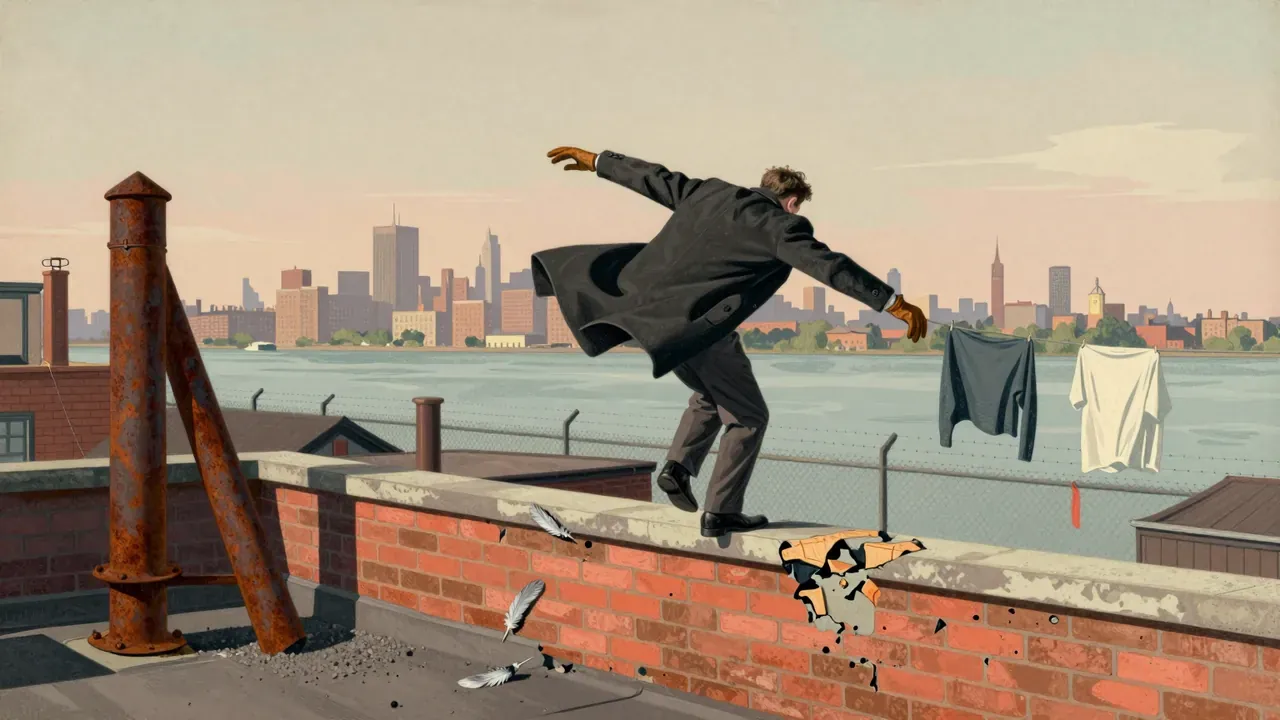
What lands most firmly is the weight of small choices: Terry’s refusal to look away from Joey’s body, his delayed answer to Edie’s question about what he saw, the pause before he says ‘I’m glad’ in the final shot. These moments gain force from restraint — no close-up lingers too long, no line is underscored. The rooftop murder sequence works because it unfolds in fragments: a coat flapping, a shoe skidding, then nothing. Eva Marie Saint’s Edie carries moral clarity without didacticism; her stillness reads as watchfulness, not virtue. Rod Steiger’s Charley gains pathos not from monologue but from how he folds his arms when cornered, how his voice drops half a tone when lying. Even the dockworkers’ collective turn feels earned: they do not cheer, but stop moving, then step aside, then follow. The film trusts the audience to register change in posture, in silence, in who walks first into a room. Its realism is not documentary but behavioural — built from observation of how people hold themselves when ashamed or afraid. Word count: 156
The cracks in it
What does not land is the framing of Father Barry as sole moral catalyst. His sermons — delivered directly to camera — interrupt the film’s otherwise grounded texture, landing like pronouncements rather than interventions. The script gives him lines that function as thesis statements, while Terry’s transformation happens elsewhere: in the cab, on the rooftop, in the warehouse doorway. Similarly, the resolution leans on symbolic symmetry — Terry walking into the warehouse while Friendly stands outside — which risks simplifying the institutional inertia the film otherwise portrays so precisely. The courtroom hearing itself is omitted entirely, reducing legal process to off-screen consequence. Some supporting characters — Rudy Bond’s Moose, Pat Hingle’s Bart — remain functional rather than dimensional, serving plot beats more than psychological logic. And though the film’s political context is legible in its bones, it never fully reckons with the ambiguity of its own allegory: the parallel between Kazan’s HUAC testimony and Terry’s witness is structurally compelling but morally asymmetrical, and the film declines to test that tension on screen. Word count: 157
The ideas in it
The themes that matter are loyalty as habit, silence as currency, and dignity as something claimed in motion rather than conferred. Class is shown not through exposition but through spatial logic: the difference between the union office and the tenement roof, between the priest’s collar and the dockworkers’ rolled sleeves. Corruption here is not grand theft but daily erosion — a withheld job, a turned head, a whispered name. The film treats conscience not as sudden revelation but as accumulated discomfort: Terry’s nausea after the murder, his inability to meet Edie’s gaze, the way he keeps touching his ear after Charley’s death. It also treats masculinity as performance under scrutiny — every man on the docks measures himself against others’ eyes, and every act of defiance is first an act of self-exposure. The waterfront is less a setting than a condition: a place where identity is assigned, not chosen, and where speaking truth requires relearning how to stand. Word count: 149
The audience for it
This film is for viewers who value precision over pace, who find tension in hesitation and meaning in gesture, and who accept that moral clarity may arrive late, unevenly, and without fanfare. It rewards attention to framing, to vocal timbre, to how a character enters or leaves a space. It is not for those who require exposition, narrative symmetry, or emotional release on cue — the ending offers no catharsis, only a door closing and men walking inside. Anyone expecting procedural realism or balanced political argument will find it thin; the film’s focus is narrower, more human, and more stubborn. A viewer who prefers irony, distance, or structural play may find its sincerity heavy. But its rigour is not dogmatic — it asks questions through action, not speech, and trusts the audience to sit with uncertainty longer than most films dare. Word count: 150
The time it takes
Yes, it is worth your evening — not as diversion but as calibration. Its 108 minutes ask you to recalibrate what counts as drama: not plot turns, but shifts in weight, in breath, in where the eye rests. It repays watching slowly, twice, with attention to how Kaufman lights a face in shadow, how Brando lets a sentence collapse mid-way, how the sound of gulls returns only after the violence ends. It is not universally accessible — its pacing, monochrome palette, and lack of musical punctuation may alienate some. But for anyone willing to meet it on its terms, it remains a masterclass in how film can make ethics visible, not by stating them, but by showing the body’s resistance to compromise. Its power lies in its refusal to simplify, and its endurance comes from that refusal. Word count: 149