The look of it
Night and the City is a British-made film noir set in post-war London, directed by Jules Dassin in exile from Hollywood. It adapts Gerald Kersh’s novel not as literary fidelity but as raw material for a tightly wound study of ambition without anchor or ethics. The film does not seek to explain Harry Fabian — it watches him move, scheme, beg, betray and run, with no interior monologue, no redemption arc, no mitigating warmth. Its aim is structural and moral: to show how a man who mistakes motion for agency collapses under the weight of his own velocity. It treats London not as backdrop but as pressure system — damp, indifferent, layered with competing hierarchies: wrestling promoters, nightclub owners, beggars’ councils, smugglers on the Thames. There is no police presence worth naming; law is absent not as omission but as deliberate erasure. The film’s vision is not cynical because it expects better — it is clinical, registering cause and effect without pause for pity. It attempts no uplift, no irony, no wink at the audience. Its logic is arithmetic: every loan has interest, every lie compounds, every alliance expires on contact with self-interest. Word count: 158.
The way it moves
The story moves with pitiless economy: Fabian’s pitch, his scramble for £200, the forged licence, the gym opening, the rigged fight, the death of Gregorius, the bounty, the chase. Richard Widmark plays Fabian not as manic energy but as frayed nervous tension — shoulders hunched, voice tight, eyes scanning for exits before he’s entered the room. Gene Tierney’s Mary Bristol is quiet, grounded, her stillness a reproach to his restlessness. Googie Withers gives Helen Nosseross a brittle, transactional sharpness; Herbert Lom’s Kristo is all contained menace, speaking little, watching more. Mutz Greenbaum’s cinematography avoids expressionist distortion: shadows are deep but legible, locations real — Shepperton soundstages blend with rain-slicked London streets, gaslit alleys, the cavernous emptiness of a closed-down theatre. Franz Waxman’s score is urgent, percussive, never sentimental. The wrestling sequence — shot with Stanislaus Zbyszko and Mike Mazurki — is brutal in duration and physical consequence, not stylised violence but exhaustion made visible. Word count: 159.
What holds
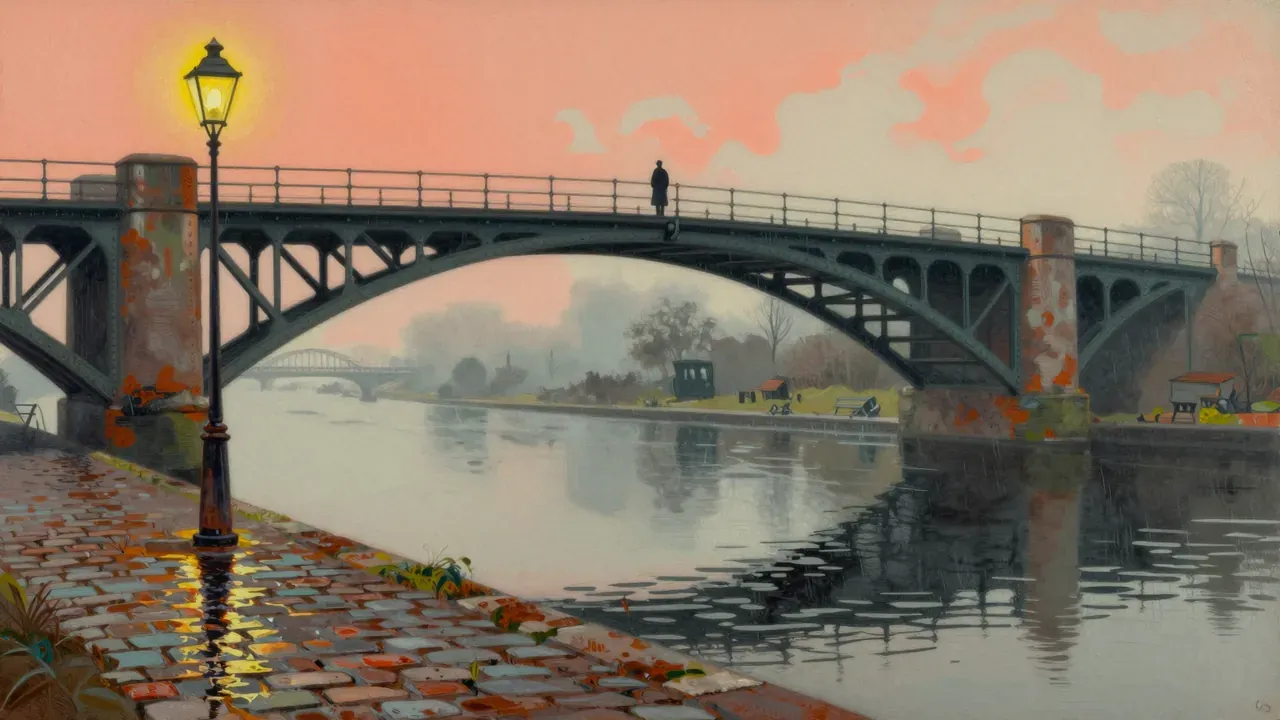
What lands is the film’s unbroken sense of consequence. Every decision Fabian makes narrows his options until only flight remains — and even that is foreclosed. The geography feels earned: Hammersmith Bridge is not symbolic but specific, its ironwork cold, its river dark and final. The supporting cast operate within clear, unspoken rules — Figler’s beggars have jurisdiction, Anna’s scow is neutral ground, Googin’s forgery carries weight because it works twice. The film trusts its audience to follow cause without exposition: we understand why Nosseross withdraws support not from dialogue but from the tilt of his head, the pause before he speaks. The ending does not resolve — it closes like a trap snapping shut. There is no epilogue, no moral summary, no survivor’s reflection. Mary’s final moment with Adam Dunne is not comfort but continuation: life goes on, just not for Fabian. That austerity lands with cumulative force. The film’s refusal to soften its gaze — on failure, on betrayal, on the sheer physical cost of lying — gives it a rare kind of honesty. Word count: 157.
Where it slips
What does not land is the film’s occasional over-reliance on plot mechanics at the expense of psychological texture. Fabian’s motivations remain surface-level: he wants to be ‘somebody’, but the film offers no origin, no memory, no glimpse of what ‘somebody’ means beyond money and noise. Some secondary characters blur — Francis L. Sullivan’s Nosseross is vivid in fury but thin in motive, Hugh Marlowe’s Adam Dunne barely registers beyond function. The American version’s tighter runtime sacrifices the UK cut’s slight tonal nuance — particularly Helen’s arc — though Dassin preferred it, the loss of her brief, faltering agency weakens the web of mutual exploitation. The wrestling milieu, while authentic in casting and staging, risks feeling like backdrop rather than lived world: its codes are asserted, not absorbed. And while the lack of sympathetic characters is a design feature, it can leave the viewer adrift — not unsettled by moral ambiguity, but detached by sheer absence of connection. Word count: 159.
What it means
The themes that matter are failure as process, not event; ambition divorced from identity; and power as delegation, not possession. Fabian fails not because he is unlucky or outwitted, but because he mistakes leverage for control — he borrows from Figler, deceives Helen, manipulates Gregorius, and assumes each act expands his sphere, when in fact each shrinks it. The film treats class not as static hierarchy but as shifting terrain: Helen sells her fur coat to fund Fabian, then discovers she has nothing left to sell; Nosseross kills himself not from poverty but from the collapse of his domestic authority. Wrestling is both literal and metaphorical — a tradition, a racket, a language of dominance and submission that Fabian tries to translate into business terms and cannot. The Thames is not romantic but functional: a border, a hiding place, a disposal route. There is no nostalgia for lost virtue — only attention to how systems sustain themselves by consuming those who misunderstand their rules. Word count: 156.
Who it’s for
This film is for viewers who value precision over reassurance, structure over solace, and moral clarity without moralising. It suits those accustomed to mid-century British realism or classical noir’s lean syntax — people who find tension in silence, dread in pacing, and weight in unsaid things. It is not for viewers who need protagonists with redeeming qualities, narrative closure, or emotional hand-holding. Those who expect character arcs to curve upward, or who rely on music or editing to signal tone, may find it austere to the point of alienation. A viewer who prefers psychological exposition over behavioural observation will likely disengage early. The film’s rigour demands patience — not for slow pacing, but for its refusal to interpret its own events. Someone who values thematic coherence over emotional catharsis will find it rich; someone who reads cinema primarily as empathy engine may find it withholding. Word count: 159.
Is it worth your evening
Yes, it is worth your evening — provided you approach it as a crafted object, not an invitation. Its ninety-two minutes accumulate like pressure: no scene wastes time, no performance strays from register, no shadow falls without purpose. It repays attention not with rewards but with revelation — how tightly cause binds effect, how quickly networks collapse when trust evaporates. It is not ‘enjoyable’ in the conventional sense, but it is absorbing, exact, and unusually consequential in its construction. Those who dismiss it as bleak miss its discipline; those who call it ‘hopeless’ mistake clarity for despair. Its value lies in its refusal to flinch — from Fabian’s end, from Helen’s forgery, from the Strangler’s arrest as mere administrative footnote. To judge it unworthy is to prefer narrative leniency over formal rigour — a valid preference, but one the film never courts. Word count: 159.