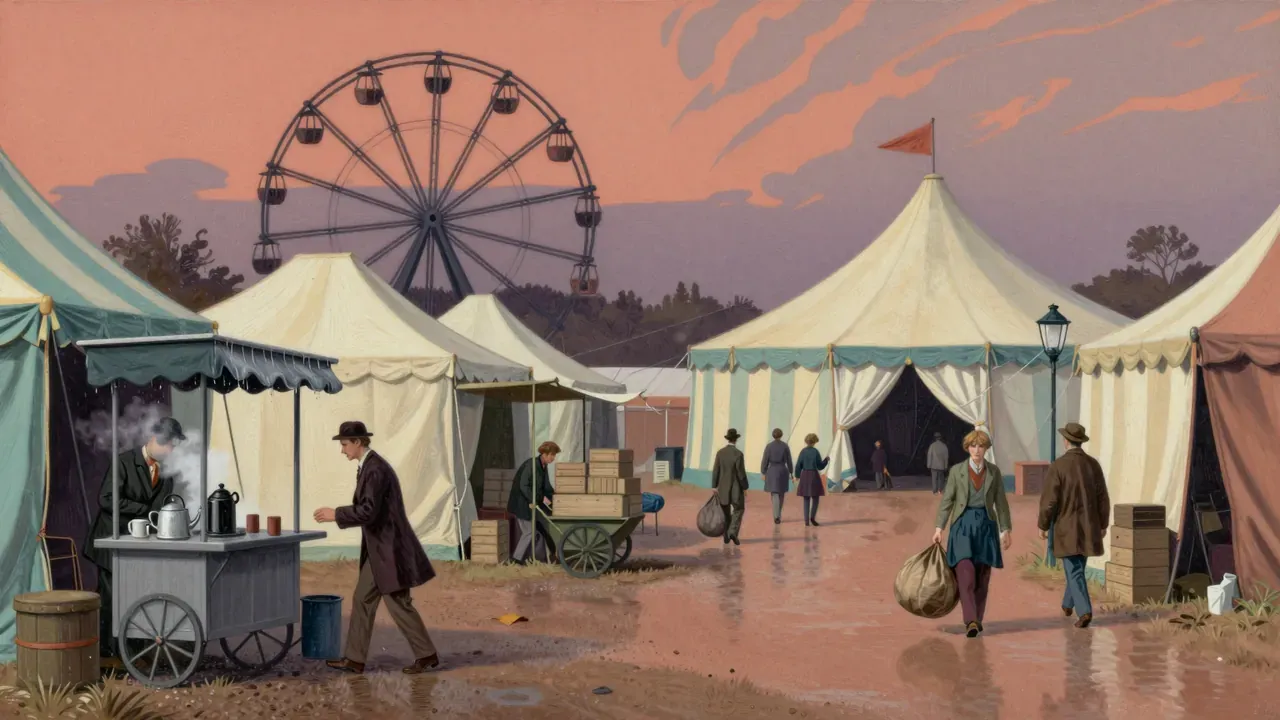
The look of it
Nightmare Alley is a 1947 crime film adapted from William Lindsay Gresham’s 1946 novel, aiming to translate its bleak, deterministic vision of moral collapse into studio-era Hollywood terms. It follows Stanton Carlisle — a carnival barker who trades grime for glamour, then glamour for ruin — through successive layers of deception: first as a mentalist in nightclubs, then as a spiritualist preying on the wealthy, and finally as a broken man reduced to the carnival’s lowest role. The film tries to sustain a tone of clinical irony while delivering pulp consequences: ambition as self-immolation, performance as identity erosion, and redemption as a flicker, not a resolution. Its ambition lies not in subverting noir conventions but in testing how far a major studio star like Tyrone Power could go into darkness without losing audience sympathy — or commercial viability. That tension between Zanuck-era restraint and Gresham’s nihilism shapes every choice, from the softened ending to the casting of Power against type. It is a studio product with literary teeth, filed down but not extracted. (158 words)
The shape of the lie
The story moves with calibrated momentum: the carnival section establishes hierarchy and rot; Chicago introduces artifice masquerading as insight; the downfall arrives not with a bang but with quiet, cumulative betrayal. Tyrone Power modulates Carlisle’s descent with physical precision — his posture stiffens as he impersonates authority, slackens as he drinks, collapses when he becomes the geek. Joan Blondell grounds the early scenes with weathered warmth and unspoken grief; Helen Walker’s Lilith Ritter is all stillness and withheld leverage, her power lying in silence and tape recorders. Lee Garmes’ cinematography avoids high-contrast expressionism in favour of functional shadow — corridors are dim, offices are cluttered, carnival tents are lit just enough to show sweat and sawdust. Barbara McLean’s editing sustains rhythm without flourish: cuts land where they must, never where they dazzle. Cyril J. Mockridge’s score underscores but does not interpret; it marks transitions, not revelations. The craft serves the arc, not the moment — a disciplined refusal of ornament in service of accumulation. (159 words)
Where the weight settles
What lands is the texture of the carnival — the smell of greasepaint and cheap whiskey, the choreography of conning an audience, the way Bruno’s menace is conveyed in a single glance across a tent flap. The film earns its moral weight not through speeches but through repetition: Carlisle hears ‘geek’ twice before he becomes one; he repeats ‘I was made for it’ only after he has no other line left. The performances land because they resist psychology — Power doesn’t signal guilt so much as carry it in his shoulders; Blondell doesn’t emote regret, she embodies its cost in every gesture toward Pete. The script’s structural rigour pays off in the Grindle sequence: the slow build of false intimacy, the pivot when Molly refuses the lie, the hollow click of Ritter’s recorder stopping mid-sentence. These are not set-pieces but pressure points — moments where the machinery of deceit jams, and the human cost becomes visible. The film’s restraint makes those moments heavier, not lighter. It trusts the audience to notice what isn’t said, and rewards that attention with coherence, not catharsis. (157 words)
What the lights miss
What does not land is the psychological plausibility of Carlisle’s final breakdown — his slide into alcoholism feels narratively expedited rather than observed. The Chicago section, though well-acted, lacks the tactile specificity of the carnival: nightclubs are generic, the elite clients interchangeable, their vulnerabilities too neatly catalogued. The film’s attempt to soften Gresham’s ending undermines its own logic — Molly’s reappearance at the finale offers hope that the source material deliberately denies, and the gesture feels less earned than imposed. There is also a disjunction between the film’s stated interest in performance-as-identity and its treatment of women: Zeena, Molly and Lilith are all defined by their relationship to Carlisle’s trajectory, not by interiority the script develops. Helen Walker’s performance compensates, but the writing gives her little beyond calculation. The carnival’s authenticity — built on ten acres of backlot and staffed by real sideshow performers — contrasts with the flatness of the Chicago milieu, where sets feel like soundstages and motivations feel like plot functions. (159 words)
The grammar of the fall
The themes that matter are not originality but insistence: the corrosion of language through repeated use, the way ritual masks both belief and fraud, and the structural inevitability of falling once you’ve built your life on borrowed authority. It treats class not as backdrop but as grammar — the carnival’s rigid pecking order mirrors Chicago’s social stratification, and Carlisle’s failure is not that he climbs, but that he believes climbing erases where he began. Addiction appears not as pathology but as habit: drinking, lying, performing — each becomes automatic long before it becomes destructive. The film’s most persistent motif is the recording device: Pete’s coded mentalism, Ritter’s tapes, Carlisle’s rehearsed patter — all are technologies of control that outlive their users. And the geek is not metaphor alone; he is the literal endpoint of a system that consumes its performers until nothing remains but the act itself. This is not a film about evil individuals, but about systems that reward mimicry over substance, and punish those who forget they are playing a part. (158 words)
Who it keeps company with
This film is for viewers who value narrative architecture over emotional payoff, who find tension in inevitability rather than surprise, and who can sit with ambiguity that resolves into quiet despair rather than catharsis. It suits those familiar with studio-era constraints — who understand why Furthman’s script tightens Gresham’s sprawl, why Goulding’s direction avoids stylisation, why Power’s casting is itself thematic. It is not for those who require moral clarity, character growth, or even consistent psychological realism. Viewers expecting the visual flamboyance of later noir — or the operatic downfall of a Shakespearean tragedy — will find it undercooked. Those who dislike slow-burn fatalism, or who need protagonists to retain agency until the final frame, will leave unsatisfied. A viewer who values James Agee’s observation that the film’s wit is rare in its context might still find its pacing glacial; someone drawn to the 2022 remake’s heightened aesthetics may find this version too restrained. What would change the verdict? A sharper delineation of Chicago’s social world — more than one named client, more than one distinct venue — would anchor the second act. (159 words)
Why it stays with you
Yes, it is worth your evening — not as escapism, but as calibration. It holds up a mirror to the mechanics of self-invention, and does so with a discipline rare in studio productions of its scale. Its power lies in accumulation: each scene adds weight, each performance deepens consequence, each cut tightens the noose. You will not leave exhilarated, but you may leave unsettled in a precise, useful way — aware of how easily competence becomes complicity, how performance bleeds into personhood, how systems absorb dissent until only the routine remains. Those who dismiss it as dated or dour miss its quiet modernity: its understanding of recorded confession as leverage, of charisma as currency, of reinvention as exhaustion. It is not for casual viewing, nor for those seeking affirmation — but for anyone willing to watch a man dismantle himself, step by deliberate step, with no music swelling, no camera pulling back, no judgment spoken aloud. Its economy is its argument. (158 words)