The look of it
Brute Force is a 1947 American crime film that sets out to depict the prison system not as a corrective institution but as a closed, violent ecosystem sustained by sadism, indifference and institutional failure. It does not aim for procedural realism or moral ambiguity: its purpose is polemical, using the prison as a compressed allegory of postwar American power — hierarchical, punitive, and unreformable. The film’s structure insists on cause and effect: every inmate’s crime stems from a relationship with a woman, but the prison itself is the true author of their fate. It treats rehabilitation as a rhetorical gesture, not a practice; parole as bait, not promise; medical care as theatre. Its political intent is unvarnished: to show how state violence operates not at the margins but at the centre of official policy, administered daily by men like Capt. Munsey, whose cruelty is neither aberrant nor personal, but systemic and rewarded. The film’s title names its thesis plainly — brute force is the only logic the system recognises, and the only language it speaks.
The shape of the story
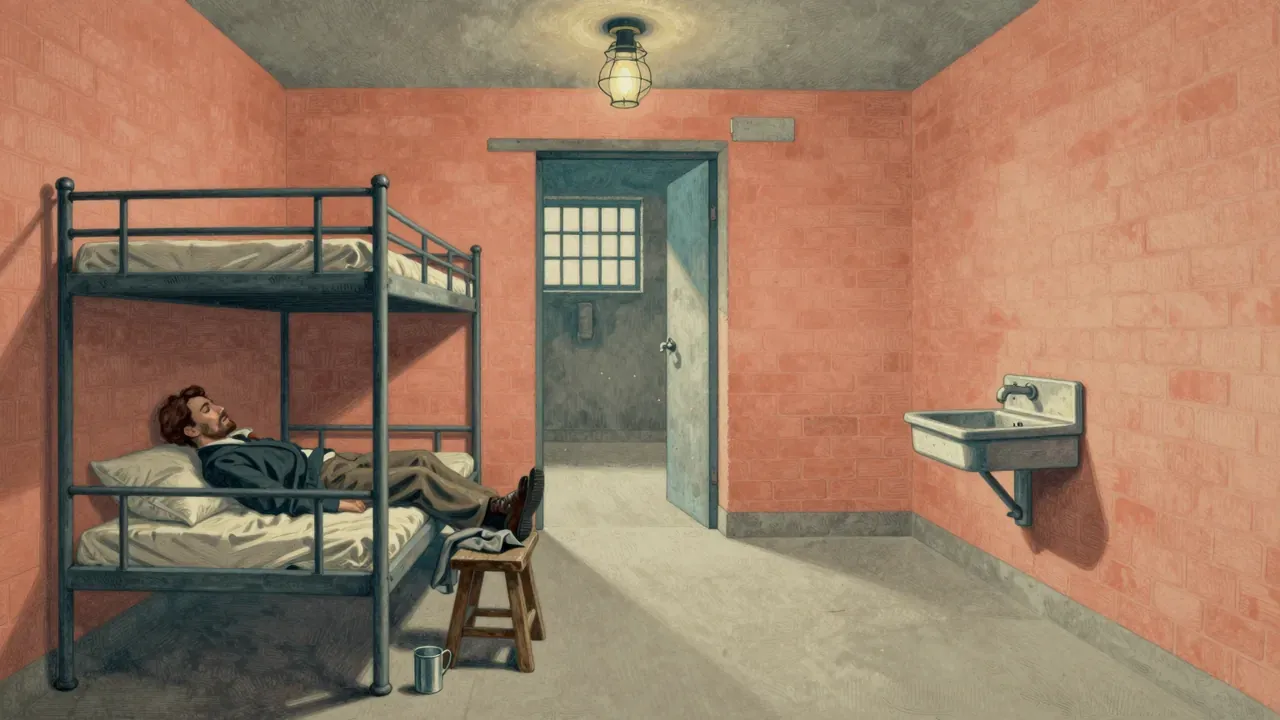
The story unfolds in tight, escalating increments: Joe Collins’ return from solitary, Munsey’s manipulations, the slow corrosion of trust among the men of cell R17, then the collapse into riot. Richard Brooks’ script gives each inmate a brief, self-contained monologue — not exposition, but confession — anchoring their crimes in desire, betrayal or desperation, never in malice alone. Burt Lancaster grounds Joe in weary resolve, not heroism; Hume Cronyn’s Munsey is chillingly precise, his authority built on paperwork and timing rather than shouting. William H. Daniels’ cinematography keeps the frame cramped and low-contrast, the prison corridors narrow and shadowed, the yard rain-slicked and indifferent. Miklós Rózsa’s score avoids leitmotif in favour of dissonant brass and abrupt silences. Edward Curtiss’ editing tightens the pacing as tension mounts, cutting between cell R17 and Munsey’s office with the rhythm of surveillance. There are no establishing shots of freedom — only frames that tighten, darken, and close.
The weight of the violence
What lands is the film’s unrelenting coherence of tone and design. Every element serves the same argument: that the prison is a machine calibrated to break people, not mend them. The brutality feels inevitable because it is ritualised — Wilson’s death under the stamping press is not shocking for its gore but for its bureaucratic calm; Louie Miller’s beating is scored to Wagner not for irony but for grim ceremonial weight. The performances avoid psychology in favour of function: Sam Levene’s Louie is not a man being tortured but a man being used as proof; Ella Raines’ Dr. Walters delivers his final address not as revelation but as exhausted summation. Even the women — Yvonne De Carlo, Ann Blyth, Anita Colby — are framed not as femmes fatales but as vectors of social pressure: their choices, limited and precarious, become the hinge on which male downfall turns. The film refuses catharsis or redemption, and that refusal lands with cumulative force. Its bleakness is not stylistic affectation but structural necessity.
The limits of character
What does not land is the film’s assumption that its audience shares its diagnosis without needing evidence beyond assertion. The prison staff are drawn in near-caricature: Munsey has no history, no motive beyond cruelty; Warden Barnes is weak but never curious; even the reformist Dr. Walters offers no concrete alternative, only lament. The inmates’ backstories, while poignant, follow a rigid pattern — love, misjudgement, arrest — which flattens individuality into typology. The film’s political urgency occasionally overrides dramatic plausibility: Gallagher’s shift from cautious pragmatist to committed revolutionary happens off-screen, motivated less by character than by plot necessity. The climactic riot, though visceral, lacks spatial clarity — the geography of the yard, tower and bridge remains vague, sacrificing tactical logic for symbolic chaos. And while the fourth-wall break by Dr. Walters is thematically resonant, it arrives after so much unrelenting grimness that it reads less as insight than exhaustion. The film’s rigour leaves little room for doubt — or for surprise.
The system as truth-teller
The themes that matter are not crime or punishment in the abstract, but the mechanics of control: how information is weaponised through informants, how discipline is manufactured through revocation of privilege, how hope is managed as a tool of compliance. Class is rendered physically — the guards wear crisp uniforms while prisoners wear threadbare grey; the warden’s office has carpet and light, Munsey’s has bare bulbs and metal chairs. Gender functions not as subplot but as structural pressure: every man’s fall is tied to a woman’s need, choice or vulnerability, exposing how economic and social precarity shapes intimate life. The film treats ‘rehabilitation’ as a myth sold to the public, not practised behind walls. Its most persistent theme is futility — not of escape, but of resistance within a system designed to absorb and neutralise dissent. Even the riot fails as revolt; it succeeds only as confirmation of the authorities’ narrative of inherent criminality. The film’s nihilism is not philosophical but administrative: the system works exactly as intended, and that is the tragedy.
Who it is for
This film is for viewers who value formal rigour over emotional release, who read cinema as argument not entertainment, and who accept that some films exist to indict rather than invite. It suits those familiar with postwar noir’s visual grammar and willing to sit with sustained discomfort. It is not for viewers seeking narrative resolution, psychological nuance, or moral complexity — the film offers none. Those who require character arcs, thematic ambiguity or tonal variation will find it monolithic. Critics who value historical context over present-day applicability may object to its didacticism; scholars of penology might note its simplification of mid-century prison reform efforts. A viewer who values empathy over indictment, or who finds catharsis essential to drama, would likely reject its uncompromising stance. Its value depends entirely on whether one accepts that a film’s purpose can be to exhaust hope, not renew it.
Why it stays with you
Yes, it is worth your evening — but only if you are prepared to spend it inside a tightly sealed, airless room where every door is locked from the outside. It is not an easy watch, nor is it meant to be: its ninety-eight minutes are calibrated to unsettle, not entertain. The film’s power lies in its consistency — every shot, line and edit reinforces its central claim about institutional violence. To dismiss it as dated or heavy-handed is to miss how deliberately it refuses concession. Someone who values subtlety over statement, or who believes cinema must offer solace, would reasonably decline. But for those who recognise that some truths are best told without relief — and that 1947’s vision of systemic failure remains legible today — Brute Force holds its ground with unnerving precision. Its worth is not in comfort, but in clarity.