The look of it
Mudbound is a historical drama set in the Mississippi Delta just before and after the Second World War, adapting Hillary Jordan’s 2008 novel. It attempts to render the structural violence of American racism not as backdrop but as weather — pervasive, inescapable, shaping every decision, every glance, every silence. Its ambition is not to narrate progress but to hold two parallel returns from war — one white, one Black — in sustained, unsentimental juxtaposition. It refuses the comfort of moral binaries: no character is wholly redeemed or irredeemable; no institution is named and condemned, only lived inside. The film’s formal project aligns with that aim: Rachel Morrison’s cinematography avoids period-drama polish, opting instead for a tactile, mud-sodden realism where light falls unevenly and faces are often half-obscured. This is not a film about heroes overcoming injustice, but about how injustice settles into bone, land, language — and how even fleeting solidarity cannot lift it.
The voices in it
The story unfolds across six perspectives — Laura, Henry, Jamie, Pappy, Hap and Florence — each given measured screen time and interiority. Performance choices avoid grandstanding: Carey Mulligan’s Laura conveys exhaustion through posture and pauses; Jason Mitchell’s Ronsel carries his European liberation like a physical weight he cannot shed; Garrett Hedlund’s Jamie moves through scenes as if underwater, his speech thickened by unspoken trauma. Virgil Williams and Dee Rees’ script parcels exposition carefully, trusting the audience to infer motive from gesture — a withheld handshake, a turned head, a hand hovering over a gun. Morrison’s camera stays close, rarely wider than medium shots, keeping focus on skin texture, fabric strain, the dampness under eyes. Tamar-kali’s score avoids orchestral sweep, using low strings, field recordings and sparse vocal fragments to echo the characters’ fractured inner states. Costume design by Michael T. Boyd reinforces class without exposition: patched cotton, mended seams, uniforms worn too long, all speaking of scarcity as inheritance.
What holds its weight
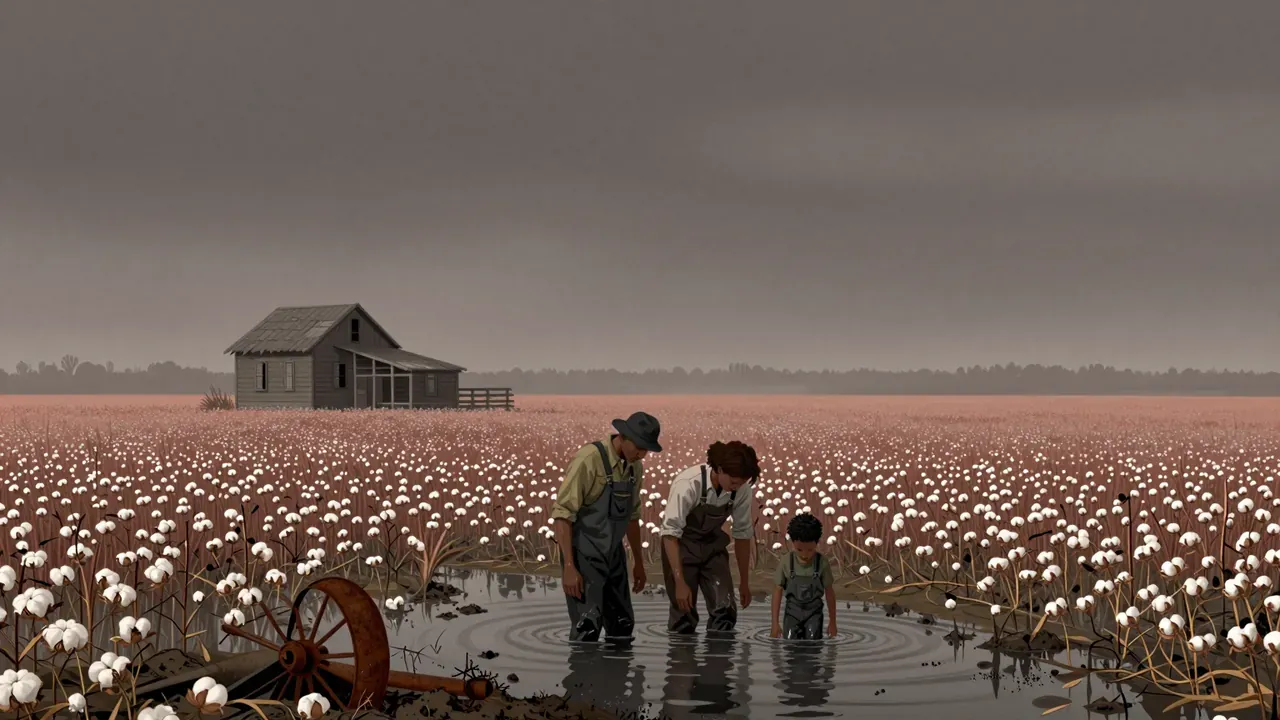
What lands most firmly is the film’s refusal to separate racism from environment. The mud is not metaphor — it is literal, viscous, recurring, sucking at boots, staining walls, drying into cracked earth that splits open when rain returns. That physical insistence makes the social conditions inseparable from geography. The bond between Jamie and Ronsel feels earned because it emerges not from shared ideology but shared disorientation — both men have seen war’s absurdity and returned to a society that insists on rigid hierarchy. The scene where Jamie whispers ‘tongue’ under duress lands with brutal precision because it follows no build-up of heroism, only cumulative pressure. Morrison’s lighting achieves its stated aim: the American dream is never shown in golden hour, only in the flat, grey light of compromise or the sickly yellow of kerosene lamps. The film’s restraint — its avoidance of voiceover, flashbacks, or musical swells at key moments — gives its moral weight gravity rather than gloss.
Where the ground shifts
What does not cohere is the framing device: the opening grave-digging sequence, meant to establish fatalism and interdependence, remains underdeveloped. It introduces no character arc or thematic pivot that the rest of the film pays off. Similarly, Pappy’s virulence, while historically grounded, edges toward caricature in his final barn confrontation — his dialogue sharpens into rhetorical abstraction, losing the granular menace of earlier scenes where his racism operates through silence, timing, or withheld labour. The film’s dual-POV structure also creates asymmetry: Florence’s perspective, though vital, receives less narrative oxygen than Laura’s or Jamie’s, and her quiet resilience risks being read as passive endurance rather than active resistance. The wartime sequences shot in Budapest feel visually distinct but tonally detached — their crispness contrasts with the Delta’s grain, briefly fracturing the film’s immersive consistency. These are not failures of intent but of balance: the film’s commitment to realism occasionally resists the dramatic compression needed for full cohesion.
What lives in the body
The themes that matter are inheritance and embodiment. Not just of land or money, but of posture, breath, speech patterns, fear responses — passed down not by choice but by repetition under constraint. The film treats PTSD not as a clinical condition but as a recalibration of perception: Jamie flinches at sudden noise not because he is broken, but because his nervous system has learned war is ambient. Racism functions similarly — not as isolated acts but as atmospheric pressure, measurable in who sits where, who speaks first, who gets medical care, whose child is named in a photograph. Class and race are shown as mutually reinforcing systems, not competing explanations: Henry’s resentment of Hap is inseparable from his own powerlessness before banks, landlords and his father. The film’s deepest concern is how dignity persists without recourse to victory — in Florence’s steady hands as she stitches, in Laura’s secret withdrawal of cash, in Ronsel’s refusal to look away even when looking invites violence.
Who walks with it
This is for viewers who accept that some stories do not resolve, who can sit with discomfort without demanding catharsis, and who value craft that serves character over spectacle. It is not for those who require clear moral signposting, narrative symmetry or emotional release — the film offers none of these. Those who expect historical drama to affirm contemporary values may find its refusal to grant redemption frustrating. Others might object to its unrelenting tone, arguing that the absence of levity or warmth renders its world uninhabitable. That objection would be valid only if the film claimed to depict life in full — but it does not. It depicts a specific, sustained pressure point. Change the verdict? Show the Jacksons’ land purchase completed, or Florence leading a voter registration drive, and the film becomes a different proposition — one of forward motion, not sedimentation.
What stays after
Yes, it is worth your evening — not as relief, but as reckoning. Its 120 minutes accumulate like soil: dense, layered, slow to shift, but impossible to ignore once settled. You will not leave uplifted, but you may leave recalibrated — noticing how light falls in your own room, how silence holds weight, how a single withheld word can carry generations. It demands attention without offering distraction, and rewards patience without promising payoff. Those who watch for plot momentum or character arcs with clean endpoints will likely feel adrift. But for those willing to inhabit its rhythms — the drag of mud, the pause before speech, the way a glance lingers too long — it delivers a rare kind of immersion: not escapism, but deepened witness. Its value lies not in what it solves, but in how thoroughly it refuses to look away from what remains unsolved.