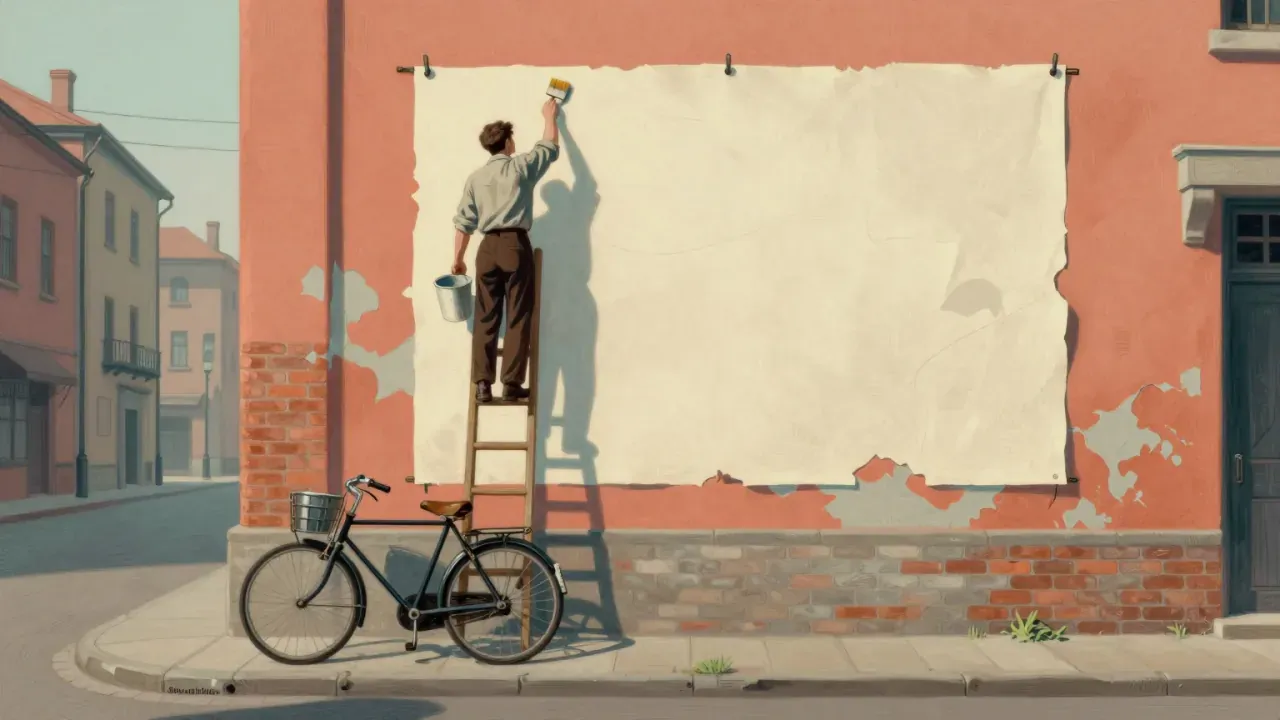
A bicycle pawned to pay for its own job
Bicycle Thieves opens with Antonio Ricci finally landing paid work in postwar Rome, pasting up film posters, on the condition that he supplies his own bicycle. His wife pawns their bedsheets to redeem the bicycle already sitting in a pawnshop, and within hours of his first shift it is stolen while he is up a ladder. The rest of the film follows Antonio and his young son Bruno across Rome, through markets, church charity queues and back alleys, trying to find either the bicycle or the man who took it before Antonio loses the job that depends on it. De Sica is not building suspense around whether they succeed so much as showing, in unbroken detail, what it costs a man to search for one object when that object is the only thing standing between his family and destitution.
Non-actors cast for how they carry themselves
De Sica cast Lamberto Maggiorani, a metalworker with no acting experience, as Antonio, and Enzo Staiola, found on a Roman street, as Bruno, favouring their unpolished, physically grounded presence over trained performance. Carlo Montuori’s cinematography stays close to the two of them as they move through real Roman locations rather than built sets, letting the postwar city’s crowds, rubble and bicycle traffic supply texture no studio could reproduce. Alessandro Cicognini’s score is used sparingly, mostly to underline moments of hope that the story is about to undercut, and Eraldo Da Roma’s editing keeps pace with walking rather than with dramatic beats, giving the search a plain, unhurried rhythm that matches its subject.
A city searched street by street
The film’s tracking of Antonio and Bruno through a genuine flea market for stolen bicycle parts, where dozens of frames and wheels are laid out for buyers who ask no questions, gives the search a concrete, procedural texture rather than a vague, generalised desperation. Bruno’s performance carries real weight without ever appearing to perform for the camera, particularly in a scene where he nearly drowns and Antonio’s relief briefly overrides his obsession with the bicycle. The closing sequence, in which Antonio, cornered by his own failure, attempts to steal a bicycle himself in front of his son and is caught almost immediately by an angry crowd, lands with a bluntness that neither excuses nor moralises about what he has done.
A father who runs out of patience with his son
Some of the film’s supporting incidents, including a visit to a fortune teller Antonio initially mocks and later returns to out of desperation, are staged briefly enough that they read more as texture illustrating Rome’s postwar superstition than as fully worked scenes in their own right. Antonio’s treatment of Bruno grows sharper and occasionally unkind as the search drags on, a choice the film does not flinch from but also does not fully sit with afterward, moving quickly past moments where a slower film might dwell on the damage. At 90 minutes the film covers a lot of ground quickly, and viewers wanting more interior access to what Antonio is thinking between locations will find the film’s method too external to supply it.
The theft that closes the film
The film’s clearest argument is about how thin the margin is between a working family and destitution in postwar Rome, where a single stolen object can undo an entire household’s fragile stability within a day. Class runs through nearly every location the search passes: the crowded flea market, the church charity service Antonio and Bruno must sit through to get a meal, the wealthier households Antonio glimpses in passing, all mapping a city stratified by who has enough and who does not. The final theft complicates any tidy moral reading, since it shows a decent man pushed by circumstance into becoming exactly the kind of person who ruined him, without the film treating that as either justified or damning.
A hard, unadorned watch
This suits viewers wanting an unsentimental, plainly told account of poverty’s daily mechanics, and anyone interested in the location shooting and non-professional casting that defined a whole movement in Italian film. It offers very little to viewers wanting hope rewarded or a clean resolution, since the ending withholds both. Those wanting stylistic flourish or formal experimentation should look elsewhere, since the film’s power comes specifically from its refusal to dramatise beyond what the situation itself provides. It is a demanding watch emotionally despite its short length and simple presentation, and it stays with a viewer well past the closing shot.
Short, plain, and hard to shake
At 90 minutes this is among the shortest and plainest films on this list, with no stylistic ornament standing between the story and the audience, and that plainness is exactly why it has stayed influential well beyond Italian cinema. Its honorary Academy Award, awarded before a competitive foreign-language category existed, reflects how quickly its reputation spread outside Italy. The ending offers no relief, only a father and son walking on into a crowd that has just humiliated one of them, and that refusal to console is worth sitting with for a single evening, even though it gives nothing back in comfort.