What the film is and what it is trying to do
Killers of the Flower Moon is a 206-minute American crime drama set in 1920s Oklahoma, adapted from David Grann’s nonfiction book. It attempts to reframe a historical atrocity — the systematic murder of Osage Nation members after oil was found on their land — not as procedural thriller or true-crime spectacle, but as a slow-burning domestic tragedy rooted in betrayal, complicity, and self-deception. Scorsese and Roth shift focus from the Bureau of Investigation’s eventual intervention to the intimate, corrosive marriage between Ernest Burkhart (Leonardo DiCaprio) and Mollie Kyle (Lily Gladstone), an Osage woman whose wealth makes her both protected and targeted. The film declines to treat the murders as isolated crimes; instead, it embeds them in the texture of daily life — church services, family dinners, county fairs — where violence is deferred, implied, or administered with quiet familiarity. Its ambition is structural as much as moral: to hold narrative space for Indigenous perspective without reducing it to exposition or testimony, and to let settler-colonial greed operate not through caricature but through banal loyalty, familial obligation, and unspoken expectation. Word count: 148
The look of it
The story unfolds across three interwoven arcs: Mollie’s quiet endurance amid escalating illness and loss; Ernest’s gradual descent from conflicted participant to active accomplice; and William King Hale’s (Robert De Niro) patient, bureaucratic malevolence. Rodrigo Prieto’s cinematography avoids grandeur — interiors are lit with the dim, uneven warmth of kerosene and early electricity, exteriors washed in flat, overcast light that flattens horizon and depth alike. Thelma Schoonmaker edits with deliberate slackness: scenes linger past comfort, pauses stretch into silence, and key moments — a cough, a glance, a delayed reaction — are given weight by omission rather than emphasis. Lily Gladstone’s performance anchors the film not through volume but through calibrated withholding: her face registers comprehension before her body does, her voice tightens before her eyes do. DiCaprio modulates Ernest’s moral erosion with physical smallness — slumped shoulders, hesitant hands, a smile that never reaches his eyes. De Niro plays Hale with the stillness of a man who has long ceased needing to persuade. Robbie Robertson’s score is sparse, often absent, letting ambient sound — wind, distant trains, radio static — carry emotional charge. Word count: 157
What lands
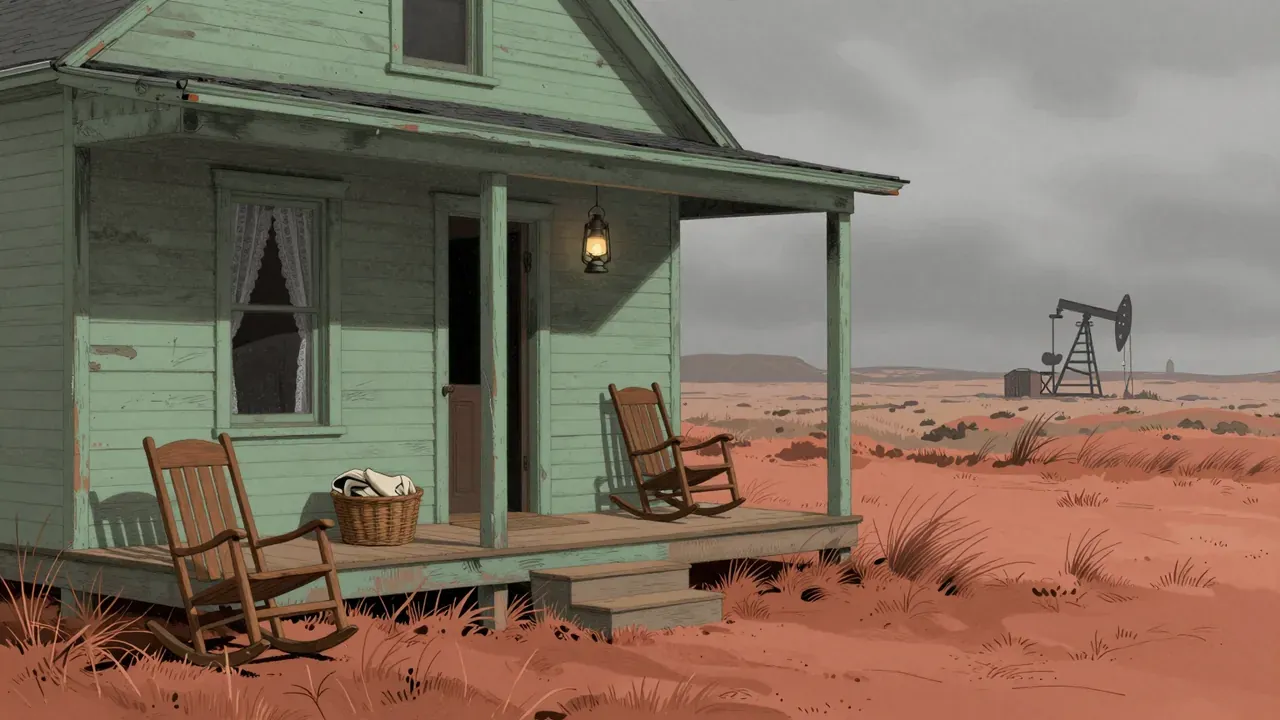
What lands is the film’s refusal to resolve its central tension: Mollie’s love for Ernest is neither excused nor pathologised, and her survival is not framed as triumph but as endurance under erasure. The Osage language spoken on screen — untranslated, un-subtitled in places — functions not as exoticism but as boundary: a linguistic space the camera observes but does not enter, mirroring the limits of Ernest’s understanding and the audience’s access. The courtroom sequence avoids catharsis; justice arrives as paperwork, not vindication. Even the final tribute — Scorsese’s voiceover naming Mollie’s descendants — lands not as closure but as quiet restitution, a gesture toward continuity rather than conclusion. The film’s pacing, often criticised as sluggish, serves its argument: colonial violence is not episodic but atmospheric, cumulative, accretive. Scenes shot on location in Osage County carry a gravitational weight no studio set could replicate — the dust, the grass, the low ceilings, the way light falls across weathered clapboard all register as evidence, not backdrop. Gladstone’s nomination for Best Actress reflects how thoroughly the film’s emotional logic rests on her restraint, not her expressiveness. Word count: 159
Where it slips
What does not land is the film’s attempt to sustain Ernest as a point-of-view anchor. His moral ambiguity curdles into opacity: his motivations blur into habit, his guilt remains interiorised and unexamined, and his final act of confession feels less like reckoning than surrender to narrative necessity. The subplot involving Tom White (Jesse Plemons) arrives late and dissipates without resonance — his procedural rigour contrasts with the film’s anti-procedural design, making his presence feel like structural scaffolding left visible. Some supporting performances — particularly Brendan Fraser’s brief turn as a corrupt attorney — register as stylised cameos rather than integrated character work. The film’s length compounds these issues: by the third hour, the repetitions of grief — another funeral, another coughing fit, another quiet exchange in the same parlour — begin to read less as accumulation and more as stasis. The decision to avoid chyrons and exposition means certain historical mechanisms — the guardianship system, the legal architecture of dispossession — remain hazy to viewers unfamiliar with the source material. This is a choice, not a failure, but it narrows the film’s accessibility without deepening its insight. Word count: 156
The weight of the land
The themes that matter are self-deception as survival strategy, love as both sanctuary and vulnerability, and the banality of sanctioned theft. The film treats colonialism not as distant history but as administrative routine: oil leases, court appointments, medical diagnoses, and marriage certificates all function as instruments of erasure. It insists that exploitation does not require mustache-twirling villains — only men like Hale who understand that power lies in controlling the terms of accountability, and men like Ernest who prefer confusion to conscience. Mollie’s Catholicism is not spiritual ornament but thematic counterpoint: a faith that promises redemption while operating within a system that denies her full personhood. The film also interrogates narrative ownership — whose story gets told, whose grief gets witnessed, whose survival gets legible as resistance. Its most persistent motif is the radio, a technology that carries both government propaganda and Osage voices, both scripted drama and real testimony, suggesting that representation itself is contested terrain. These concerns are not abstracted into metaphor; they live in the script’s refusal to name Ernest’s poison outright, in the editing’s hesitation before showing a death, in the way Gladstone’s gaze holds the camera just long enough to unsettle the viewer’s position as witness. Word count: 155
Who it is for
This film is for viewers who value sustained attention over momentum, who trust silence as meaning-making, and who approach cinema as ethical inquiry rather than entertainment. It rewards patience with cumulative emotional precision and historical gravity. It is not for those who require clear moral binaries, plot propulsion, or cathartic resolution — the film offers none. Those expecting a Scorsese crime saga in the mode of Goodfellas or Casino will find its rhythms alienating; its pacing is closer to Kelly Reichardt than to Michael Mann. Viewers unfamiliar with Osage history may struggle with the film’s deliberate opacity around legal structures, though its emotional core remains legible. Critics who called it ‘overlong’ or ‘detached’ are not wrong about its formal choices — they simply disagree with the premise that some histories demand slowness as respect. A tighter edit would sharpen focus but risk flattening the very ambiguity the film seeks to preserve. Word count: 150
Is it worth your evening
Yes, it is worth your evening — if you are prepared to give it two hundred and six minutes without reservation. Its scale is not indulgence but insistence: this story requires time because the violence it documents was incremental, the resistance it honours was quiet, and the love at its centre was lived in increments too small for headlines. It repays attention not with plot twists but with accumulating detail — the way Gladstone adjusts her shawl, the way DiCaprio’s hands tremble when holding a teacup, the way Prieto frames windows not as exits but as thresholds. Those who leave unsatisfied have likely expected a different kind of film — one that explains rather than embodies, that resolves rather than lingers. The verdict does not change if you watch it on Apple TV+ instead of in a theatre, but the sound design — Robertson’s final score, the layered ambience of Osage County — demands proper speakers. Word count: 149