The radius of the lens
Daguerréotypes is a documentary film made in Paris in 1975, shot entirely within ninety metres of Agnès Varda’s home on Rue Daguerre. It sets out to assemble a quiet, unforced portrait of a street—not as a backdrop for narrative or argument, but as a living archive of presence: shopkeepers, neighbours, passers-by, all filmed where they work or live. Varda does not seek explanation or resolution; instead, she fixes attention on duration, repetition, and proximity. The film’s ambition is typological: to gather people as specimens of place and time, yet without reducing them to data. It treats the street as both subject and constraint—its geography dictating the frame, its rhythms shaping the edit. There is no voiceover narration beyond brief, dry interjections; no music beyond ambient sound; no intervention beyond the act of asking three questions. This is not ethnography by immersion, nor journalism by inquiry. It is observation held steady, with the camera positioned like a resident who has decided, for eighty minutes, not to look away. (158 words)
The look of it
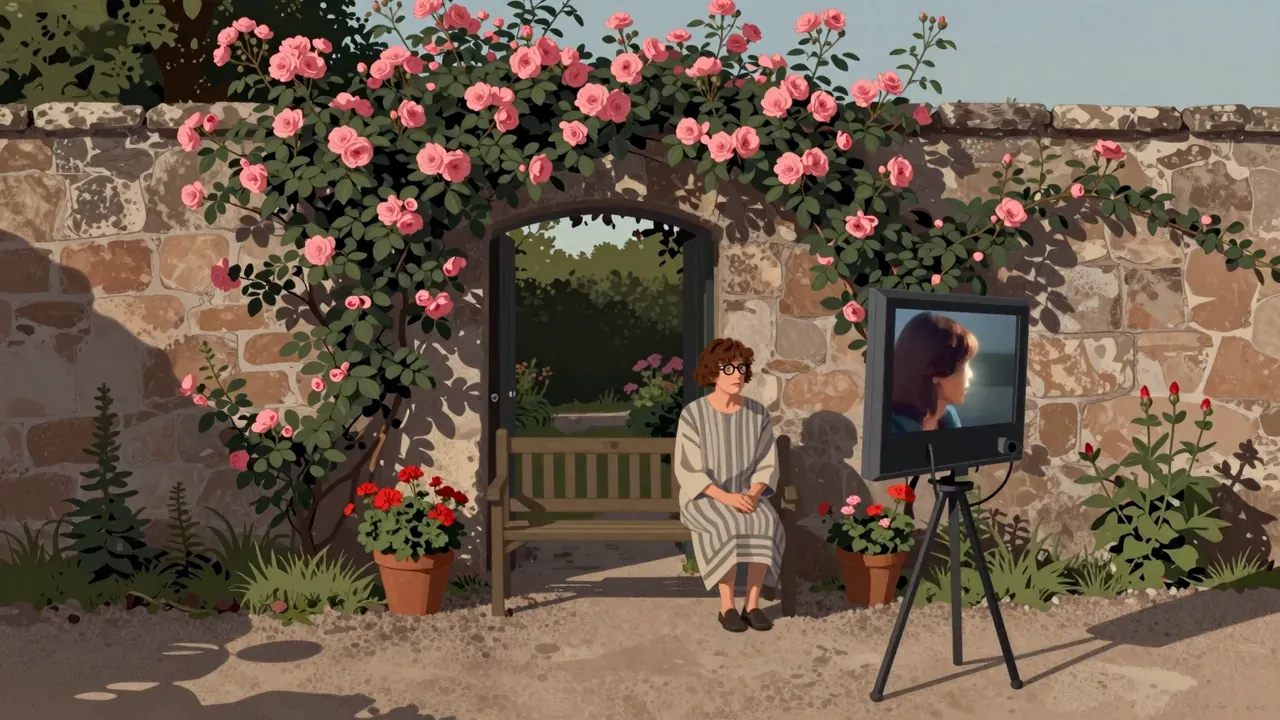
The film works through strict formal economy: static shots, long takes, minimal movement, no cuts mid-interview. Subjects are framed frontally, often posed against shopfronts or doorways, their bodies aligned with architectural lines—echoing the rigidity of early photographic portraiture. Nurith Aviv and William Lubtchansky keep exposure flat and natural, avoiding contrast or shadow play; light falls evenly, as it might from a midday Paris sky filtered through glass. Varda’s direction is invisible but precise: each person answers the same three questions—‘Where did you come from?’, ‘When did you get here?’, ‘Why did you come?’—and those answers are left unedited, unannotated, uncontextualised beyond what the speaker offers. There are no cutaways, no establishing shots beyond the street itself, no subtitles for non-French speakers—the language barrier remains intact, part of the texture. Performances are not performed; they are given, sometimes hesitant, sometimes brisk, always grounded in the physical reality of the space. The editing rhythm is patient, almost stubborn: pauses are kept, silences held, glances lingered on. Nothing is heightened; nothing is concealed. (159 words)
What stays in the frame
What lands is the cumulative weight of specificity—the way a baker’s flour-dusted apron reads as both uniform and relic, how a tailor’s measuring tape loops over his shoulder like a second spine, how an elderly woman’s hesitation before answering ‘Why did you come?’ becomes more legible than any summary could make it. The film’s refusal to interpret gives its subjects autonomy: we do not learn whether someone’s migration was voluntary or forced, whether their shop is thriving or failing—we see the counter, the stock, the hands at work, the light on the pavement outside. That restraint allows minor details to accrue meaning: the way one man adjusts his glasses before speaking, another wipes his brow with the back of his hand, a third folds his arms only after finishing his sentence. These are not gestures selected for symbolism; they are simply there, caught because the camera stayed. The film’s quietness is not passive—it is attentive in a way few documentaries are. It trusts that duration, repetition, and proximity can generate insight without exposition. And it does: the street emerges not as a collection of stories, but as a field of coexistence, where difference is ordinary, not exceptional. (159 words)
What slips between the takes
What does not land is any sense of structural progression or thematic escalation. The film’s evenness—its resistance to hierarchy, emphasis, or variation—can flatten over time. Without shifts in tone, pace, or perspective, some sequences blur: two butchers, three grocers, four hairdressers, each asked the same questions, each filmed in near-identical framing, begin to echo rather than accumulate. There is no editorial hand guiding us toward contrast or contradiction; when differences do appear—between generations, nationalities, or temperaments—they are presented without comment, and so risk feeling incidental rather than illuminating. The absence of context also means certain absences go unremarked: no children under five appear, no visible poverty or distress, no political references, no mention of strikes, housing shortages, or the 1968 protests still recent in memory. This is not evasion—it is method—but it leaves the film vulnerable to charges of aestheticising the everyday without reckoning with its pressures. A viewer expecting critique, irony, or rupture will find none. What is offered is fidelity to surface; what is withheld is interpretation of depth. That choice holds, but it does not persuade everyone. (159 words)
The weight of the title
The themes that matter are classification and proximity: how people are sorted—by origin, occupation, accent, age—and how those categories both hold and fail. The title’s pun on ‘daguerreotype’ points to photography’s early promise of objective record, and to the social impulse to fix identity in type. Varda’s subjects are ‘types’ only in the sense that they occupy roles—baker, tobacconist, widow—that anchor them in the street’s ecology. But the film undermines typology by refusing to let any single answer define a person: a man says he came from Algeria ‘because of work’, then adds, ‘but also because I wanted to see Paris’, then laughs. Another says she arrived ‘in 1947’, then corrects herself: ‘No—1948. I remember the rain.’ These small hesitations and corrections resist neat filing. The film also treats proximity as ethical method: shooting only within ninety metres is not just logistical—it is a vow not to extract, to stay local, to treat the immediate as sufficient. That commitment makes migration, memory, and belonging feel tactile, not abstract. The street is not a metaphor for France; it is a place where France happens, unevenly, quietly, day by day. (159 words)
Who walks past, who stops
This film is for viewers who value attention over exposition, who find resonance in repetition, and who trust that a fixed gaze can yield more than a roving one. It suits those accustomed to slow cinema, to observational documentary, or to the still-life tradition in photography and painting. It is not for viewers who require narrative propulsion, emotional escalation, or clear authorial stance—those who expect documentaries to argue, diagnose, or resolve will find Daguerréotypes withholding. It is also unlikely to engage audiences accustomed to digital pacing, multi-threaded storytelling, or voiceover authority. Someone who values clarity of purpose over ambiguity, or who seeks historical context rather than lived texture, would leave unsatisfied. That is not a flaw in the film but a boundary in its design: it assumes patience as prerequisite, not virtue. Change the frame—add narration, cut the runtime by twenty minutes, insert archival footage—and the film ceases to be what it is. Its worth depends entirely on accepting its terms. (159 words)
The length of the evening
Yes, it is worth your evening—if your evening includes space for stillness, if you are willing to sit with ordinariness without demanding it signify, and if you accept that eighty minutes spent watching people answer three questions may deepen your sense of how lives settle into place. It rewards no effort beyond presence: no prior knowledge, no decoding, no emotional labour beyond noticing. But it asks for that much—and for some, that is too much. Those who associate documentary with revelation, urgency, or reform will find it inert. Those who associate cinema with movement, transformation, or climax will find it static. Its value lies precisely in its refusal to perform. It does not try to move you; it waits for you to move closer. That is its modest, unwavering offer. To reject it is reasonable; to accept it is to grant time to what is usually passed by. That exchange—time for attention—is rare, and it holds. (159 words)