The subject of it
Memories of Underdevelopment is a Cuban drama film from 1968 that attempts to render the interior life of a man suspended between political rupture and personal inertia. It does not seek to explain the Revolution, nor to endorse or condemn it, but to hold in focus the contradictions of an educated, bourgeois consciousness trying — and failing — to reconcile itself with historical change. The film adapts Edmundo Desnoes’s novel with deliberate structural looseness: its narration is subjective, its chronology porous, its tone neither polemical nor nostalgic. It uses documentary footage not as illustration but as counterpoint — real crowds and speeches heard over Sergio’s voice, which remains detached, ironic, often self-mocking. Its ambition is formal and philosophical at once: to make alienation legible as both psychological condition and social symptom, without reducing either to slogan or sentiment. It treats ideology not as doctrine but as atmosphere — thick, unspoken, inescapable.
The structure of it
The film works through a tightly controlled disjunction between voice and image, thought and action. Sergio Corrieri plays Sergio Carmona Mendoyo with a stillness that reads less as passivity than as withheld engagement; his performance avoids theatricality, relying instead on timing, posture, and the slight drag in his speech to suggest a man ten years older than his own age. Ramón F. Suárez’s cinematography keeps Havana’s light flat and grainy, favouring medium shots and shallow focus that isolate Sergio within frames crowded with detail — posters, radios, passing cars, half-finished conversations. Leo Brouwer’s score is sparse, often absent, letting street noise and silence carry weight. Editing by Nelson Rodríguez Zurbarán fractures time without confusion: flashbacks arrive without warning, documentary cuts feel abrupt but never arbitrary. The use of non-professional actors — particularly Ofelia González as Hanna — introduces a quiet unevenness that suits the film’s refusal of polished realism. Real intellectuals appear as themselves, grounding abstraction in lived presence.
The look of it
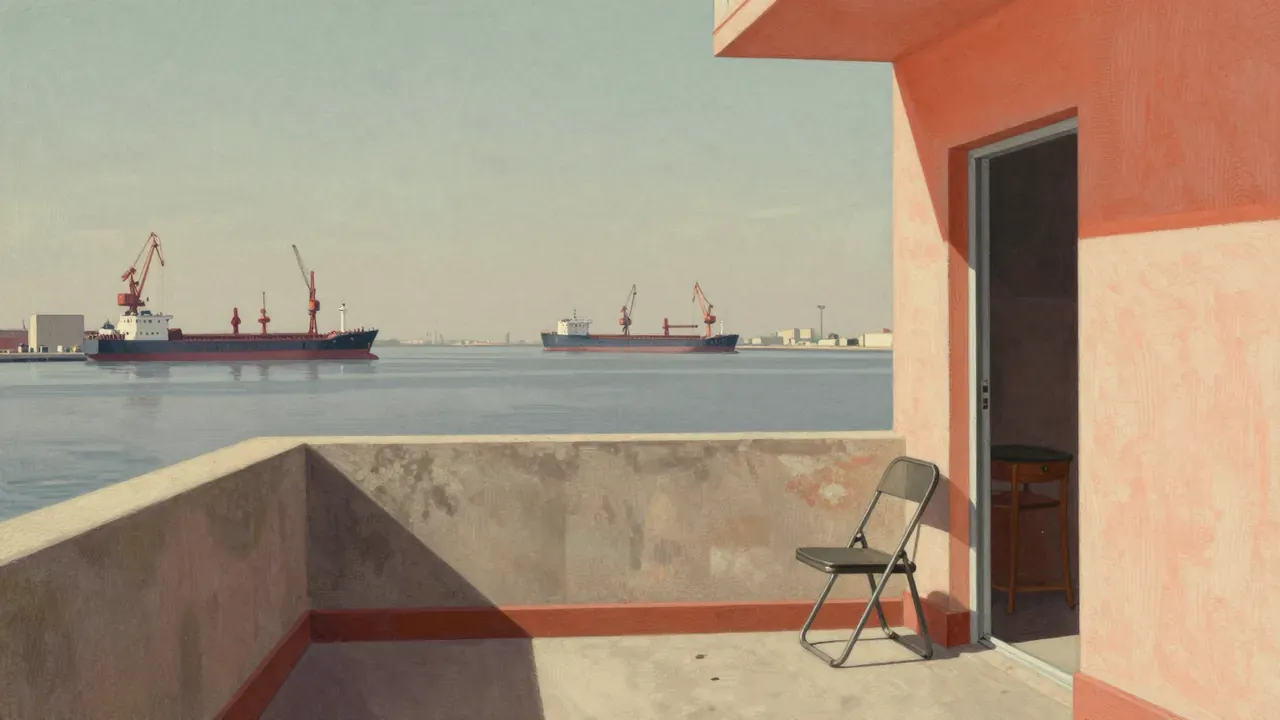
What lands is the cumulative pressure of Sergio’s unreconciled position: his intelligence, his irony, his privilege, his boredom, his fear — all held in suspension without resolution. The film’s most persuasive moments are those where politics enters obliquely — a radio bulletin cutting across a love scene, a child’s question about missiles met with evasion, the way Sergio’s apartment overlooks Havana harbour but never quite connects him to it. The documentary inserts do not lecture; they register as interruptions Sergio cannot fully absorb, making his detachment palpable rather than abstract. Daisy Granados’ Elena feels vivid not because she is developed, but because her youth and directness expose Sergio’s evasiveness. The FOCSA Building penthouse — all glass and concrete — becomes a physical metaphor for his vantage: elevated, exposed, insulated. The film’s restraint — its refusal to moralise or dramatise crisis — gives its portrait of paralysis unusual authority.
The sound of it
What does not land is the framing of Hanna, whose role was reduced due to the actress’s inexperience. Her absence leaves a structural gap: Sergio’s longing for her is cited but never embodied with enough texture to anchor his sense of loss. The film gestures toward romantic yearning as another form of ideological displacement, but the thread remains thin. Likewise, some supporting characters — Pablo, Noemi — function more as narrative pivots than people; their motivations blur into exposition. The film’s commitment to subjectivity occasionally tips into opacity: a sequence may feel less like memory and more like omission, especially for viewers unfamiliar with the Cuban context of 1962–64. The political references assume a baseline knowledge — not of doctrine, but of rhythm, of what was being debated, feared, celebrated — that the film does not supply. This is not a flaw in intent, but a limit in reach.
The idea of it
The themes that matter are alienation as class habit, memory as evasion, and underdevelopment as a condition of perception as much as economy. The film treats ‘underdevelopment’ not as a stage to be overcome but as a lens — one that distorts time, flattens urgency, and turns history into background noise. Sergio’s irony is not wit but insulation; his reading is not engagement but deflection. The film links personal inertia to structural privilege: his ability to wait, to observe, to narrate rather than act, depends on material security untouched by the shortages others face. It also examines how revolution reshapes intimacy — not just who you love, but how you speak to them, how you listen, whether you trust your own reactions. The missile crisis looms not as plot device but as temporal rupture: the moment when abstraction (‘nuclear war’) threatens to cancel all other abstractions (‘bourgeois doubt’, ‘intellectual freedom’). These are not ideas illustrated, but conditions enacted.
The pace of it
This film is for viewers who value precision of tone over narrative propulsion, who find resonance in ambiguity, and who are willing to sit with a protagonist whose intelligence does not redeem his inertia. It rewards attention to silence, to framing, to the weight of an unanswered question. It is not for those who require clear moral alignment, linear cause-and-effect, or emotional catharsis. Some will find Sergio insufferable, not complex — a charge Gutiérrez Alea anticipated and built into the film’s design. Others may struggle with its pacing, its refusal to translate Cuban specificity into universal shorthand. A viewer who needs historical context spelled out, or who expects political cinema to offer solutions rather than diagnoses, will leave frustrated. That is not a failure of the film, but a mismatch of expectation.
The weight of it
Yes, it is worth your evening — provided you approach it as a work of sustained, unsentimental observation rather than entertainment. Its ninety-seven minutes unfold with unhurried gravity, each scene calibrated to deepen rather than resolve Sergio’s predicament. It repays rewatching not because it hides clues, but because its textures — the quality of light on a wall, the cadence of a voiceover, the placement of a documentary cut — reveal new layers on second glance. Those who dislike films that withhold judgement or resist closure may find it exhausting. But for anyone interested in how cinema can hold contradiction without simplifying it — how a single consciousness can be both perceptive and paralysed, critical and complicit — this remains indispensable. Its power lies not in what it says, but in how thoroughly it inhabits the space between saying and doing.