The shape of wanting
Gregory’s Girl is a low-budget Scottish romantic comedy set in a Cumbernauld secondary school, aiming to portray adolescent uncertainty without caricature or condescension. It follows Gregory Underwood, a teenage footballer displaced from centre forward by Dorothy — a girl who joins the team and becomes the object of his shy, misdirected attention. Bill Forsyth writes and directs with deliberate lightness: no grand stakes, no moral pivot, no climactic confession. Instead, the film treats first attraction as a series of small, reversible missteps — asking someone out, misreading signals, being passed between friends like a relay baton. It avoids the schematic plotting of American teen films of the era, opting for episodic observation over narrative propulsion. The tone is dry but not detached; affectionate but never sentimental. Its ambition lies in fidelity — to how teenagers speak (not how screenwriters imagine they should), how they move in ill-fitting clothes, how they defer to older siblings or mimic adult gestures without understanding them. It is a film about waiting, misunderstanding, and the quiet relief of being liked back — not as triumph, but as ordinary, unremarkable grace.
The look of it
The story unfolds through modest, interlocking episodes: trials for the school team, awkward conversations in chip shops, walks through suburban parks, and the persistent, unexplained presence of a man in a penguin suit. John Gordon Sinclair plays Gregory with physical precision — hesitant posture, delayed reactions, eyes darting away mid-sentence — while Dee Hepburn’s Dorothy remains gently opaque, her motivations unstated and her agency intact. Clare Grogan, as Carol, delivers a performance that balances mischief and warmth without tipping into archetype. Michael Coulter’s cinematography keeps compositions loose and grounded: hand-held shots during football drills, static frames in school corridors, natural light bleaching the grey brick of Abronhill High. Colin Tully’s score is spare — piano motifs repeated with slight variation, like thoughts circling the same question. Forsyth’s script gives space to minor characters: Gregory’s ten-year-old sister Madeleine speaks with unnerving clarity, not precocity; his friends Andy and Charlie fail at hitch-hiking to Caracas not for laughs, but because the idea itself is both absurd and perfectly plausible in their world.
The rhythm of it
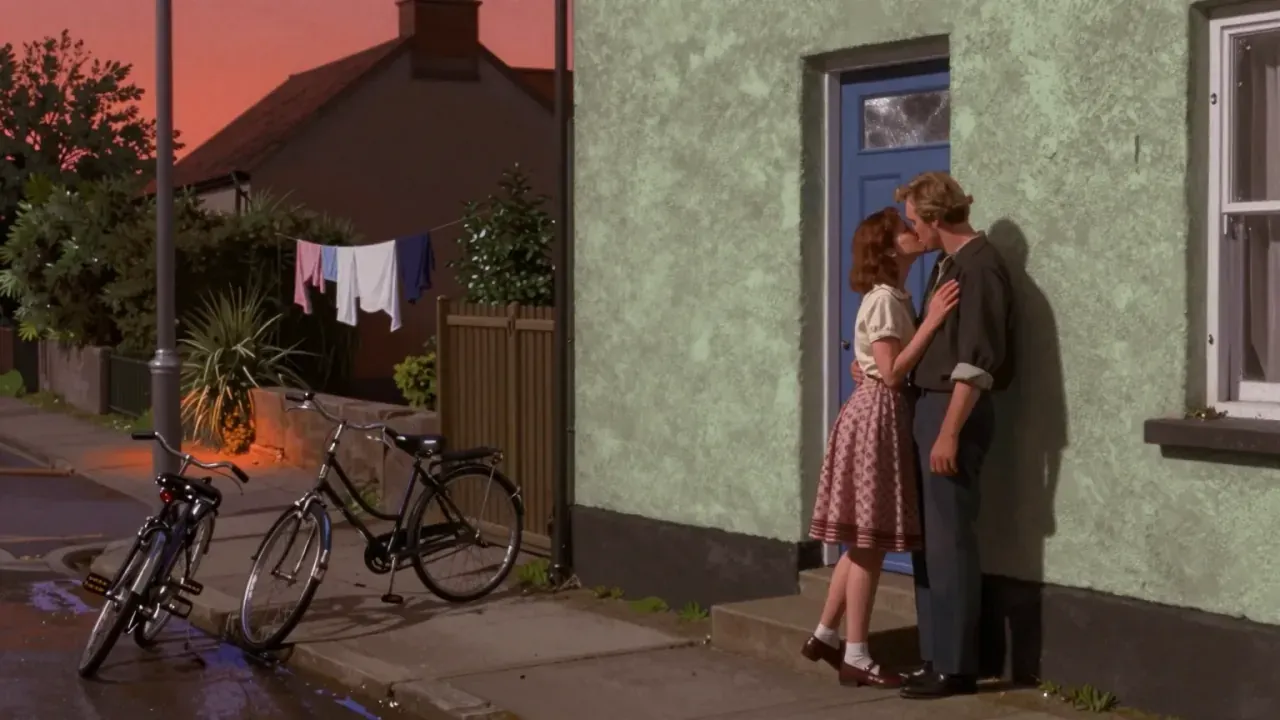
What lands is the film’s refusal to resolve adolescence into either farce or trauma. Gregory’s disappointment when Dorothy stands him up is real, but it does not curdle into bitterness; his confusion when handed from one girl to another feels true because it is never mocked. The sequence where he walks with Susan — two teenagers talking plainly about nothing much, then kissing repeatedly on a doorstep — carries weight precisely because it is unceremonious. The film trusts its audience to register significance in pauses, in glances held half a beat too long, in the way Dorothy tucks her hair behind her ear before passing Gregory the ball. Even the penguin — an absurdist non-sequitur — works because it exists outside explanation: a reminder that life contains nonsense, and that nonsense need not mean anything. The ensemble cast, many drawn from Glasgow Youth Theatre, moves with the unselfconscious rhythm of people who have not yet learned to perform themselves for cameras. Their line deliveries are flat, sometimes mumbled, always credible — a contrast to the polished cadences of most 1980s British comedies.
The silence in it
What does not land is the film’s structural looseness when viewed as conventional narrative. There is no third-act reversal, no confrontation, no earned revelation — just a gradual softening of Gregory’s expectations and a quiet shift in his attachments. Some viewers may find the pacing slack, particularly in the middle stretch where football practice and school corridors repeat without obvious escalation. The subplot involving Andy and Charlie’s abortive attempt to reach Caracas functions more as tonal punctuation than thematic reinforcement, and its logic — that women outnumber men there — is left hanging, unexamined. The re-dubbed American version, with flattened accents, confirms how much the film relies on the texture of Scottish speech: vowels stretched, sentences trailing off, humour buried in understatement. Without that grain, some of the social nuance dissolves. And while the film avoids mean-spiritedness, it also sidesteps deeper questions of class or gender expectation — not out of ignorance, but by design: it chooses narrow focus over broad commentary, and that choice will frustrate those seeking sociological heft.
The weight of it
The themes that matter are not announced but accumulated: the asymmetry of attention in early attraction, the way friendship networks mediate romance rather than enable it, and the quiet authority of younger voices — Madeleine’s advice is more useful than Steve’s, though neither is fully right. The film treats adolescence not as a phase to be endured but as a condition of perpetual recalibration: Gregory changes positions on the pitch, shifts emotional allegiance, adjusts his idea of what ‘dating’ means — all without fanfare. Football serves as literal and metaphorical structure: rules are known, roles are assigned, but play is improvised. The school setting is neither oppressive nor idyllic — it is simply the air Gregory breathes. There is no nostalgia for this world, nor condemnation of it; Forsyth films it with the same neutral curiosity he might apply to a weather system. The film’s central insight is that vulnerability is not a state to be overcome, but a baseline — and that learning to hold it lightly, without irony or shame, is the closest thing to maturity it offers.
The pace of it
This film is for viewers who value behavioural accuracy over plot momentum, who find pleasure in the rhythm of unremarkable days, and who do not require characters to articulate their feelings aloud to understand them. It suits adults who remember the weight of small embarrassments, and teenagers who recognise the exhaustion of performing competence. It is not for those who expect romantic leads to declare love, villains to obstruct, or endings to settle meaning. Fans of John Hughes or Richard Linklater may find it too muted; admirers of Mike Leigh or Andrea Arnold may find it too gentle. Its pace assumes patience; its humour assumes familiarity with Scottish reserve. Those who dislike films where characters walk without destination, talk without resolution, or kiss without orchestral swells will leave unmoved. A viewer who values tight plotting, clear motivation, or thematic exposition would reasonably reject it — but that rejection would stem from mismatched expectations, not failure of execution.
The time of it
Yes, it is worth your evening — provided you watch it without demand. At 91 minutes, it occupies less time than a commute, and repays attention with cumulative quietness rather than immediate impact. It does not dazzle, provoke or unsettle; it settles. Its value lies in its consistency of tone, its refusal to flatter its characters or its audience, and its precise calibration of embarrassment and hope. You could watch it twice in the time it takes to scroll through half a streaming queue — and feel, after the second viewing, that you had noticed something new in the way Gregory ties his shoelaces, or how Dorothy’s shorts ride up slightly when she runs. It is not urgent, but it is durable. Those who dismiss it as slight have mistaken restraint for emptiness. Those who embrace it discover how much can be said in silence, how much character lives in hesitation, and how rare it is for a film to treat growing up as neither tragedy nor punchline, but as ordinary, tender, ongoing work.