The look of it
Hôtel Monterey is a silent, non-narrative documentary feature that observes the architecture and inhabited spaces of a single New York hotel over sixty-five minutes. It does not seek to explain, interpret or humanise the building; instead, it treats the hotel as a sequence of formal propositions — about framing, duration, light, repetition and spatial logic. Chantal Akerman, then twenty-one, approaches the site with the rigour of an architectural surveyor and the patience of a phenomenologist: each shot is held long enough for perception to shift, for habit to dissolve and for the eye to register texture, shadow, reflection and decay. There is no voiceover, no text, no music, no cutaways to context. The film’s ambition is structural: to make time visible through stillness, and space legible through sustained attention. It asks the viewer to recalibrate their relationship to duration, to accept observation as action, and to find meaning in accumulation rather than progression. This is not cinema as storytelling but as embodied measurement — of height, width, depth, silence, and the weight of unoccupied rooms.
How it moves
The film works through fixed camera positions, each held for between thirty seconds and several minutes, capturing corridors, stairwells, elevators, bedrooms, bathrooms and rooftop views from the Hotel Monterey at 215 West 94th Street. Babette Mangolte’s cinematography is precise and unadorned: natural light dominates, often low and directional, casting long shadows across worn carpet and cracked plaster. No person speaks; only one or two figures appear briefly, always at a distance, never addressed or identified. There are no performances in the conventional sense — no actors, no script delivery, no emotional arc — only the incidental presence of residents and staff moving within frames they do not acknowledge. Editing is minimal and rhythmic: cuts occur only when the camera repositions, usually to a new floor or axis, creating a slow, vertical and horizontal cartography. The absence of sound is absolute and deliberate; what remains is the physicality of the image — grain, focus drift, dust motes, the slight tremor of a tripod on an old floor. Every decision serves the film’s central method: to let space speak through duration, not dialogue.
What stays with you
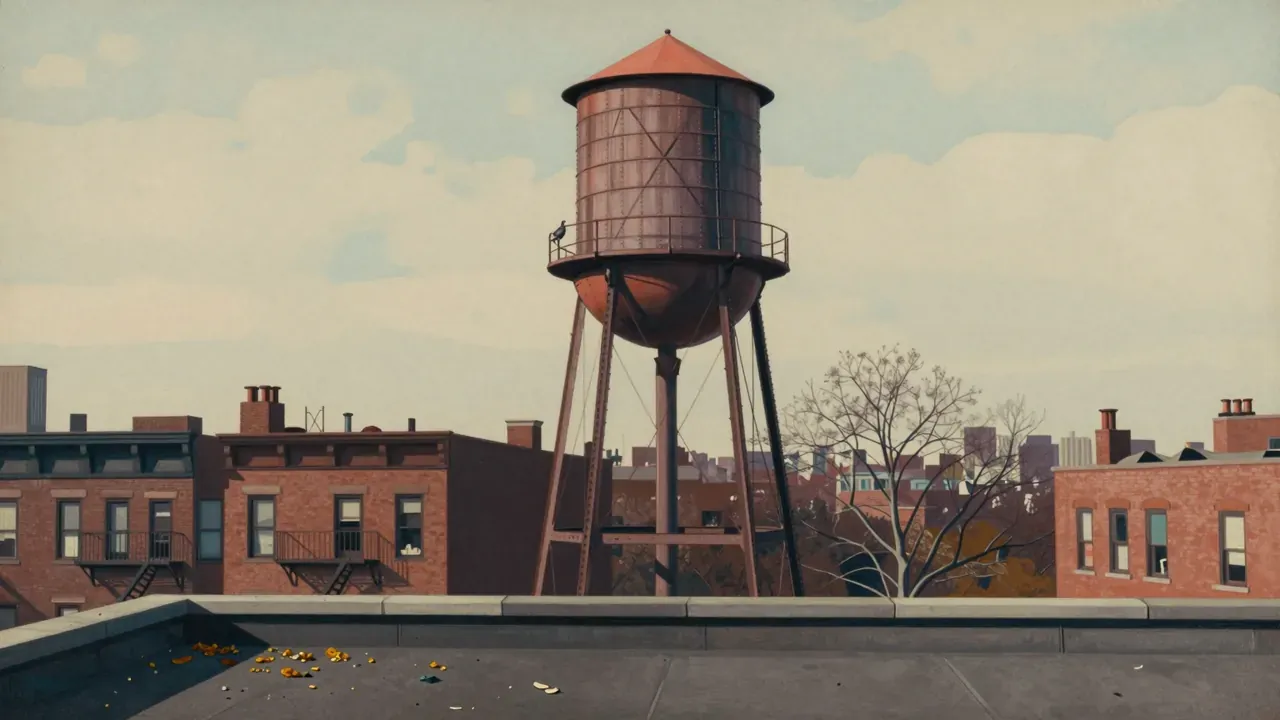
What lands is the cumulative effect of sustained attention — how a corridor becomes uncanny after ninety seconds, how a water tower against sky acquires gravitas through repetition, how the emptiness of a room feels charged once you’ve watched it long enough to notice the way light creeps across its floor. The film succeeds in making the ordinary monumental, not through embellishment but by withholding interpretation. Its austerity compels a different kind of watching: less scanning, more settling; less waiting for something to happen, more noticing what is already there. The rhythm of the cuts — never abrupt, never justified — begins to feel like breathing: inhale (hold), exhale (reposition), inhale again. Even viewers unfamiliar with structural film recognise the integrity of this approach. The hotel’s layered history — built in 1914, renamed in 1916, later rebranded as Days Hotel — is never named, yet its material traces are legible: brass fixtures dulled by decades, fire escapes bolted to brick, wallpaper peeling at the seams. That quiet historical resonance lands without exposition. The film’s power lies in its refusal to translate experience into meaning — it lets meaning emerge from the act of looking itself.
What slips away
What does not land is any sense of narrative momentum or psychological revelation. Viewers expecting insight into the lives of residents, or even into Akerman’s own biography, will find none. There is no character study, no social critique articulated, no political subtext made explicit — though some may read class or urban neglect into the building’s condition, the film offers no support for such readings. The silence, while formally coherent, can feel impenetrable on first viewing, especially without context about structural film’s conventions. Those accustomed to expository documentary may mistake the absence of voiceover for absence of intention. Likewise, the lack of variation in pacing — no acceleration, no release, no contrast in tempo — risks monotony if approached as entertainment rather than as a durational proposition. The film does not accommodate distraction; it demands continuity of attention, and those unable or unwilling to grant it will find the experience inert rather than immersive. Its rigour is also its limit: it refuses to meet the viewer halfway.
What it thinks about
The themes that matter are endurance, anonymity, architecture as memory, and the politics of observation. The hotel is not a setting but a subject — a palimpsest of use and abandonment, of public function and private retreat. Its basement corridors suggest containment; its upper-floor rooms, isolation; its rooftop, precarious vantage. These are not metaphors imposed by editing or commentary but spatial facts revealed by duration. The film quietly interrogates how buildings shape behaviour — how doorways direct movement, how ceilings compress or liberate, how light defines hierarchy within a space. There is also a theme of transience: the hotel hosts people who pass through, leave traces, vanish — yet the structure persists, altered but intact. Akerman does not moralise this, but the contrast between human impermanence and architectural persistence is palpable. Silence here is not emptiness but density — of unspoken histories, unrecorded conversations, unphotographed moments. The film’s form enacts a kind of ethical restraint: it watches without judging, records without claiming authority over what it sees.
Who it’s for
This film is for viewers who value precision of form over exposition, who find interest in the grammar of looking, and who are willing to sit with stillness as a mode of engagement. It suits those familiar with structural film, minimalist art, or architectural photography — or those open to learning its language. It is not for viewers who rely on narrative scaffolding, emotional cues or informational payoff to sustain attention. Anyone seeking context about 1970s New York, hotel labour, or Akerman’s biography will be disappointed — the film gives none. Those who associate documentary with advocacy, testimony or explanation will likely reject it as withholding or inert. A change in verdict would require the film to offer either greater formal variation — say, shifts in focal length or perspective — or a subtle sonic layer, such as ambient recording, which might anchor perception differently. As it stands, its rigour is absolute, and its audience necessarily narrow — but not exclusionary, only exacting.
What it asks of you
Yes, it is worth your evening — but only if you arrive prepared to watch, not consume. Sixty-five minutes is long for silence and stasis, yet the film repays attention with increasing returns: textures sharpen, rhythms clarify, spatial relationships deepen. It is not relaxing, nor is it demanding in the conventional sense; it asks for presence, not effort. Those who dismiss it as ‘just a hotel’ miss how thoroughly it reorients perception — how a doorframe becomes a threshold of thought, how a ceiling fan’s shadow becomes a clock. Others will find it arid, especially without prior exposure to Akerman’s work or to the structural tradition. The verdict rests on whether you accept that cinema can be a discipline of attention rather than a vehicle for story. If you do, Hôtel Monterey holds up — not as a relic, but as a calibration tool for how we see the world. It remains urgent because attention, like architecture, is eroded by haste and assumption.