The sound of distance
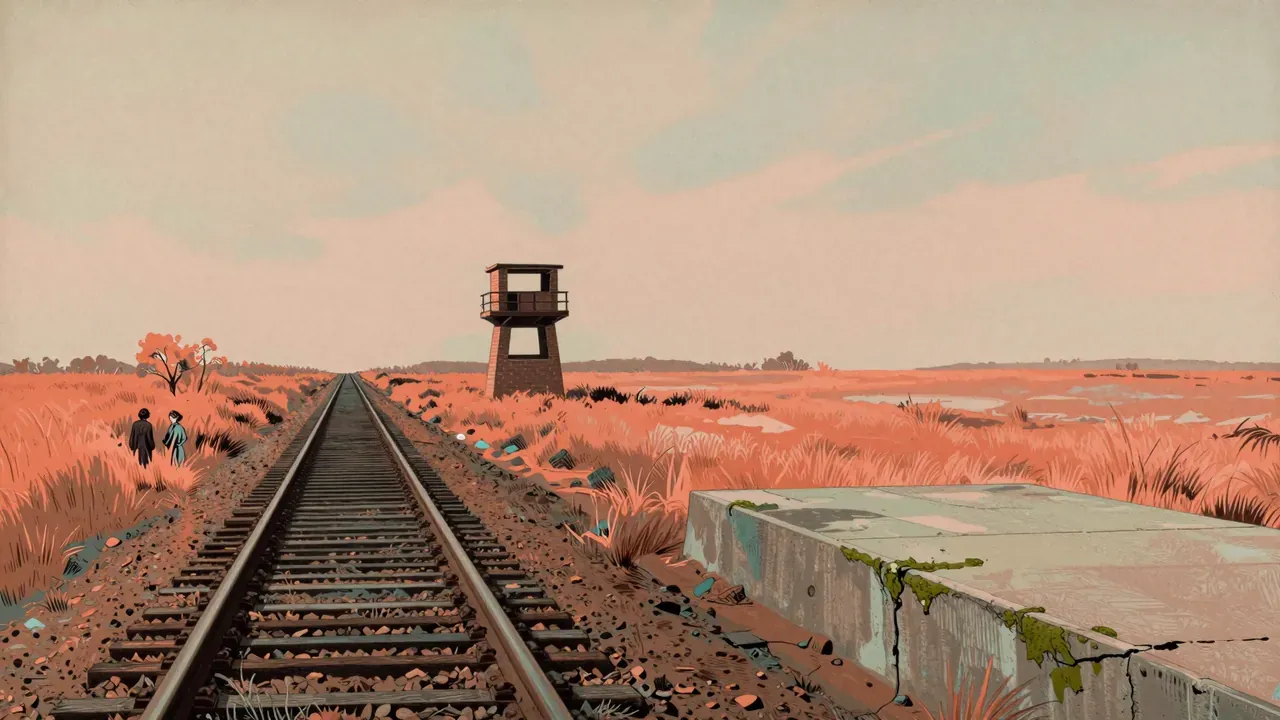
News from Home is a documentary film that holds stillness as its central proposition. It does not seek to explain New York, nor to narrate Akerman’s time there, but to place the viewer in the physical and emotional space of distance — between a daughter in exile and her mother writing from home. The film’s aim is not exposition but resonance: it uses the material reality of the city — its subway platforms, ferry decks, street corners — as a counterpoint to the intimate, unanswerable language of private letters. There is no argument being made, no thesis advanced; instead, the film constructs a slow, durational field where geography and feeling coexist without mediation. It treats the city not as a character or symbol, but as a surface against which memory and longing settle. The voice-over is not commentary but presence — a reading, not an interpretation. This is not a film about New York in 1976, nor about Belgium in 1971–73, but about the silence that opens between two places when one person leaves and another stays. Its method is subtraction: no interviews, no music, no narration beyond the letters, no attempt to bridge the gap it names.
The look of it
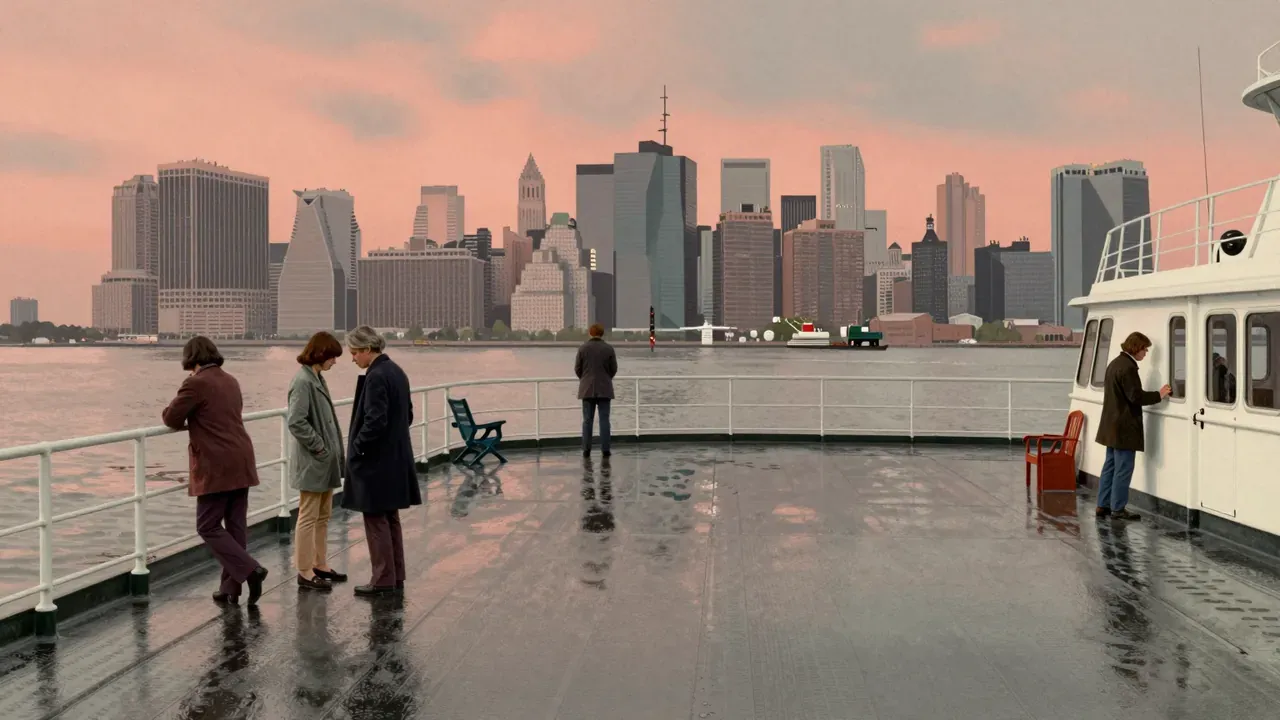
The film works through strict formal alignment: Babette Mangolte’s cinematography fixes on static or gliding long takes — the Times Square subway platform, the Staten Island Ferry deck, the slow drive up Tenth Avenue — each shot held until its weight settles. Chantal Akerman reads her mother’s letters in French, her voice flat, unhurried, neither mournful nor detached, but matter-of-fact — the tone of someone rehearsing a ritual. Francine Sandberg’s editing sustains this rhythm: cuts are rare, timed to shifts in location or light, never to emotion or emphasis. There is no performance in the conventional sense; Akerman appears only as a voice, and the city appears only as image — no faces are identified, no passers-by addressed. Sound was added in post-production, meaning the ambient noise — train rumbles, distant sirens, wind — is layered deliberately, not captured live. This separation reinforces the film’s structure: image and voice exist in parallel, not in dialogue. The craft is austere by design: no lighting adjustments, no camera movement beyond what the vehicle or tripod permits, no score, no text on screen. Every decision serves the film’s refusal to translate feeling into explanation.
What stays with you
What lands is the cumulative pressure of duration. After several minutes watching the same subway platform — people passing, trains arriving, light shifting on tile — the city stops being scenery and becomes atmosphere: a texture of waiting, transit, anonymity. The letters, read aloud with quiet regularity, gain weight not from their content — they describe minor domestic events, weather, health updates — but from their repetition across time and space. Their banality becomes the point: this is how love persists across distance, not in grand declarations but in the daily accounting of ordinary life. The pairing of mundane words and monumental images creates a quiet dissonance that lingers. The film’s restraint allows the viewer to project, not because it invites identification, but because it refuses to prescribe it. You do not need to have lived in New York or written home from abroad to feel the ache of the unsaid — the film makes that ache visible through patience, not persuasion. It lands not as revelation but as recognition, slow and low.
What slips away
What does not land is any expectation of narrative progression or emotional resolution. There is no arc, no climax, no release — only accumulation and return. Viewers accustomed to documentary conventions — interviews, voice-of-God narration, contextual titles, chronological framing — will find nothing to anchor them. The film offers no biographical scaffolding beyond what the letters imply; it assumes the viewer will sit with ambiguity rather than seek clarification. Some may read the stillness as emptiness, the repetition as monotony, the lack of commentary as evasion. Others may find the voice-over too detached, the images too passive, the absence of human interaction too stark. The film does not accommodate impatience. It does not soften its terms: if you require explanation, motivation, or closure, it will not supply them. Its refusal to interpret the letters — to say what they mean, or what Akerman felt reading them — is deliberate, but it is also a barrier for those who expect the film to do the work of meaning-making on their behalf.
What it’s really about
The themes that matter are distance, memory, and the labour of correspondence. Not the romance of letters, but their physical and emotional weight: the time they take to write, post, cross borders, arrive; the gaps between them; the way small details accrue significance when separated by miles and months. The film treats alienation not as pathology but as condition — the natural state of being elsewhere, of living in two places at once. It also engages with urban solitude: not loneliness, but the quiet coexistence of strangers in shared infrastructure — subways, ferries, streets — where proximity does not imply connection. Class is present but unspoken: Akerman’s ‘vagabond’ existence in New York contrasts with her mother’s rooted domesticity, yet neither is judged or explained. Time itself is a theme: the letters span two years, the images were shot in summer 1976, the voice-over is recorded later still — the film exists in a layered temporality, where past, present and recording moment overlap without hierarchy. There is no nostalgia here, only persistence.
Who it’s for
This film is for viewers who trust duration as a mode of understanding, who accept that some feelings resist paraphrase and some distances cannot be bridged on screen. It suits those familiar with structuralist or essay-film traditions, or those willing to meet a work on its own formal terms. It is not for viewers who require narrative propulsion, psychological exposition, or visual variety — those who rely on editing rhythms, musical cues or spoken analysis to orient themselves will likely feel adrift. It is also not for those seeking historical documentation of 1970s New York: the city is rendered atmospherically, not topographically. A viewer expecting social critique, political context or even personal confession will leave unrewarded. That said, the film’s austerity is not exclusionary by accident — it is the point. To ask it to open up would be to contradict its central gesture: the maintenance of a boundary, both geographical and emotional, that cannot and should not be crossed.
Is it worth your evening
Yes, it is worth your evening — provided you set aside the expectation of entertainment or explanation. Ninety minutes spent with News from Home is ninety minutes spent inside a precise, sustained attention: to light on pavement, to the cadence of a mother’s handwriting translated into speech, to the way a city breathes when no one is directing its motion. It rewards slowness, not insight; endurance, not epiphany. Those who find value in films that ask more than they answer, that hold space rather than fill it, will find it resonant. Those who watch to be told, moved, or instructed will not. Nothing in the film changes if you bring different expectations — it remains fixed, like the subway platform at 3 a.m. But your experience of it depends entirely on whether you arrive willing to stand still, to listen without translating, to let the distance remain.