The look of it
Here Comes Mr. Jordan is a studio-era fantasy comedy built on a single, cleanly articulated conceit: a boxer dies too soon, is denied his rightful life by celestial bureaucracy, and must re-enter the world in another man’s body. It does not aim for theological rigour or metaphysical speculation; it treats Heaven as a clerical department — with filing cabinets, interoffice memos, and mid-level angels who misread dials — and uses that premise to stage a tightly wound farce about identity, agency, and moral restitution. The film adapts Harry Segall’s 1938 play Heaven Can Wait, but strips away its more sentimental or philosophical overtones in favour of brisk narrative propulsion and character-driven wit. Its ambition is structural and tonal: to sustain disbelief without solemnity, to make ethical choices feel consequential without sermonising, and to land every reversal with the precision of a well-timed punchline. It assumes no prior knowledge of angelology or boxing lore, only that the audience will accept a world where soul-transfer is bureaucratically administered and morally legible.
The weight of it
The story moves with unbroken momentum: Joe Pendleton’s death, his protest in the afterlife, the reluctant body-swap, the slow recalibration of his new life, and the final, physically seamless transfer into the boxer Murdock. Robert Montgomery plays Joe with grounded physicality — his posture shifts subtly between incarnations, his voice tightens when he’s improvising, and his saxophone playing (deliberately clumsy) becomes a quiet through-line of authenticity. Claude Rains’ Mr. Jordan is dryly authoritative, never whimsical, his authority resting in cadence and stillness rather than flourish. Evelyn Keyes gives Bette Logan quiet resolve, not just romantic foil. Joseph Walker’s cinematography avoids expressionist shadows or heavenly glow; instead, he keeps interiors evenly lit, even in the celestial scenes, treating Heaven as an office building with better acoustics. Viola Lawrence’s editing sustains rhythm without flash — cuts land on reaction shots, not spectacle. The script’s dialogue is dense but uncluttered, each line serving exposition, character, or irony in turn.
The heart of it
What lands most securely is the film’s central paradox: that moral clarity can coexist with narrative absurdity. Joe’s decision to inhabit Bruce Farnsworth’s body is not a compromise but a pivot — he chooses justice over continuity, using wealth not for comfort but restitution. That choice gains weight because the film refuses to caricature either Farnsworth’s corruption or the victims’ vulnerability. The scene where Joe, as Farnsworth, quietly restores Bette’s father’s reputation is played without fanfare, yet carries real emotional gravity. Similarly, the climax — Joe slipping into Murdock’s body mid-fight — works because the film has spent no time explaining how soul-transfer functions, only what it costs and what it permits. The supporting cast lands precisely: Edward Everett Horton’s fussy officiousness, James Gleason’s loyal, bewildered Corkle, and Rita Johnson’s sharp-edged Julia all occupy distinct tonal spaces without spilling into caricature. Even the murder plot feels functional, not sensational — a necessary engine, not a detour.
The cost of it
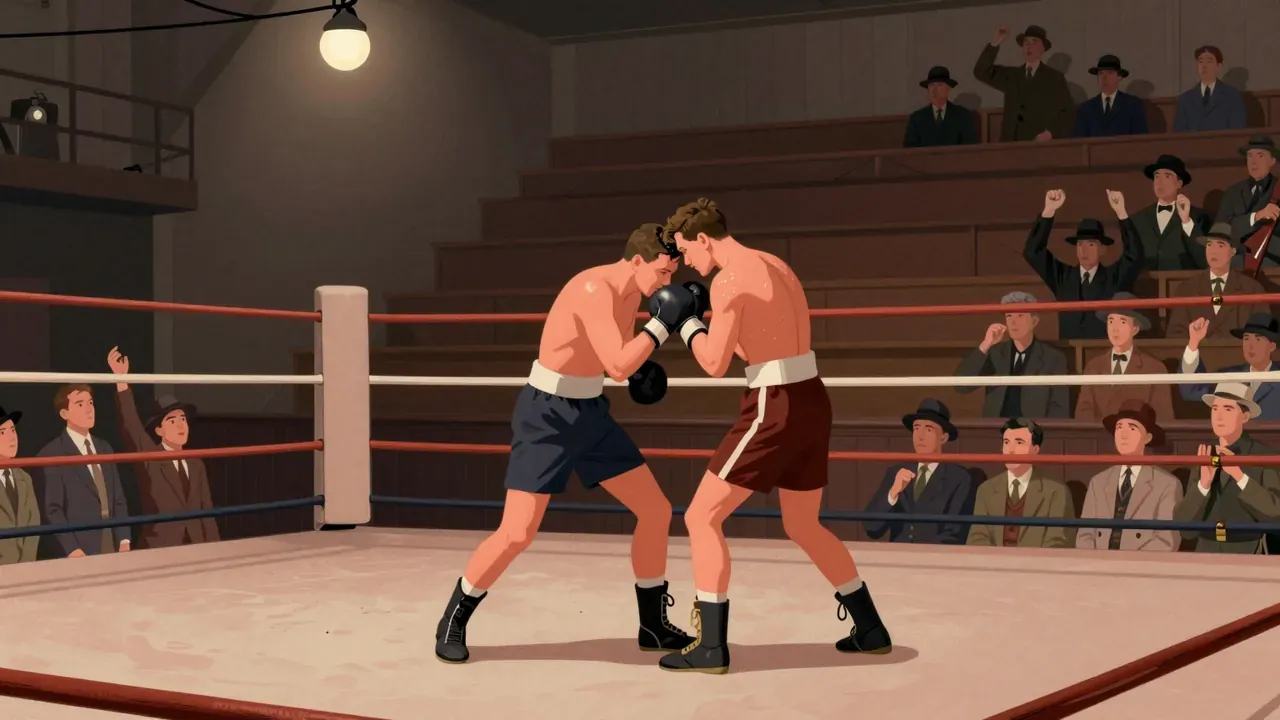
What does not land is the film’s attempt to soften its own logic at the very end. Once Joe becomes Murdock, the film erases his memory — a narrative convenience disguised as mercy — and replaces it with a vague, smiling reunion that leans on chemistry rather than consequence. This undercuts the earlier insistence that identity is durable, that choices matter across bodies. The final beat feels like a concession to genre expectations: the romance must conclude, the champion must be crowned, the angel must exit with a quip. There is no reckoning with what it means to live inside someone else’s life, only a tidy handover. The boxing match itself, though narratively decisive, lacks visceral texture — no sweat, no fatigue, no sense of physical risk beyond the gunshot wound already healed. The film’s lightness begins to read as evasion in its last ten minutes, trading moral complexity for charm. A viewer attuned to the stakes set up in the first act may find the resolution emotionally thin, even if technically polished.
The idea of it
The themes that matter are bureaucratic fallibility, embodied ethics, and the quiet violence of financial predation. The film treats Heaven not as a realm of judgment but of administration — mistakes happen, records get misfiled, and redress is procedural, not divine. That framing makes mortality feel less like fate and more like systemic error. Joe’s moral arc is not about becoming good, but about exercising agency within compromised conditions: he cannot return to his old life, so he reshapes a new one around restitution. His use of Farnsworth’s money is never indulgent; it is forensic, targeted, restorative. The film also treats class not as backdrop but as mechanism — Julia and Tony kill Farnsworth not out of passion but calculation, and their crime is enabled by the same financial opacity that ruined Bette’s father. Boxing here is not metaphor but vocation: Joe’s skill is literal, his discipline tangible, his ambition unromanticised. The film’s enduring seriousness lies in how it ties spiritual error to material harm, and redemption to concrete repair.
The audience for it
This film is for viewers who value tightly constructed studio comedies where every line serves plot or character, who respond to understated performances over flamboyant ones, and who do not require visual spectacle to feel narrative satisfaction. It rewards attention to timing, to the weight of a pause, to how a glance shifts meaning across a room. It is not for those who need psychological realism in fantasy premises, or who find mid-century pacing sluggish — there are no montages, no jump cuts, no musical numbers to break the rhythm. It will frustrate anyone expecting thematic ambiguity or moral grey areas: the film draws clear lines between right and wrong, and expects the audience to follow them. Those who dislike period-specific idioms — the clipped diction, the formal address, the absence of modern irony — may find its tone remote. But its craftsmanship remains legible: this is not nostalgia bait, but a working model of how to build a comic fable that holds its shape across eighty minutes.
The time for it
Yes, it is worth your evening — not as a relic, but as a demonstration of how much can be achieved with economy, clarity, and restraint. Its ninety-one minutes pass without slack, its stakes remain human-scale, and its emotional payoffs are earned, not imposed. It asks little of the viewer beyond willingness to accept its rules, then repays that trust with consistency and wit. Someone who values contemporary pacing or naturalistic acting may find it distant, but that distance is a feature, not a flaw — it reflects the film’s deliberate, architectural approach to storytelling. A viewer who dismisses it as ‘old-fashioned’ would likely also reject the formal discipline of a Haydn quartet or a Le Corbusier floor plan: the objection lies not in the work, but in the terms of engagement. To watch it is to witness Hollywood craft operating at full capacity, unburdened by self-reference or apology.