The Return
God’s Country is a documentary film made by Louis Malle for PBS, observing the farming community of Glencoe, Minnesota across two periods: initial footage shot in 1979 and return filming in 1985. It does not aim to explain agricultural policy or diagnose economic collapse, but to register how the same people — farmers, shopkeepers, schoolteachers — speak, move, and hold silence when their livelihoods are eroded by overproduction, debt, and falling commodity prices. Malle does not position himself as analyst or advocate; he films without narration, without explanatory graphics, without interviews structured around argument. The film’s intention is observational continuity: to show what remains visible in faces, barns, and roadside signs when a place thought stable begins to fray. It treats Glencoe not as case study but as locus — a specific American town where national trends settle into daily habit and unspoken strain. The title gestures toward irony, but the film itself avoids commentary. Its project is fidelity to duration: six years between rolls of film, measured not in data but in weathered hands and unchanged kitchen wallpaper.
The Look of It
The film works through sustained, unhurried attention: long takes of tractors moving across fields, static shots of Main Street at dusk, conversations filmed at eye level in living rooms and feed stores. Louis Malle handles cinematography himself, using natural light and avoiding close-ups that isolate emotion — instead letting expression emerge in pauses, shifts in posture, or the way someone looks past the camera while answering a question. James Bruce’s editing sustains this rhythm: sequences unfold without montage, without juxtaposition meant to provoke contrast. There are no re-enactments, no archival inserts, no voice-over. Performances are non-performative: residents speak plainly, sometimes haltingly, about loan payments, land values, and sons leaving for cities. The craft is restrained — no score, no sound design beyond ambient wind, radio static, or distant grain dryers. Even the structure resists narrative arc: it opens and closes with seasonal change, not resolution. What holds the film together is consistency of gaze, not argument. Malle’s presence is felt not in intervention but in persistence — returning, watching, waiting for what the town will reveal without prompting.
What Stays in Frame
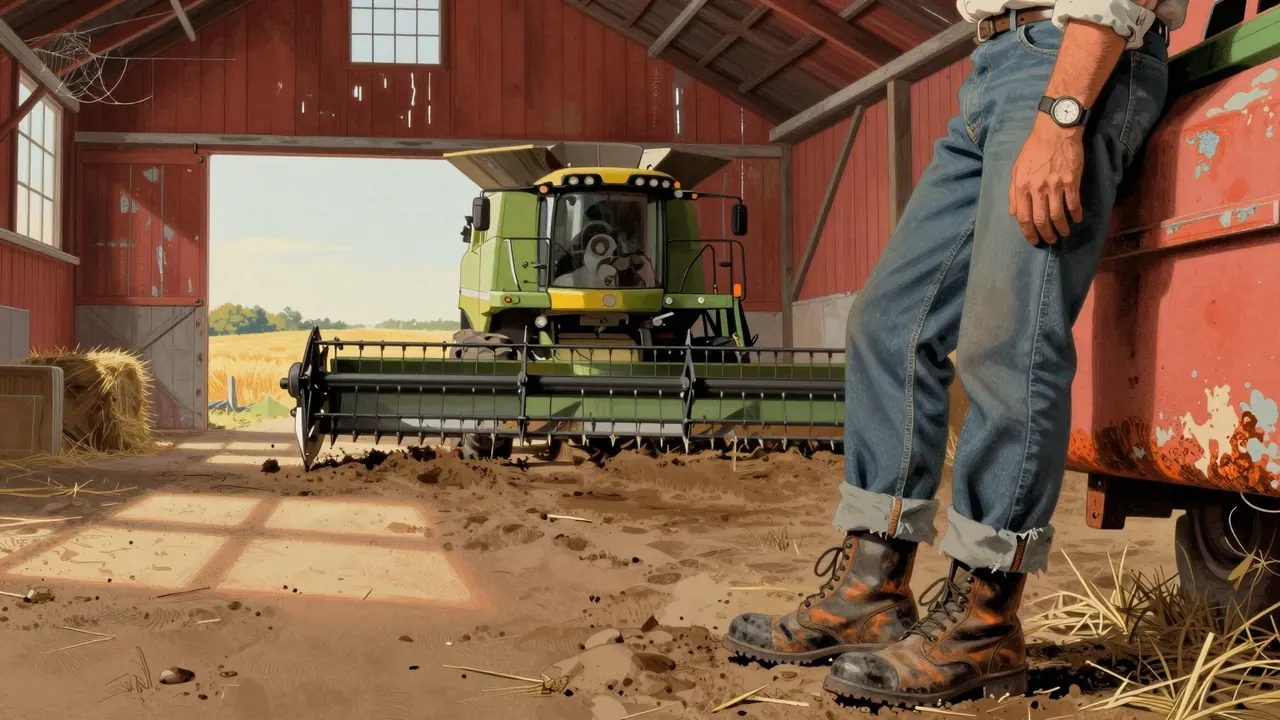
What lands is the cumulative weight of small, unembellished details: the way a farmer rubs his thumb over a rust spot on a combine harvester; the pause before a woman says ‘I don’t know if we’ll make it through spring’; the repeated image of a closed hardware store with ‘For Lease’ taped crookedly to the glass. These moments accrue because they are never framed as symbolic — they are simply there, recorded without emphasis. The film’s restraint allows viewers to sit with ambiguity: frustration coexists with stoicism, resignation with dark humour, loyalty to place with quiet despair. The absence of exposition means nothing is explained, but much is legible — in the tilt of a head, the stacking of seed bags, the way a teenager leans against a pickup while adults talk money. The film trusts its subjects’ speech rhythms and physical presence to carry meaning, and that trust pays off in scenes that feel neither curated nor exploited. There is no climax, but there is resonance: a sense that something real has been witnessed, not illustrated.
What Is Left Out
What does not land is any clear articulation of structural cause. The film registers economic distress but does not name federal policy shifts, bank consolidation, or global commodity markets — not even obliquely. Viewers unfamiliar with US farm policy in the early 1980s may struggle to grasp why these families face ruin beyond bad luck or poor decisions. The refusal to contextualise risks flattening complexity into atmosphere: hardship becomes mood rather than consequence. Likewise, the decision to exclude all historical footage — no maps, no charts, no news clips — leaves some sequences under-anchored. A long shot of an empty grain elevator reads powerfully, but its significance depends on prior knowledge of storage overcapacity in 1985. The film assumes familiarity with rural Midwestern life, or at least willingness to infer. Those expecting analysis — of debt cycles, trade agreements, or mechanisation’s social cost — will find the film withholding. It observes symptoms without diagnosing disease, and that omission, while deliberate, narrows its reach beyond those already attuned to agrarian decline.
The Shape of Erosion
The themes that matter are continuity and erosion — not as opposites but as interwoven conditions. Time passes visibly: crops rotate, children grow, paint peels, machinery ages — yet the town’s fundamental shape remains, even as its function hollows out. The film treats land not as property but as inherited condition: something worked, borrowed against, passed on, and increasingly impossible to sustain. Another theme is speech as survival tactic — how people talk around crisis rather than through it, using understatement, humour, or silence to preserve dignity. There is also a quiet meditation on visibility: who gets seen in national narratives, and how rural lives become legible only when they falter. The title’s irony is muted, not polemical — the ‘God’s Country’ idea lingers as background hum, present in church bulletins and high-school mottoes, but never interrogated. Instead, the film asks what faith looks like when promise goes unfulfilled: not in sermons, but in the act of feeding chickens at dawn despite unpaid bills.
Who It Meets
This film is for viewers who value slow, unmediated observation and who accept that understanding need not require explanation. It suits those familiar with rural America or with documentary traditions that privilege duration over exposition — fans of Frederick Wiseman or Alanis Obomsawin, for example. It is not for viewers seeking narrative propulsion, causal clarity, or moral resolution. Those who expect documentaries to argue, persuade, or propose solutions will find it frustratingly inert. Teachers using it in economics or history classes would need to supplement heavily — the film offers texture, not scaffolding. It also assumes tolerance for stillness: long takes, minimal movement, subdued sound. Anyone needing constant visual or rhetorical stimulation will disengage. The verdict changes if the film were accompanied by contextual essays or discussion guides — then its observational strength could anchor deeper analysis. As it stands, its value lies in what it refuses to do, not what it asserts.
What It Leaves With You
Yes, it is worth your evening — provided you approach it as a document of tone and texture, not as a primer on farm economics. Its ninety-five minutes pass without urgency, yet accumulate a quiet gravity few films achieve without music or montage. You leave with a tactile sense of Glencoe: the smell of damp earth after rain, the creak of porch swings, the low thrum of diesel engines at idle. That immersion is earned, not manufactured. It is not for those who measure documentary value by information density or argumentative force — they will call it thin. But for those who believe cinema can bear witness without interpreting, who find ethical weight in restraint, it delivers something rare: a portrait that does not flinch, simplify, or console. Its worth lies in fidelity, not utility — and fidelity, in this case, feels like a kind of honour.