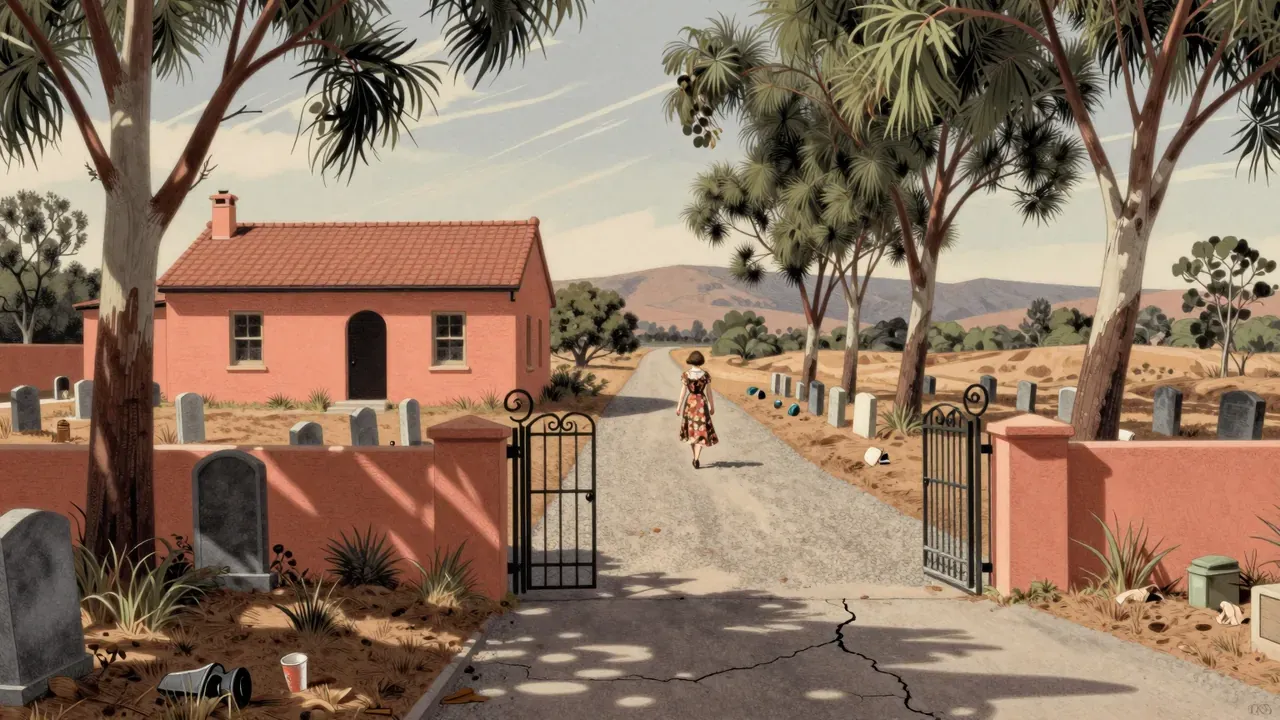
The headline that started it
Gates of Heaven is a documentary film about pet cemeteries in California, made without narration, exposition or music. It does not seek to explain the business, judge its participants or resolve moral questions about animal death and human grief. Instead, it arranges interviews with people involved — a failed entrepreneur, a rendering-plant manager, cemetery owners, grieving pet owners, an elderly neighbour — into two loosely parallel sections, separated by a single reflective interlude. Errol Morris’s aim is structural and philosophical: to place ordinary speech under sustained, unblinking attention, allowing patterns of belief, contradiction and repetition to emerge without commentary. The film treats its subject not as eccentric material for satire nor as sentimental fodder for uplift, but as a lens through which to observe how people articulate meaning when confronted with mortality, failure and attachment. It assumes no prior knowledge of pet burial services, nor any shared cultural framework beyond spoken English. Its ambition is quiet: to hold space for voices that would otherwise vanish, and to let their logic — however partial or idiosyncratic — stand on its own. (158 words)
The voices, unmediated
The film works through interview footage shot mostly in natural light, with static compositions and minimal camera movement. Ned Burgess’s cinematography avoids stylisation: interiors are evenly lit, exteriors unvarnished, faces framed at medium distance without emphasis or flattery. There is no voiceover, no archival footage, no re-enactments, no score — only dialogue, ambient sound and silence between sentences. Performances are not performed: subjects speak directly to the camera, often haltingly, repeating phrases, correcting themselves, trailing off. Morris edits these fragments into rhythmic clusters — a man describing his dog’s last breath appears twice, slightly differently; a rendering-plant manager’s dry account of incineration follows a widow’s trembling recollection of her cat’s burial. The editing creates resonance rather than argument. Sound recording is functional, not polished: breaths, pauses and background noise remain audible. This restraint makes the film’s emotional weight accrue slowly, not through manipulation but through accumulation — each speaker’s vocabulary, cadence and posture becoming part of the film’s texture. The craft serves observation, not interpretation. (159 words)
The rhythm of repetition
What lands is the cumulative effect of listening closely to people who speak without knowing they are being heard as philosophers. A rendering-plant manager’s matter-of-fact description of pet disposal carries the same weight as Floyd McClure’s earnest belief that animals deserve dignity in death. Florence Rasmussen’s quiet observation — ‘Here today, gone tomorrow’ — lands because it is neither ironic nor sentimental, but simply true in its brevity and timing. The film’s structure allows parallels to form without stating them: McClure’s failed venture and the Harberts’ thriving business are not contrasted as success versus failure, but as two versions of the same impulse — to impose order on loss. The absence of music or narration means nothing is underscored, so when a pet owner asks where the thing that made the dog move has gone, the question hangs without resolution, and that lack of answer feels honest rather than evasive. The film earns its gravity not by asserting profundity but by refusing to look away from the effort people make to name what matters. That effort, repeated across twenty-odd speakers, becomes the film’s quiet centre. (157 words)
Two cemeteries, one question
What does not land is any attempt to read the film as straightforward reportage or as pure satire. Its refusal to clarify intent leaves some viewers stranded: without narration or context, the rendering-plant manager’s remarks may register as callous rather than pragmatic; McClure’s persistence may seem delusional rather than principled. The film offers no biographical scaffolding — we learn almost nothing about subjects’ ages, education or economic circumstances — so their statements float free of social explanation. This is deliberate, but it can feel withholding to viewers accustomed to documentaries that frame testimony with evidence or analysis. Some sequences — particularly those involving minor figures whose lines do not recur or echo — drift without accumulating significance. The pacing, too, resists conventional rhythm: long silences follow short answers, and transitions between speakers are abrupt, not bridged by visual or auditory cues. These choices are consistent with the film’s method, but they do not accommodate impatience. The film assumes attention as a given, and those unwilling or unable to sustain it will find stretches opaque or inert. It does not fail in its aims — it fulfils them rigorously — but its rigour is incompatible with passive viewing. (159 words)
The grammar of loss
The themes that matter are not about pets, but about how language functions when anchored to loss. Mortality appears not as abstraction but as daily logistics — exhumation permits, cemetery plots, cremation temperatures — spoken with the same gravity as theological speculation. The film traces how people use concrete detail to contain the uncontainable: a woman lists her dog’s favourite foods; a man describes the exact angle at which his cat’s head rested in its casket. These specifics are not distractions from meaning but its substance. Another theme is the asymmetry of care: humans bury animals with ritual while often neglecting their own dead with equal practicality. The film also explores entrepreneurial faith — not as greed or delusion, but as the stubborn insistence that a need exists, even when no market confirms it. And underlying all this is a quiet meditation on presence: what remains after departure, not just of animals but of ideas, businesses, marriages, towns. The cemetery is less a site of mourning than a threshold where intention meets entropy, and where speech becomes the only monument that lasts. (156 words)
The weight of the pause
This film is for viewers who trust silence as much as speech, who find philosophical weight in vernacular phrasing, and who accept that clarity may arrive obliquely — through repetition, juxtaposition or pause. It suits those accustomed to essay films, observational documentaries or literary non-fiction where meaning accrues over time rather than declares itself. It is not for viewers who require narrative propulsion, explanatory context or emotional signposting. Those expecting irony will be frustrated if they mistake sincerity for naivety; those seeking pathos may find the film too reserved to offer comfort. People who dislike unedited speech — hesitations, repetitions, digressions — will struggle. The film assumes patience as a condition of engagement, not a virtue to be rewarded. Anyone needing immediate stakes or clear authorial stance should look elsewhere. Its audience is narrow but deep: readers of Joan Didion, listeners of BBC Radio 4’s ‘Archive on 4’, viewers of Frederick Wiseman’s later work. To dislike it is reasonable; to dismiss it as shallow or pretentious misunderstands its terms. What would change the verdict? A different opening — one that signals its method — might widen access, but that would contradict its purpose. (159 words)
What remains unsaid
Yes, it is worth your evening — provided you give it your full attention and do not expect conventional reward. It repays close viewing not with revelation but with recalibration: after Gates of Heaven, ordinary speech sounds richer, quieter moments feel more charged, and the act of listening becomes a kind of ethical practice. Its value lies in duration, not incident: the ninety minutes are spent inside a sustained act of attention, modelled and extended to the viewer. Those who watch it once may feel unsettled or uncertain; those who return find new connections — between McClure’s idealism and Harberts’ pragmatism, between Rasmussen’s brevity and the widow’s rambling. It is not entertainment, nor instruction, nor therapy — it is a discipline of perception. People who dislike it tend to want either sharper satire or warmer sentiment; neither is offered. But its integrity is absolute. To call it ‘difficult’ mistakes its slowness for obstruction. It moves at the pace of thought, not plot — and for that reason, it remains urgent. (158 words)