The making of it
Fearless Hyena Part II is a 1983 Hong Kong martial arts film directed by Lo Wei and credited to Jackie Chan as writer, intended as a sequel to The Fearless Hyena. It attempts to sustain the slapstick-kung fu hybrid formula established in the first film — blending juvenile physical comedy with lineage-based revenge plotting — while accommodating Chan’s abrupt departure from Lo Wei’s production company mid-shoot. The film does not conceal its fractured genesis: it is a contractual obligation fulfilled under duress, stitched together from incomplete principal photography, archive footage, and stunt doubles standing in for Chan in key action sequences. Its ambitions are narrow: to capitalise on Chan’s rising fame without his full participation, to deliver a marketable genre product during a period when triad influence over Hong Kong film distribution was at its peak, and to assert Lo Wei’s authorial control despite the star’s defection to Golden Harvest. It makes no pretence of narrative coherence or tonal consistency, operating instead as a patchwork of set pieces loosely tethered to a revenge framework.
The story of it
The story follows Cheng Lung (Jackie Chan) and his cousin Tung (Austin Wai) as they uncover their shared past in the slaughtered Yin-Yang Brotherhood and confront the villains Heaven and Earth. But narrative propulsion is repeatedly undermined: scenes jump without motivation, motivations shift without explanation, and character relationships — particularly between Lung and his long-lost uncle — appear fully formed without development. Chan’s performance is limited to early scenes and reused material; Li Hsiao Ming doubles for him elsewhere, and the mismatch in timing, framing, and physical presence is evident. Lo Wei’s direction lacks the rhythmic precision of Chan’s own later work: fight choreography is perfunctory, editing disjointed, and pacing erratic. Gordon Willis is not involved; the cinematography — uncredited in the fact sheet — is functional rather than expressive, favouring flat lighting and static setups. The score, also uncredited, leans on stock cues and reprises from the first film. There is no discernible visual motif or thematic through-line in the craft: what exists serves utility, not articulation.
The look of it
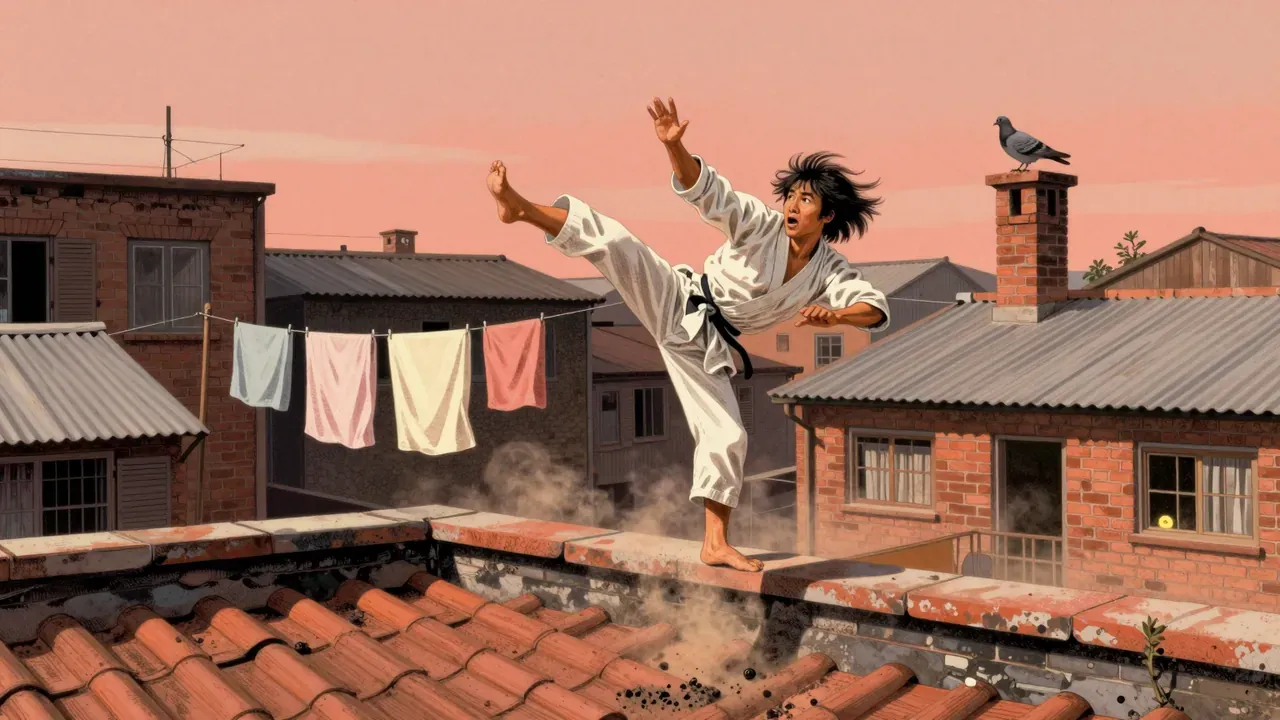
What lands is the sheer, unselfconscious absurdity of the premise — two men keeping frogs and snakes in their trousers, a windmill-powered chamberpot delivery system, a villain named ‘Jaws Four’ — which functions as low-stakes, pre-ironic farce. The physical gags that do involve Chan retain his signature timing and risk-aware commitment, however brief: a stumble into mud, a misfired kick, a startled recoil from a coiled reptile. Austin Wai’s performance as the indolent cousin carries a sardonic energy that survives the editing cuts, and James Tien’s dual role as both father figure and antagonist adds a sliver of structural irony. The film’s refusal to take itself seriously — even when it tries — becomes its most consistent register. In moments where the camera holds on a ridiculous tableau — a man balancing on a bamboo pole while holding a live eel — the film achieves a kind of accidental surrealism, unmoored from plot but anchored in tactile, bodily comedy. This is not intentional artistry, but it is legible, repeatable, and oddly durable.
The feeling of it
What does not land is any sense of stakes, consequence, or emotional continuity. The massacre of the Yin-Yang Brotherhood is referenced but never shown, mourned, or meaningfully revisited; vengeance arrives without weight. The Heaven and Earth villains lack distinction beyond costume and title: their menace is declamatory, not embodied. The doubling is jarring — not just in appearance, but in posture, rhythm, and reaction time — and the reuse of footage from the first film feels less like homage than desperation. Dialogue scenes are undercut by mismatched eyelines and inconsistent sound design, suggesting ADR recorded without reference to picture. The film’s attempt at pathos — Lung’s reunion with his uncle, the revelation of shared blood — collapses under the weight of its own logistical compromises. There is no tonal calibration: slapstick abuts solemnity without transition, and the score often contradicts the image. What should feel urgent reads as arbitrary; what should feel earned feels imposed.
The weight of it
The themes that matter are loyalty under coercion, the instability of authorship, and the physical body as both instrument and liability. The film’s production history — Chan’s contract breach, Lo Wei’s triad-backed retaliation, Jimmy Wang Yu’s mediation — shadows every frame, turning the text into an unwitting document of power asymmetry in the Hong Kong studio system. The repeated use of doubles and archive footage literalises the idea of the performer as replaceable, the star as a brand detached from embodiment. The cousins’ laziness is not just comic shorthand but a quiet rebellion against inherited duty: their reluctance to train, their reliance on mechanical aids, their preference for frogs over fighting — all suggest exhaustion with the very logic of the martial arts genre. Even the title’s repetition — ‘Part II’ — becomes thematic: sequels as obligation, not evolution; legacy as burden, not inheritance.
The audience for it
This film is for viewers who approach Hong Kong cinema as archaeology — those interested in how industrial pressures shape form, or who seek to trace Jackie Chan’s stylistic emergence through its ruptures and failures. It rewards attention to seams: where the double enters, where the music loops, where the script abandons causality. It is not for viewers seeking coherent storytelling, emotional investment, or polished action choreography — those will find its gaps frustrating rather than illuminating. Fans of Chan’s Golden Harvest work may find it alienating, while devotees of Lo Wei’s earlier Bruce Lee films may see only decline. A viewer who values narrative integrity over historical context will reject it outright; one who accepts that meaning accrues in the margins — in mismatched sleeves, in reused crane shots, in the silence between takes — may find it unexpectedly resonant. Its value lies entirely in what it reveals about conditions of production, not in what it delivers as entertainment.
The time for it
It is not worth your evening if you expect a functioning film — one with cause and effect, sustained tone, or character logic. But it is worth ninety minutes if you treat it as a case study: in contract law as dramaturgy, in triad economics as editing principle, in star power as contested terrain. It fails as a sequel, but succeeds as evidence — of how a film can persist despite the absence of its central performer, how genre conventions can absorb rupture without collapsing, and how commercial imperatives can override aesthetic ones so completely that the result becomes a negative imprint of intention. Someone who watches it for laughs alone will leave disappointed; someone who watches it to understand why Jackie Chan spent the next decade building his own production unit will find it indispensable. Its worth depends not on what it achieves, but on what questions it forces you to ask about authorship, labour, and survival in commercial cinema.