What it watches
Fellow Citizen is a 48-minute Iranian documentary made in Tehran in 1983, directed and written by Abbas Kiarostami. It observes, without narration or explanation, a single civil servant attempting to regulate pedestrian and vehicular movement on an ordinary city street. The film does not seek to instruct, persuade or diagnose; it sets up a minimal premise — one person enforcing traffic rules — and records how that premise interacts with the unscripted behaviour of passers-by. There is no voiceover, no interview framework, no archival insertions or explanatory titles. Kiarostami treats the street as a site of spontaneous social theatre, where authority is neither absolute nor illegitimate, but contingent, negotiable and often gently undermined. The film’s ambition lies not in argument or revelation but in sustained attention: it asks the viewer to watch closely, to notice how people pause, evade, joke, defer or ignore — not as types, but as individuals caught mid-decision. Its method is observational, its stance neutral, its duration calibrated to let patterns emerge slowly, without forcing them. It is a study in micro-social friction, conducted in real time, on location, with no re-staging. (158 words)
How it watches
The film works through strict formal economy: a fixed camera position, natural light, diegetic sound only, and no editing that conceals time or continuity. Kiarostami does not cut away to reaction shots or contextualise with maps or statistics; he holds on the street corner, letting actions unfold within the frame. There are no credited performers — only citizens behaving as they would without a camera, though their awareness of being filmed occasionally surfaces in glances or pauses. The civil servant appears repeatedly, calm and persistent, his interventions brief and verbal rather than physical. His authority is linguistic and procedural, not coercive. Sound design is unmanipulated: car horns, shouted exchanges, footsteps and distant announcements form a layered urban texture. Gordon Willis is not involved; the cinematographer is uncredited in the fact sheet, so no attribution is made. The editing rhythm is patient, favouring duration over emphasis. There are no close-ups, no slow motion, no music. What registers is not performance in the theatrical sense but the grain of lived response — hesitation, mimicry, irritation, complicity — all captured because the camera stays put long enough for it to arrive. (156 words)
What stays in view
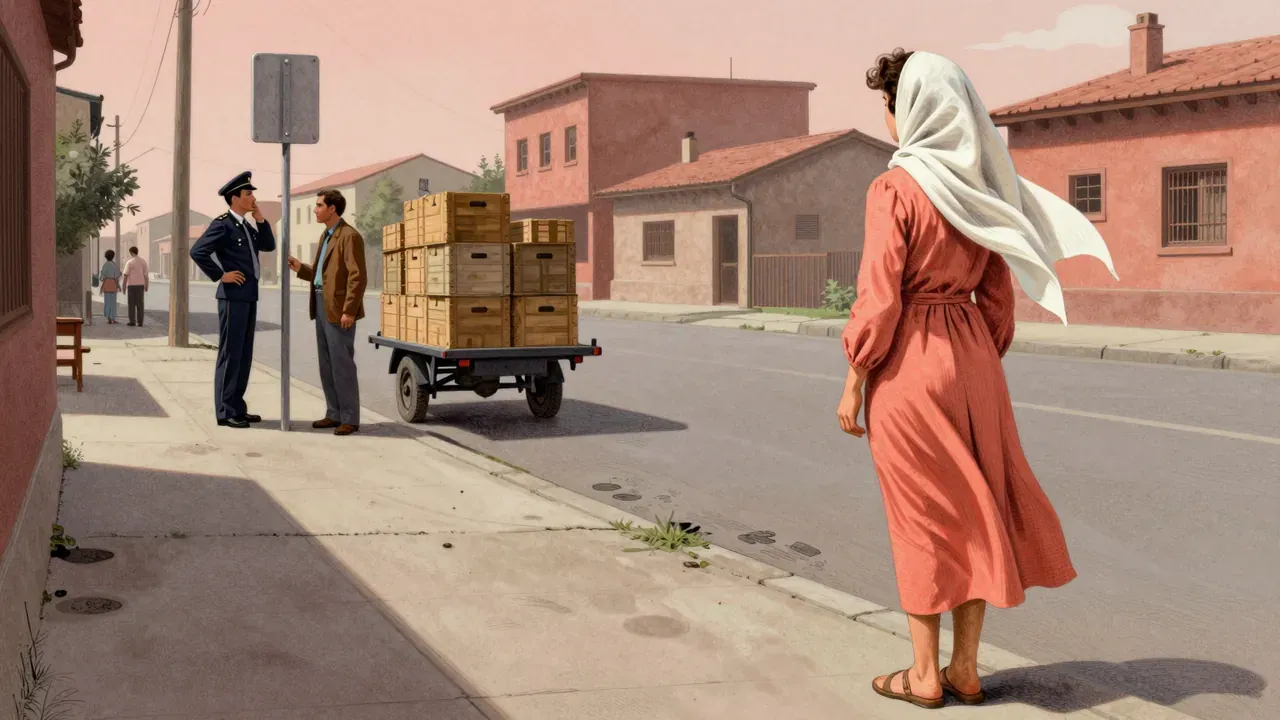
What lands is the quiet accumulation of behavioural nuance: how a woman adjusts her headscarf while waiting to cross, how a boy mimics the official’s hand gesture before darting across, how two men debate the rule while standing still, how a driver leans out to argue without switching off the engine. These moments do not build to a climax, but they cohere into a portrait of civic habit — not as doctrine, but as practice, constantly revised in real time. The film avoids caricature even when situations turn absurd, because it refuses to isolate or repeat any single incident for comic effect. Its restraint allows ambiguity to persist: is the official earnest or ineffectual? Are the pedestrians defiant or merely distracted? The answer remains open, and that openness feels ethically precise. The duration — just under fifty minutes — proves sufficient to establish rhythm without inducing fatigue. The viewer begins to anticipate certain responses, then notices when they diverge: a shrug instead of a smile, silence instead of protest. That shift in expectation is where the film’s intelligence resides — not in what it shows, but in how steadily it watches. (159 words)
What stays out
What does not land is any sense of structural development beyond observation. There is no progression in the official’s tactics, no escalation in public resistance, no discernible change in the street’s character across the runtime. The film’s refusal to narrativise means it offers no resolution, no irony, no synthesis — and for some viewers, that absence will read as vacancy rather than discipline. Those expecting critique of bureaucracy, satire of authority or ethnographic insight into post-revolutionary Tehran may find the film too withholding. Its neutrality risks feeling like evasion if one assumes documentary must diagnose. The lack of context — no date stamp, no title card naming the district, no indication of whether this is routine or exceptional — may frustrate viewers accustomed to expository framing. The sound recording, while authentic, is sometimes muffled or distant, making individual exchanges indistinct. And because the camera never reframes or follows, some interactions exit the frame before concluding, leaving gaps that feel accidental rather than compositional. None of this violates the film’s stated terms, but it does mean the work asks more of the viewer’s tolerance for unresolvedness than many documentaries of its era demand. (157 words)
What moves beneath
The themes that matter are not abstract propositions but embodied conditions: the fragility of consensus, the improvisation of order, the gap between rule and habit, and the quiet labour of maintaining public space. The film treats traffic regulation not as infrastructure policy but as social choreography — a daily rehearsal of shared assumptions about movement, priority and consequence. It reveals how law operates not through enforcement alone, but through repetition, recognition and mutual adjustment. There is no mention of ideology, revolution or state power in the fact sheet, and the film makes no reference to them; its political dimension is enacted, not declared. Class, gender and age register not as categories but as variables in response: older men pause longer, children test boundaries more openly, women often wait for confirmation before crossing. The street becomes a microcosm not of Iran specifically, but of any dense urban setting where strangers negotiate proximity without shared history. The theme of attention itself is central — the official’s attention, the citizens’ attention, the camera’s attention — and how each shapes what becomes visible, permissible or forgettable. (156 words)
Who watches with it
This film is for viewers who value sustained observation over exposition, who find interest in behavioural subtlety rather than plot, and who accept documentary as a mode of attention rather than argument. It suits those familiar with Kiarostami’s later work, or with the observational traditions of Frederick Wiseman or the Maysles brothers. It is not for viewers who require narrative propulsion, thematic clarity or contextual anchoring — those who expect documentaries to explain, advocate or summarise will likely disengage within ten minutes. Teachers of film or urban studies may find it pedagogically useful, but students seeking illustrative examples of Iranian society in the 1980s will need supplementary material. A viewer who values craft over message, or who finds pleasure in the granularity of unscripted human exchange, will sit with it willingly. Someone who associates documentary with advocacy, journalism or historical record will reasonably consider it thin. Its value changes if viewed as part of Kiarostami’s evolving method — as a hinge between his early educational films and the fiction-documentary hybrids that followed — but the fact sheet gives no basis for that framing, so the verdict rests solely on what is present. (159 words)
What it costs
Yes, it is worth your evening — provided you approach it as a discrete, modest act of looking, not as a key to understanding Iran, traffic policy or Kiarostami’s oeuvre. Its value lies in its unwavering commitment to a single perceptual task: watching how people inhabit shared space when asked to conform, briefly, to a minor structure. At 48 minutes, it asks little time but rewards close attention with accumulating detail — the kind that fades from memory if blinked past. It is not ‘important’ in the way of landmark documentaries, nor ‘entertaining’ in any conventional sense, but it is exact, unhurried and free of condescension. Those who dislike it will likely do so on principle — objecting to its refusal to interpret, its silence on context, its resistance to utility. Their objection is valid, but it misidentifies the film’s aim. What would change the verdict? A longer runtime would dilute it; added narration would betray it; sharper sound or tighter editing would impose a subjectivity the film pointedly avoids. Its worth is in its limits. (158 words)