The shape of time
Cold War is a Polish-language drama set across Europe between the late 1940s and early 1960s, tracing the repeated, self-defeating entanglement of two people — Wiktor, a composer and ensemble director, and Zula, a singer whose ambition and instability shape every turn. It is not a historical survey but a tightly wound chamber piece: its aim is to render love as both compass and compulsion, a force that persists without resolution or redemption. Paweł Pawlikowski frames this not as romance but as recurrence — the same gestures, the same failures, the same silences, repeated across borders and decades. The film’s structure is elliptical, skipping years in single cuts; its tone is unsentimental, its emotional register held at a low, steady hum. It assumes familiarity with mid-century Eastern European politics not as backdrop but as pressure — bureaucratic, ideological, spatial — that bends the characters’ choices without ever explaining itself. There are no voiceovers, no exposition about Stalinism or defection law; the weight comes from what is withheld, not declared. Word count: 148
The look of it
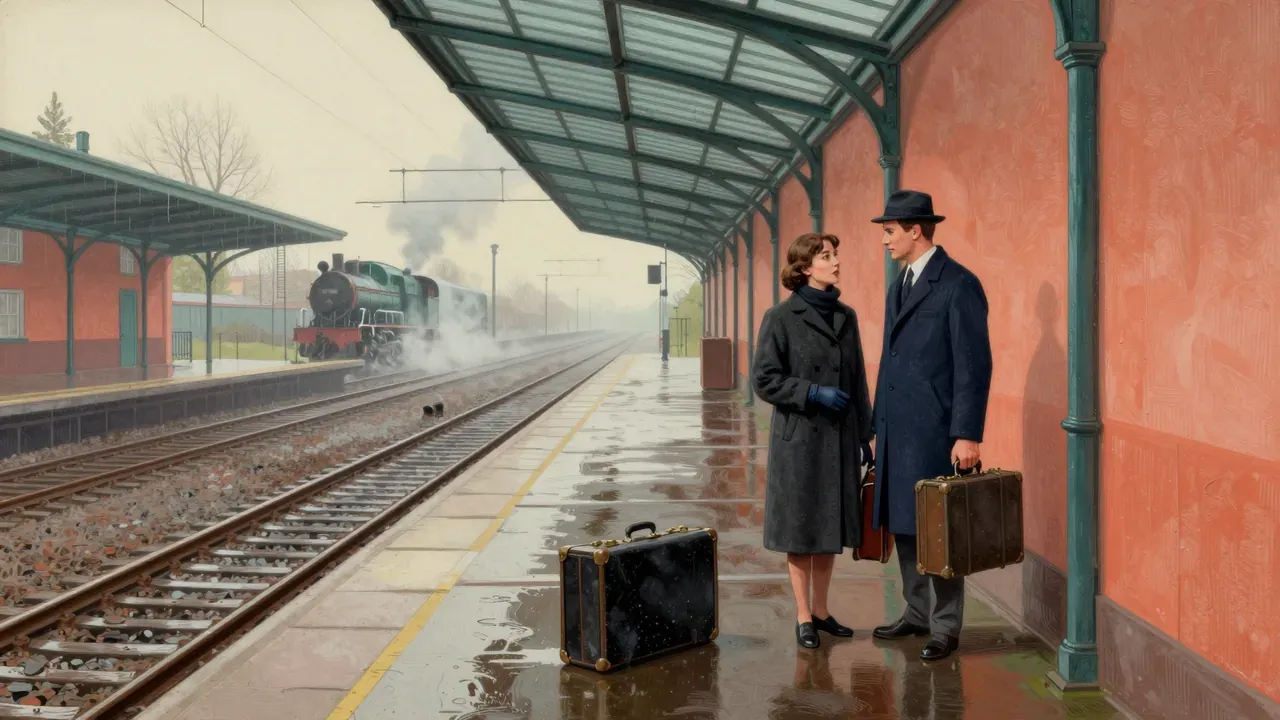
The story unfolds in precise, unadorned vignettes, each anchored by Łukasz Żal’s monochrome cinematography: high-contrast, shallow-focus, often shot in Academy ratio, with interiors lit so sparingly that faces dissolve into shadow at the edges. Joanna Kulig and Tomasz Kot carry the film through gesture and stillness more than dialogue — Kulig’s Zula is all coiled energy and sudden withdrawal, Kot’s Wiktor all restraint and delayed reaction. Supporting performances are calibrated to the same economy: Agata Kulesza as Irena conveys professional disillusionment in a single glance; Jeanne Balibar and Cédric Kahn appear briefly in Paris, their presence signalling cultural displacement without exposition. Marcin Masecki’s score uses jazz, folk motifs and silence with surgical precision — a saxophone phrase recurs like a memory one cannot place. Jarosław Kamiński’s editing sustains rhythm through repetition: matching cuts across time, mirrored compositions, pauses held just past comfort. Nothing is over-emphasised; nothing is redundant. Word count: 152
What lingers
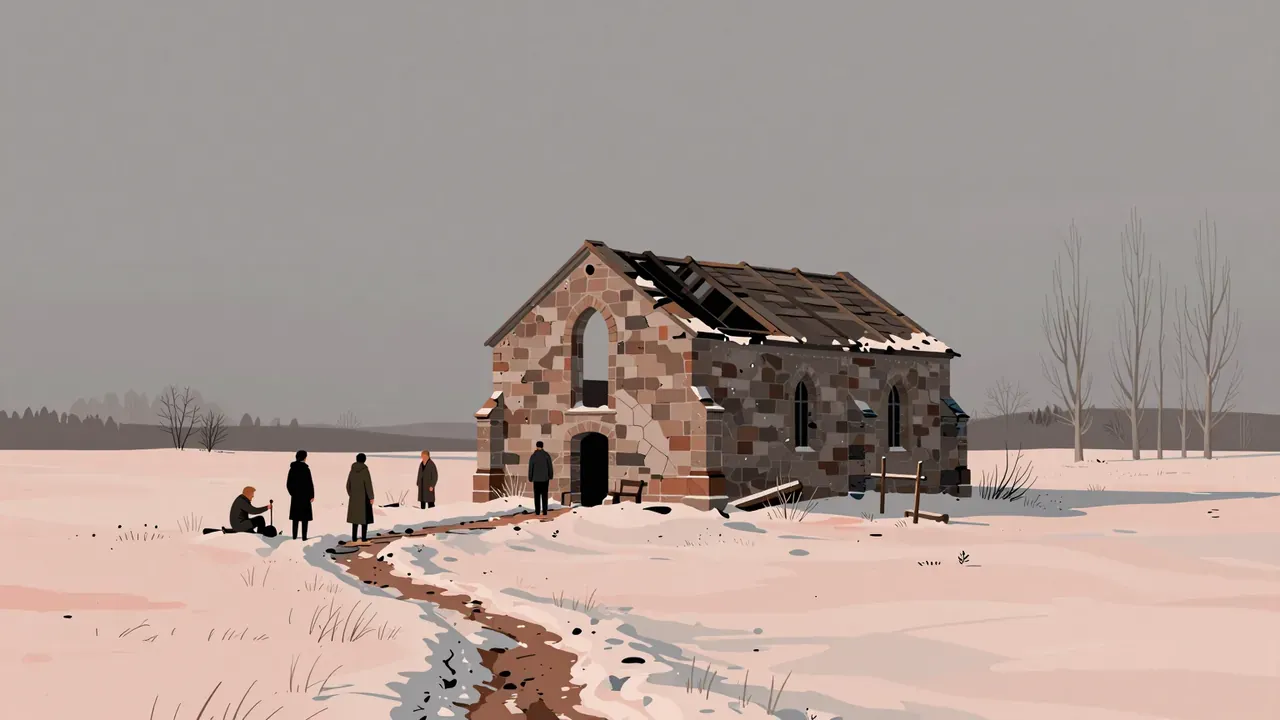
What lands is the film’s cumulative emotional logic: the way obsession wears down into habit, then exhaustion, then resignation. The recurring image of the abandoned church — first seen in the opening shot, returned to at the end — works not as symbolism but as structural anchor, a physical constant against which all human motion appears fleeting and futile. The final sequence avoids catharsis or clarity: the couple’s departure from view is neither triumph nor tragedy, but a quiet cessation of struggle. That ambiguity is earned by the film’s refusal to assign blame — not to the state, not to individual weakness, not even to love itself. The austerity of form serves the subject: when Wiktor’s hand is shown disfigured after prison, the camera holds on it for three seconds, then cuts away — no explanation, no close-up on his face. This restraint makes the moments of vulnerability land harder: Zula’s confession in Paris about lacking confidence, spoken flatly over café noise, carries more weight than any monologue could. Word count: 154
Where it slips
What does not land is the film’s occasional reliance on ellipsis as substitute for psychological continuity. Some transitions — particularly Zula’s abrupt shift from Parisian ambition to Yugoslav-stage shock, or her later descent into alcoholism — feel less like compression and more like omission. The script gives her motives but rarely lets her articulate them beyond fragments; her interiority remains inferred rather than inhabited. Similarly, Wiktor’s moral position — his resistance to propaganda, his decision to flee, his later return — is presented as fact, not explored as choice. The film assumes we will accept his integrity without seeing its cost in real time. This works for atmosphere but weakens agency: both leads become vessels for mood before they fully become people with contested inner lives. A viewer who values sustained character development over tonal consistency may find the gaps frustrating, not evocative. The film’s rigour becomes a limitation when it denies the characters room to contradict themselves. Word count: 150
What it’s really about
The themes that matter are not the Cold War as ideology but as condition: the way political constraint reshapes desire, how exile hollows out identity, and why some attachments persist not because they nourish but because they confirm a sense of self. The film treats music not as expression but as instrument — of state control, of personal reinvention, of failed translation across language and culture. Zula’s faked peasant origins and later embellished backstory for Michel expose authenticity as performance under pressure. Class, gender and national belonging are never named as concepts but enacted: in the way Kaczmarek leverages bureaucracy to possess Zula, in the way Wiktor’s Parisian collaborators treat her voice as raw material, in the way Zula’s marriage to Kaczmarek secures Wiktor’s release but erases her autonomy. The film’s deepest concern is with endurance — not heroism, not resistance, but the quiet, daily persistence of feeling in circumstances designed to extinguish it. Word count: 152
Who it’s for
This film is for viewers who value formal discipline over narrative exposition, who find emotional resonance in restraint, and who accept that some relationships defy interpretation. It suits those accustomed to arthouse pacing and monochrome visual grammar — viewers who do not require closure or moral framing to feel satisfied. It is not for those who need psychological cause-and-effect, who rely on dialogue to establish motivation, or who expect historical context to be spelled out. A viewer who found Ida emotionally distant may find Cold War similarly withholding; someone who prefers the layered exposition of The Lives of Others may find this too taciturn. Its brevity is not efficiency but selection — it omits what it deems irrelevant to its central pulse. Change the editing rhythm or add explanatory scenes, and the film would lose its defining tension between compression and gravity. Word count: 150
Is it worth your evening
Yes, it is worth your evening — not as diversion but as immersion in a singular aesthetic and emotional register. Its eighty-four minutes pass with the quiet insistence of a metronome, leaving space for reflection rather than filling it with incident. It rewards attention to composition, to silence, to the weight carried in a glance or a pause. It is not ‘enjoyable’ in the conventional sense, but it is rigorously felt and precisely made. Someone who watches primarily for plot momentum or character arc may leave unsatisfied; someone open to mood as meaning, to absence as articulation, will find it resonant long after the credits. Its value lies in what it refuses: explanation, justification, uplift. To ask whether it is ‘worth it’ is to misunderstand its terms — it does not offer return on investment but fidelity to its own logic. Word count: 149