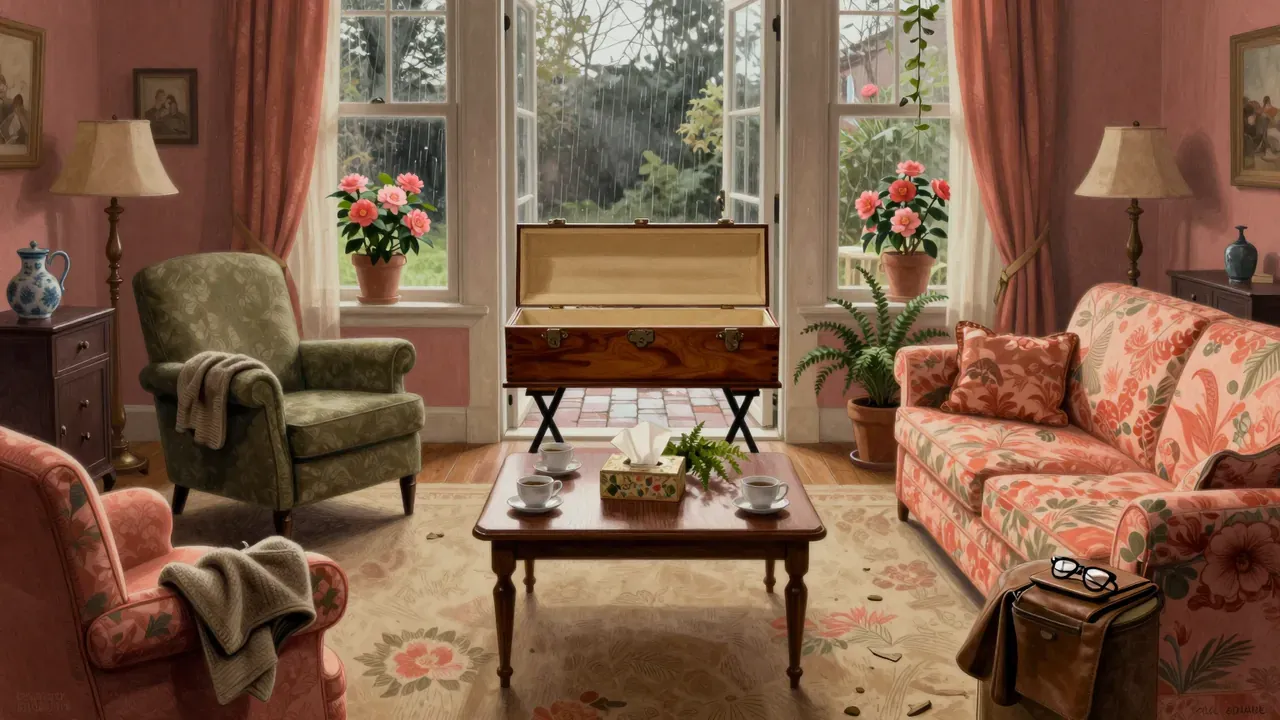
The reason they gather
The Big Chill is a drama about eight former University of Michigan students reuniting in Beaufort, South Carolina, after the suicide of their friend Alex. It attempts to map the emotional and ideological distance between their shared 1960s idealism and their early-1980s realities: compromised careers, stalled relationships, unspoken regrets, and the quiet erosion of political conviction. Lawrence Kasdan and Barbara Benedek wrote it as a semi-autobiographical reckoning — not with loss alone, but with how time reshapes belief, intimacy, and self-perception. The film does not dramatise Alex’s life or death beyond its triggering function; instead, it holds a mirror to the survivors, using the weekend-long gathering as a controlled pressure chamber for midlife dissonance. Its ambition is structural and tonal: to let conversation, silence, and music carry narrative weight; to treat friendship as both scaffold and subject; and to locate meaning not in resolution, but in the shared, unvarnished act of remembering who they were — and who they are now. It is less a story about grief than about the habits of thought that outlive the causes that formed them. (158 words)
The look of it
The film works through tight ensemble choreography and restrained craft choices. John Bailey’s cinematography keeps interiors soft-edged and sun-bleached, favouring medium shots that hold groups in frame without privileging any one speaker. Carol Littleton’s editing sustains rhythm across overlapping dialogue and digressive monologues, letting scenes breathe without rushing toward payoff. The soundtrack — curated by Meg Kasdan and built around soul and rock from the characters’ youth — functions as emotional counterpoint and temporal anchor, not mere decoration. Performances are calibrated to understate: Kevin Kline’s dry wit, Glenn Close’s contained exhaustion, Jeff Goldblum’s restless irony, and William Hurt’s wounded stillness all avoid theatricality. Tom Berenger and JoBeth Williams ground the group’s history with lived-in ease. There is no villain, no plot twist, no external threat — only the friction between memory and present behaviour, and the slow dawning that none of them fully understood Alex, or each other. The script trusts its actors to land subtext in pauses, glances, and half-finished sentences. That trust pays off in moments of cumulative honesty rather than singular revelation. (159 words)
What sticks
What lands is the texture of shared history — the way old jokes resurface, how domestic routines become ritual, and how physical proximity reignites dormant affections and resentments. Scenes like the communal breakfast, the touch-football game, or the late-night kitchen confessions feel observed rather than staged, anchored by specific, unshowy details: Harold handing out running shoes, Nick fumbling with his Porsche, Meg studying an ovulation chart while listening to Marvin Gaye. The film’s emotional precision lies in its refusal to moralise: Karen’s marital dissatisfaction, Nick’s addiction, Michael’s opportunism, Sarah’s quiet complicity in her own unhappiness — none are framed as failures, but as adaptations. The soundtrack lands because it is diegetic and functional: characters hear it, move to it, argue over it. Aretha Franklin’s voice enters not as commentary but as atmosphere — part of the house’s acoustic memory. The film also lands its central paradox: that reunion can clarify absence more than presence, and that grief often expresses itself as irritation, distraction, or sudden tenderness toward the wrong person. These are not dramatic beats but psychological ones, and they accumulate with quiet authority. (157 words)
Where it slips
What does not land is the structural conceit of Alex as absent centre. Though his suicide initiates the gathering, the film never convincingly establishes why he mattered so much — or why his death should provoke such sustained introspection from people who had lost contact with him for twelve years. The cut flashback scenes, reportedly excised by Kasdan himself, leave a narrative void: we see Alex only in the coffin, and hear only second-hand fragments about his character. This makes his influence feel asserted rather than earned. The subplot involving Harold’s insider tip — a plot device meant to test ethics and loyalty — arrives abruptly and resolves without consequence, its stakes feeling arbitrary next to the personal ones. Some performances falter under the weight of exposition: Mary Kay Place’s Meg occasionally slips into sitcom cadence, and Don Galloway’s Richard remains a sketch of conservative blandness rather than a counterpoint with depth. The film also strains under its own thematic weight when characters articulate ideas too neatly — ‘Was our idealism just fashion?’ is a real question, but the delivery risks sounding like a seminar prompt. The film’s restraint becomes rigidity in these moments, mistaking silence for ambiguity. (159 words)
What it’s really about
The themes that matter are not generational identity or 1960s nostalgia, but the durability of friendship as infrastructure, the quiet violence of accommodation, and the way time hollows out conviction without always replacing it with anything else. It treats adulthood not as arrival but as ongoing negotiation — between public role and private need, between memory and revision, between care and convenience. Class surfaces obliquely: Harold’s entrepreneurial success, Meg’s legal pivot, Sam’s celebrity — all mark divergent paths from shared origins, yet none are examined for systemic cause, only personal cost. The film’s most persistent theme is the unreliability of shared narrative: each character remembers Alex differently, recalls the past with selective emphasis, and interprets the present through lenses polished by regret or relief. It is also a film about listening — or failing to — whether to others, to music, or to one’s own body. The recurring motif of phones (Sarah’s daughter calling Meg, Sam fielding agent calls) signals a world where connection is constant but rarely deep. What endures is not ideology, but the stubborn, unglamorous fact of having known someone long enough to recognise their silences. (159 words)
Who it’s for
This film is for viewers who value talk over action, subtext over exposition, and emotional realism over narrative propulsion — particularly those who have revisited old friends and found the conversation more revealing than the reunion. It suits people familiar with the textures of early-1980s American middle-class life: the beige carpets, the cassette tapes, the unspoken rules of cohabitation. It is not for viewers who require clear arcs, defined antagonists, or catharsis on cue. Those who find prolonged ambivalence exhausting, or who expect satire where the film offers diagnosis, will likely disengage. A younger audience may struggle with the lack of digital mediation or explicit identity framing — this is a film about white, college-educated boomers whose privilege goes unnamed but shapes every choice. Someone who values sharp political critique may find its treatment of disillusionment too interior, too personal. But that is the point: the film argues that large-scale disappointment often settles first in the bedroom, the kitchen, the car — not the ballot box. Change the setting to a Zoom call or shift the characters to Gen Z, and the verdict would differ. (159 words)
Is it worth your evening?
Yes, it is worth your evening — provided you watch it as a mood piece, not a puzzle to solve. Its 105 minutes unfold like a slow exhale: deliberate, unforced, attentive to the weight of ordinary gestures. It rewards patience, not decoding. People who dislike it tend to cite its inertia or its perceived self-seriousness — fair objections, if you approach it expecting momentum. But its power lies in accumulation: the third time Nick walks past the same porch swing, the way Sarah’s hand lingers on Harold’s arm during a phone call, the precise moment Meg stops believing she’ll conceive. These are not climaxes but inflections — and they land because the film refuses to underline them. It is not timeless, but it is durable: its concerns with memory, compromise, and the quiet labour of staying connected remain legible decades later. To dismiss it as dated is to miss how precisely it documents a particular kind of emotional weather — one that returns, seasonally, in many lives. It earns its place not through spectacle, but through fidelity. (159 words)