The shape of it
Unfaithfully Yours is a studio-era romantic comedy built around a structural conceit: a conductor’s three orchestral pieces each trigger a distinct fantasy of how to respond to his wife’s suspected infidelity. It tries to sustain farce not through escalating physical chaos alone, but through the precise, almost clinical mismatch between grand musical rhetoric and domestic banality. Preston Sturges treats classical music not as background but as narrative engine — each overture or tone poem becomes the formal grammar for a self-contained comic set-piece, with Rex Harrison’s Sir Alfred de Carter acting out variations on jealousy as if conducting his own psyche. The film does not aim to resolve marital doubt realistically; it stages the absurdity of moral imagination when unmoored from evidence. Its ambition lies in marrying high-culture reference with low-comedy execution, trusting that the audience will follow the logic of a man whose inner life is scored, rehearsed, and conducted like a symphony — even when the score calls for murder, martyrdom, or suicide.
The sound of it
The story hinges on misdirection, both narrative and tonal: Alfred receives no proof of betrayal, only a fragmentary report he refuses to read, then burns, then accidentally sets fire to his dressing room while retrieving it. Performances are tightly calibrated — Harrison plays Alfred with clipped diction and mounting rigidity, Darnell with warm, unflustered patience, Vallée with breezy, oblivious charm. Victor Milner’s cinematography keeps interiors crisp and shallow-focus, favouring medium shots that frame characters as performers in their own domestic theatre. Alfred Newman’s score does not merely accompany; it re-orchestrates the film’s logic, quoting Rossini, Wagner and Tchaikovsky not as decoration but as dramatic scaffolding. Sturges’ script gives every minor role a clear function — Edgar Kennedy’s Sweeney is credulous but not stupid, Lionel Stander’s Standoff is sardonic but not cynical — and the pacing holds its breath before each fantasy, then releases into controlled mayhem. The craft is unified: writing, performance, music and camera all serve the same premise — that emotional crisis can be parsed, rehearsed, and failed at like a difficult passage of music.
The fantasy of it
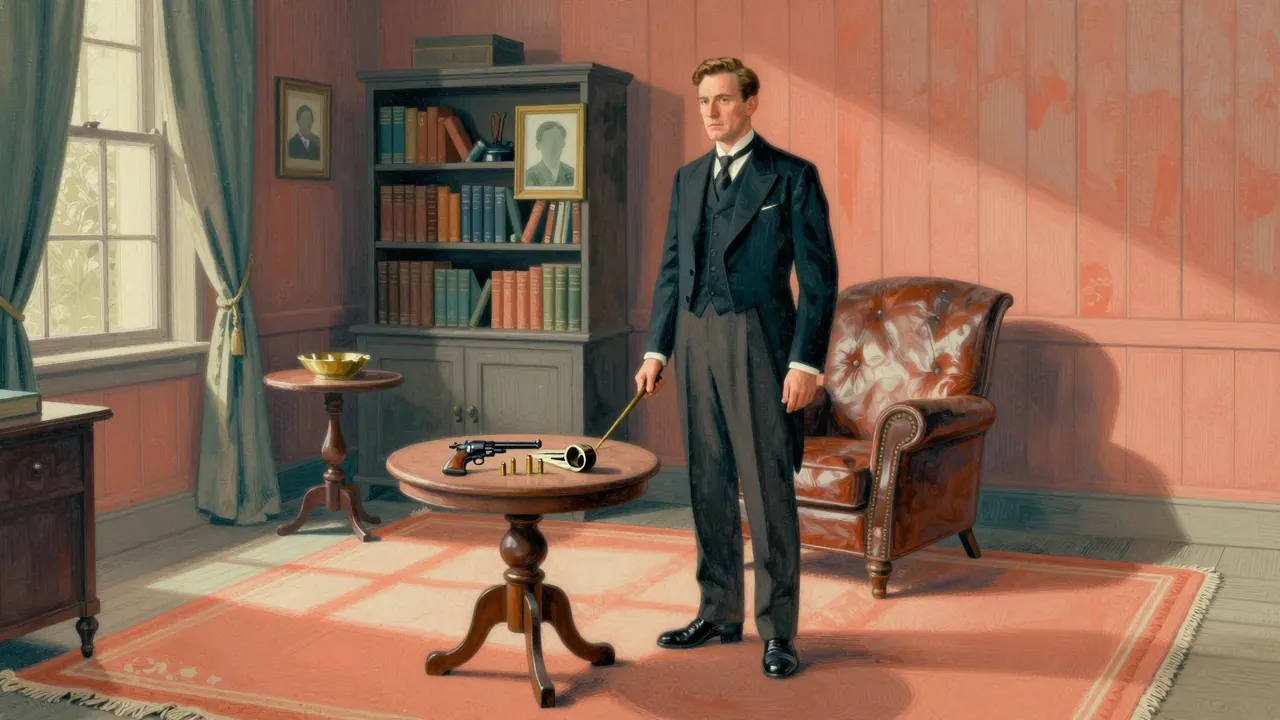
What lands is the precision of the fantasy sequences: the Rossini murder plot, with its absurdly meticulous planning and instant collapse into slapstick; the Wagnerian renunciation, undermined by spilled ink and a ruined cheque; the Tchaikovsky roulette, derailed by forgotten bullets and misplaced cartridges. These are not gags strung together but fully imagined worlds that obey their own internal rules — until those rules collide with reality’s stubborn texture. Harrison’s physical control sells the contrast between Alfred’s commanding presence on the podium and his fumbling ineptitude at home. The film’s satire of artistic temperament lands because it never mocks creativity itself, only the way ego can mistake rehearsal for action. Even the supporting cast lands cleanly: Rudy Vallée’s August is so amiably dense he becomes a kind of moral anchor, and Barbara Lawrence’s Barbara radiates untroubled ease. The music does not just underscore — it comments, contradicts, and occasionally outwits the characters, making the orchestra feel like a silent, knowing chorus.
The friction of it
What does not land is the framing device’s thinness: the detective report exists only to spark the fantasies, and its actual contents — Daphne searching for her sister in Tony’s room — arrive too late to carry dramatic weight. The hotel fire subplot feels tacked on, serving neither character nor theme beyond delaying Alfred’s lunch. Some transitions between fantasy and reality lack rhythmic clarity, leaving moments where the shift registers as confusion rather than wit. The film’s reliance on mid-century social codes — the deference to conductors, the assumption of male authority over marital investigation — now reads less as satire and more as period texture, which blunts some of its irony. A few secondary characters, like Dr. Schultz or Jules the valet, appear solely to deliver exposition or absorb a pratfall, without accruing personality. The 128-minute runtime also tests patience in the second act, where Alfred’s repeated failures risk repetition without escalation. The film assumes familiarity with its musical references; without that knowledge, the structure’s elegance recedes, leaving only the surface farce.
The thought of it
The themes that matter are self-deception as rehearsal, the gap between intention and execution, and the domestication of grand narratives. Jealousy here is not a feeling but a genre — one Alfred tries on like different costumes, each borrowed from opera or symphonic poetry. The film treats creativity as both weapon and alibi: Alfred composes revenge in his head with the same discipline he brings to conducting, yet cannot execute even the simplest version of it in real time. There is also a quiet commentary on class and nationality — Sir Alfred’s Englishness is performative, his title honorary, his authority borrowed from art rather than birth, and his crisis unfolds entirely within a gilded American hotel world. The music does not elevate the drama; it reveals how easily high culture can be repurposed for private delusion. What endures is not the plot’s resolution but the observation that moral seriousness often begins with misunderstanding — and that forgiveness, when it comes, arrives not as triumph but as relief, after the fantasies have exhausted themselves.
The pace of it
This film is for viewers who enjoy structural ingenuity in comedy, who recognise musical references without needing them explained, and who value writing that trusts the audience to follow logic rather than spoon-feed punchlines. It suits those comfortable with mid-century pacing and studio-era restraint — people who find humour in precision, not velocity. It is not for viewers who require emotional realism, strong narrative causality, or rapid-fire delivery; those who expect the stakes of infidelity to be treated with psychological depth or contemporary nuance may find its approach arch or evasive. Fans of Tarantino’s later list or Kael’s praise might be disappointed by its gentler rhythms. The film rewards attention to construction, not immersion — so it is not for passive viewing, nor for those who prefer comedy anchored in character flaw over conceptual play. Its pleasures are cumulative, not immediate, and its wit deepens with familiarity.
The time of it
Yes, it is worth your evening — provided you watch it as a crafted object, not a story to be believed. Its 128 minutes unfold with the deliberation of a well-rehearsed concerto, and its rewards lie in the alignment of music, script and performance, not in plot momentum. You will need to accept its central conceit without demanding plausibility, and to tolerate stretches where the satire leans on period manners rather than universal ones. Those who dislike extended fantasy sequences or find classical music intimidating may feel distanced. But for anyone interested in how comedy can be built like architecture — with load-bearing motifs, counterpoint, and deliberate repetition — it remains singular. Its influence is visible in later films that treat interiority as spectacle, but few match its balance of intellectual rigour and physical clumsiness. It earns its time not by rushing forward, but by holding still long enough for the joke to settle, then resonate.