The look of it
Summertime is a British-Italian-American co-production, directed by David Lean in 1954 and released in 1955, that adapts Arthur Laurents’ play The Time of the Cuckoo into a Venice-set drama about a middle-aged American woman’s solitary holiday and her brief, intense romantic entanglement with a married Italian antiques dealer. It aims to ground romance in psychological realism: not as wish-fulfilment but as a tremulous, morally ambiguous encounter shaped by loneliness, cultural dislocation, and the quiet desperation of unexamined lives. Lean and co-writer H. E. Bates shift emphasis from the play’s theatrical structure toward observational detail — the weight of a suitcase, the glare off canal water, the hesitation before a kiss — treating Venice not as backdrop but as active counterpoint: beautiful, indifferent, and saturated with other people’s intimacy. The film does not seek to resolve Jane Hudson’s situation, nor to moralise it; instead, it holds her vulnerability steady, without irony or condescension, while refusing to flatter her illusions. Its ambition lies in restraint: to make emotional exposure feel earned, not expositional. (158 words)
The weight of her presence
The story unfolds linearly, anchored by Katharine Hepburn’s performance as Jane Hudson — precise, watchful, physically contained until moments of sudden, almost involuntary release. Rossano Brazzi’s Renato is warm but evasive, his charm calibrated to deflect scrutiny. Jack Hildyard’s Eastmancolor cinematography avoids postcard prettiness: shadows pool in Venetian alleyways, interiors are dim and textured, daylight feels thin and transient. Peter Taylor’s editing sustains a measured rhythm — pauses linger, reactions are given space, dialogue overlaps only when it serves unease. Alessandro Cicognini’s score is sparse, leaning on strings and harp to underscore mood rather than dictate it. The script, rewritten multiple times before settling on Lean and Bates, retains some theatrical scaffolding — particularly in exposition-heavy exchanges at the Pensione Fiorini — but gains authenticity through location shooting: gondoliers’ shouts, church bells, the clink of glasses in Piazza San Marco are diegetic, not decorative. The film works best when it trusts its images over its explanations: Jane stepping backward into the canal, or dropping a gardenia into dark water, carries more narrative force than any speech about longing. (159 words)
The things that land
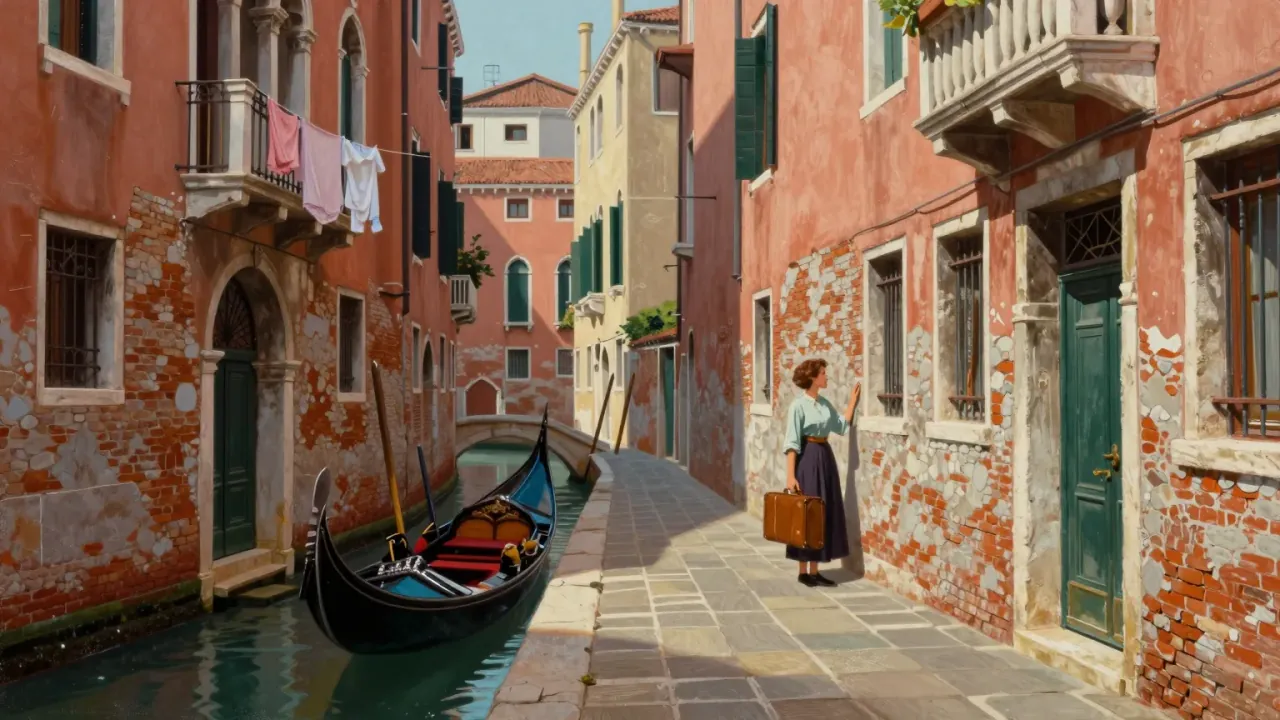
What lands is the accumulation of small, truthful gestures: Hepburn’s slight tightening of the jaw when Renato first touches her wrist; the way she arranges her new gloves on the bed before their second date; the silence between them after he admits he is married. The Venice locations do not merely frame the action — they condition it. A narrow calle forces proximity; a sunlit piazza exposes isolation; the damp chill of stone stairs makes intimacy feel like an act of will. The film’s emotional honesty rests on Hepburn’s ability to convey both self-reliance and its fragility — not as contradiction, but as habit worn thin. The scene at the concert, where La gazza ladra swells beneath murmured conversation and a flower seller interrupts, works because it refuses to subordinate character to spectacle. Even the censored consummation — implied through cutaways and Cicognini’s hushed strings — retains power because the build-up is so tactile: the rustle of fabric, the warmth of shared breath, the way Jane’s hand lingers on Renato’s sleeve before pulling away. These moments land because they are observed, not orchestrated. (157 words)
Where it stumbles
What does not land is the structural reliance on exposition to clarify Renato’s marital status and Jane’s internal conflict. Several conversations — particularly with Phyl Yaeger and Signora Fiorini — restate thematic points already established through action or expression, flattening subtext into summary. Darren McGavin’s Eddie Yaeger remains underwritten, his affair with the Signora introduced as plot convenience rather than psychological inevitability. The subplot involving Mauro, though visually engaging, serves little beyond local colour and occasional comic relief, never deepening Jane’s arc. Some scenes feel stranded between theatrical convention and cinematic naturalism: the pensione dinner table sequences, for instance, rely on overlapping dialogue that sounds rehearsed rather than lived-in. The film’s attempt to balance American reserve with Italian expressiveness occasionally tips into caricature — Renato’s ‘things are different here’ speech lands with the weight of a thesis statement, not a confession. And while the censorship cuts were necessary for 1955 distribution, their absence leaves certain emotional transitions abrupt: Jane’s shift from hope to disillusionment lacks the full texture of what was removed. (156 words)
What it’s really about
The themes that matter are loneliness as a condition rather than a mood; the asymmetry of desire across cultural and marital lines; and the quiet violence of respectability — how social expectation shapes not just behaviour but perception of self. Ageing is present not as decline but as accumulated caution: Jane’s savings, her careful packing, her reluctance to ask directions all signal a life organised around avoidance of risk. Venice functions as both mirror and provocation: its beauty highlights her solitude, its history suggests permanence against her transience, its Catholic architecture silently judges her choices. The film treats adultery not as transgression but as consequence — the inevitable outcome of two people meeting outside sanctioned structures, each carrying unspoken histories. Class is implicit in Jane’s ‘fancy secretary’ status: she has money enough for Venice, but not enough for ease; her clothes are neat but dated, her posture deferential. The theme of authenticity recurs materially — the red goblet, the gardenia, the opera overture — each object tested, questioned, then accepted on its own terms, much like the relationship itself. (159 words)
Who it’s for, and who it isn’t
This film is for viewers who value psychological nuance over plot propulsion, who find resonance in restraint, and who accept that some endings are closures without resolution. It suits those familiar with mid-century British and Italian cinema, or with Lean’s later work, where landscape and silence carry equal weight with dialogue. It is not for viewers who require clear moral framing, rapid pacing, or narrative payoff — Jane’s departure is neither triumphant nor tragic, but simply the next thing. Those expecting a conventional romance may find its ambiguity frustrating; those sensitive to period-specific gender dynamics may bristle at the film’s quiet acceptance of Renato’s privilege. A viewer who values Hepburn’s craft above all else will find much to admire; one who prioritises narrative symmetry will leave unsatisfied. The verdict shifts if the film were restored to its uncensored version — the missing footage would deepen the stakes of Jane’s choice, making her final stillness less enigmatic, more exhausted. (158 words)
Is it worth your evening?
Yes, it is worth your evening — provided you approach it as a study in emotional calibration, not a love story with guarantees. Its 100 minutes unfold with unhurried attention to gesture, light, and silence, rewarding patience with moments of startling clarity. It repays rewatching not for plot revelation but for the slow accumulation of detail: how Hepburn’s hands move differently before and after the canal fall, how the colour red recurs in goblets, flowers, and dress fabric, how Venice’s light changes from morning gold to evening grey. It is not escapist, nor urgent, nor comforting — but it is honest in a way few studio-era films dared to be. Those who dislike ambiguity or demand narrative closure will not find satisfaction here. But for viewers attuned to the weight of a glance or the significance of an unmade decision, Summertime offers something rare: a portrait of longing that refuses to flatter, simplify, or resolve. Its endurance lies in that refusal. (159 words)