The look of it
Tunes of Glory is a tightly wound psychological drama set in the immediate postwar winter of a Highland regimental barracks, attempting to dissect the collision between martial tradition and peacetime authority through the fraught succession from one commanding officer to another. It adapts James Kennaway’s 1956 novel with fidelity to its core tension: not between good and bad men, but between two incompatible kinds of legitimacy — earned in combat versus inherited by lineage and education. The film does not seek to mythologise the army, nor to indict it wholesale; rather, it isolates a microcosm where rank, ritual, and repressed feeling constrict like the stone walls of Shepperton’s sets. Its ambition is structural and behavioural: to show how discipline curdles into humiliation, how deference masks contempt, and how ceremony — the bagpipes, the dancing, the mess hierarchy — becomes both armour and noose. It avoids battlefield spectacle entirely, choosing instead the suffocating intimacy of corridors, snooker rooms, and whisky-stained officers’ quarters. This is not a war film about combat, but about what remains when the fighting stops: the unspoken hierarchies, the unhealed wounds, and the unbearable weight of being seen.
The sound of it
The story unfolds in strict chronological sequence across a few weeks in early 1948, anchored by the arrival of Colonel Barrow and the slow erosion of Lieutenant-Colonel Sinclair’s authority. Arthur Ibbetson’s cinematography keeps the interiors dim and grainy, favouring tight framing and shallow focus that press characters against each other and the walls. Anne V. Coates edits with surgical restraint — no flashbacks, no exposition beyond what is spoken or observed. Malcolm Arnold’s score uses pipes not as folk ornament but as psychological leitmotif: their blare is never celebratory, always ominous or funereal. Alec Guinness plays Sinclair with physical swagger and vocal rasp, yet avoids caricature by grounding his volatility in exhaustion and pride. John Mills’ Barrow is quieter, more internalised; his breakdown is conveyed through posture, hesitation, and the gradual slackening of his jawline. Supporting performances — Dennis Price’s sardonic adjutant, Gordon Jackson’s wary sergeant-major, Susannah York’s tentative Morag — are uniformly precise, never overstated. The script gives each officer distinct speech rhythms and class markers, and the direction trusts them to carry subtext without underlining it.
The weight of it
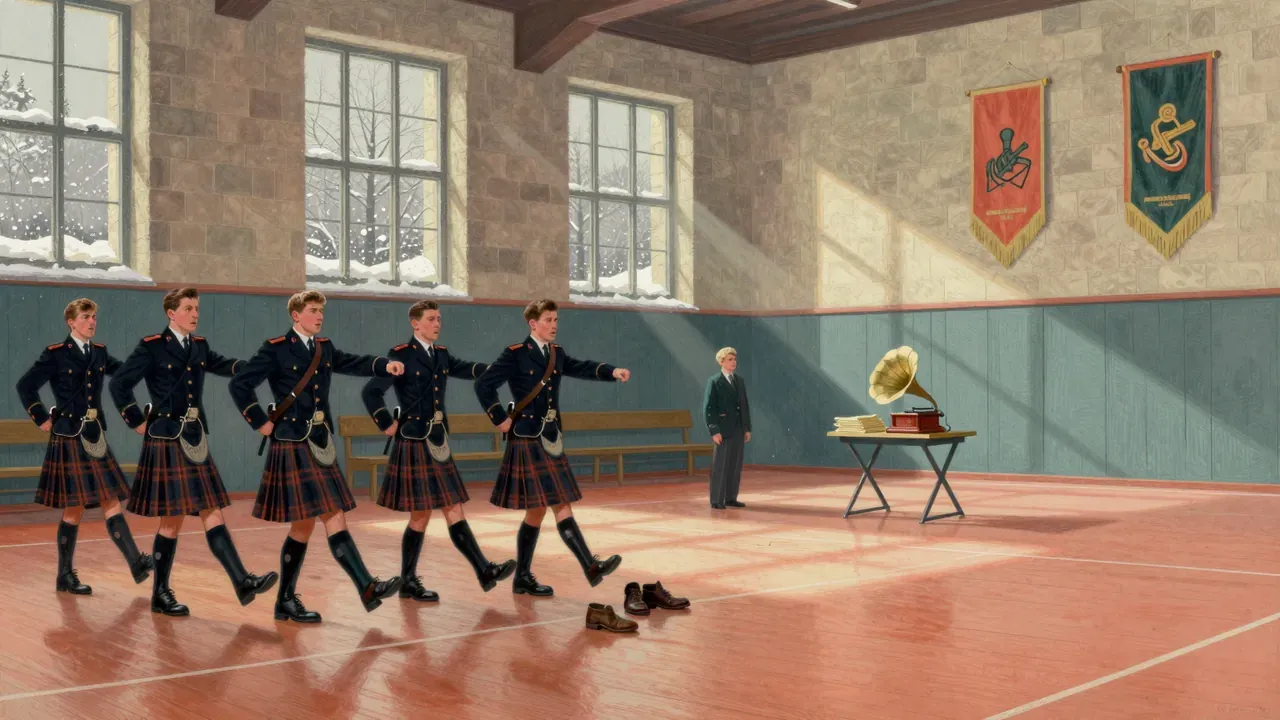
What lands most firmly is the cumulative pressure of the setting: the barracks feels lived-in and inescapable, its routines rigid enough to chafe but too familiar to abandon. The dance scene — where veteran officers are ordered to learn ‘proper’ Scottish country dancing — works because it is absurd, humiliating, and utterly plausible; it crystallises the film’s central conflict without dialogue. The snooker room confrontation, where Barrow realises he has no allies, lands with quiet devastation — Mills’ silence speaks louder than any outburst. The final sequence, though contested, gains force from its refusal to offer catharsis: Sinclair’s sobbing into his Tam o’ shanter is raw, unvarnished, and physically unglamorous. The bagpipes playing over falling snow do not resolve anything; they simply continue, indifferent. The film’s moral ambiguity also lands: neither man is wholly right or wrong, and the institution itself remains opaque, neither condemned nor exonerated. Even the minor details — the way whisky is poured, how a salute is held, the weight of a uniform tunic — register with documentary-level specificity, making the psychological rupture feel earned, not imposed.
The breaking point
What does not land is the romantic subplot involving Morag and Corporal Fraser, which functions as narrative ballast rather than emotional counterpoint. It introduces no new thematic dimension and resolves without consequence, serving only to trigger Sinclair’s violence in a way that feels contrived rather than inevitable. The portrayal of enlisted men as broadly comic or quaint — particularly in the mess scenes — sits uneasily beside the film’s otherwise unsentimental tone, introducing a layer of patronising ‘local colour’ that undermines its psychological seriousness. Some critics at the time found the ending emotionally dishonest: Sinclair’s public breakdown, while powerful, arrives after a series of escalating confrontations that lack sufficient interior preparation, making his collapse feel less like inevitability and more like dramatic convenience. The film also struggles to reconcile its critique of military hierarchy with its reverence for regimental ritual — the bagpipes are both weapon and lament, but the film never fully interrogates why this particular tradition endures while others crumble. That ambivalence is honest, but it leaves certain tensions unresolved rather than explored.
The language of it
The themes that matter are authority without consent, masculinity as performance, and the corrosion of self-worth under enforced irrelevance. The film treats rank not as abstract status but as daily practice — how one stands, drinks, dances, salutes — and shows how easily those habits become instruments of control or self-destruction. It examines leadership as inheritance versus leadership as endurance, asking whether command belongs to those who founded the institution or those who bled for it. Class is embedded in gesture: Barrow’s Oxford vowels, Sinclair’s Glaswegian bluntness, the way Cairns and Scott navigate both worlds without belonging to either. The film also probes the psychology of collective guilt — Sinclair’s declaration that he murdered Barrow, and that all officers are accomplices, reframes suicide not as personal failure but as institutional indictment. There is no villain, only systems that demand obedience even as they hollow out the men who serve them. The Highland setting is not exotic backdrop but structural metaphor: the regiment is a closed world with its own grammar, its own music, its own fatal logic — and its rituals are both refuge and prison.
The breaking down
This film is for viewers who value precision of performance over plot propulsion, who find tension in stillness and meaning in silence, and who are willing to sit with moral discomfort without resolution. It suits those familiar with British postwar social history or military culture, though neither is required — the dynamics translate plainly. It is not for viewers who require narrative momentum, clear moral alignment, or emotional release; those seeking catharsis will leave unsettled. Fans of The Bridge on the River Kwai may expect similar scale or thematic sweep, but Tunes of Glory operates at a lower register, more intimate and less heroic. Those who dislike period dramas with formal diction or static staging may find its pacing deliberate to the point of austerity. A viewer who values psychological realism over spectacle, or who finds power in understatement, will respond strongly. Someone who prefers explicit character arcs or thematic clarity would likely find it frustrating — and that is not a flaw in the film, but a mismatch of expectation.
The leaving
Yes, it is worth your evening — provided you approach it as a chamber piece, not an epic. Its 107 minutes pass without hurry but never drag, sustained by performances that deepen with attention and a structure that rewards patience. It repays rewatching: small gestures — a glance away, a pause before speaking, the way a glass is set down — accrue significance on second viewing. It is not entertainment in the conventional sense, but it is absorbing, intelligent, and emotionally exacting. Those who dismiss it as ‘stuffy’ or ‘dated’ are likely responding to its resistance to modern pacing or its refusal to simplify its characters. Yet its concerns — about legitimacy, loyalty, and the cost of maintaining face — remain current. Its power lies not in what it says, but in how relentlessly it observes what goes unsaid. To call it ‘slow’ mistakes restraint for inertia; to call it ‘cold’ mistakes clarity for indifference. It earns its gravity, and holds it without apology.