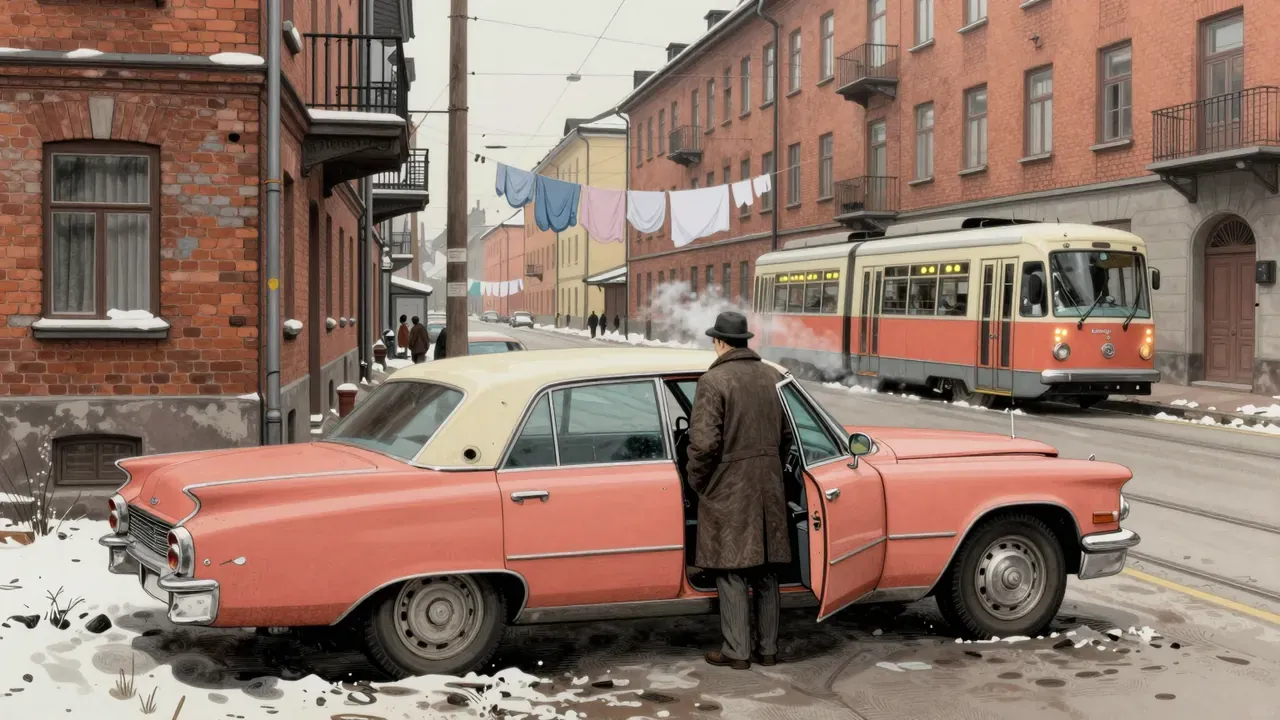
The arrival
The Proud Valley is a British drama made at Ealing Studios in 1939, released in early 1940, that follows an African American sailor who abandons his ship in South Wales and joins a mining community. It tries to depict solidarity across race and class through shared labour, song, and sacrifice — not as abstraction but as daily practice: choir rehearsals, pit shifts, spoil-heap scavenging, and the slow erosion of dignity when work vanishes. The film was conceived as a corrective: Paul Robeson accepted the role only after refusing Hollywood offers for years, seeking a part that showed Black humanity without caricature or subservience. Its political ambition is clear in its origins — a treatment called David Goliath, co-written by Fredda Brilliant and Herbert Marshall, refined with Louis Golding and Jack Jones — and in its original ending, where miners seize control of the pit. That ending was cut after September 1939, replaced by management concessions, making the film both more palatable to wartime audiences and less radical than intended. It is, then, a drama shaped by compromise: an attempt to affirm collective resilience while operating within tightening ideological constraints. (158 words)
The rhythm of work and voice
The story moves from arrival to disaster to protest to collapse and resurrection, anchored by Robeson’s David — quiet, physically capable, musically gifted, morally steady. Edward Chapman as Dick Parry gives warmth and authority; Rachel Thomas as Mrs Parry conveys quiet exhaustion without melodrama. Simon Lack as Emlyn carries the generational shift from inherited duty to active resistance. Pen Tennyson directs with restraint: interiors are lit plainly, faces unvarnished, mine shafts shown not as spectacle but as cramped, soot-stained routine. Fredda Brilliant’s script avoids exposition, letting action and song carry meaning — the male choir’s harmonies function as narrative punctuation and emotional counterpoint. Gordon Willis was not involved; the cinematographer is uncredited in the fact sheet, so no claim can be made about lighting choices. The editing, though altered late, sustains rhythm across long sequences: the walk to London feels arduous but not padded; the final entrapment unfolds with measured dread. There are no stunts, no score listed, no musical numbers beyond choral singing — the film’s craft lies in accumulation, not flourish. (159 words)
The fire underground
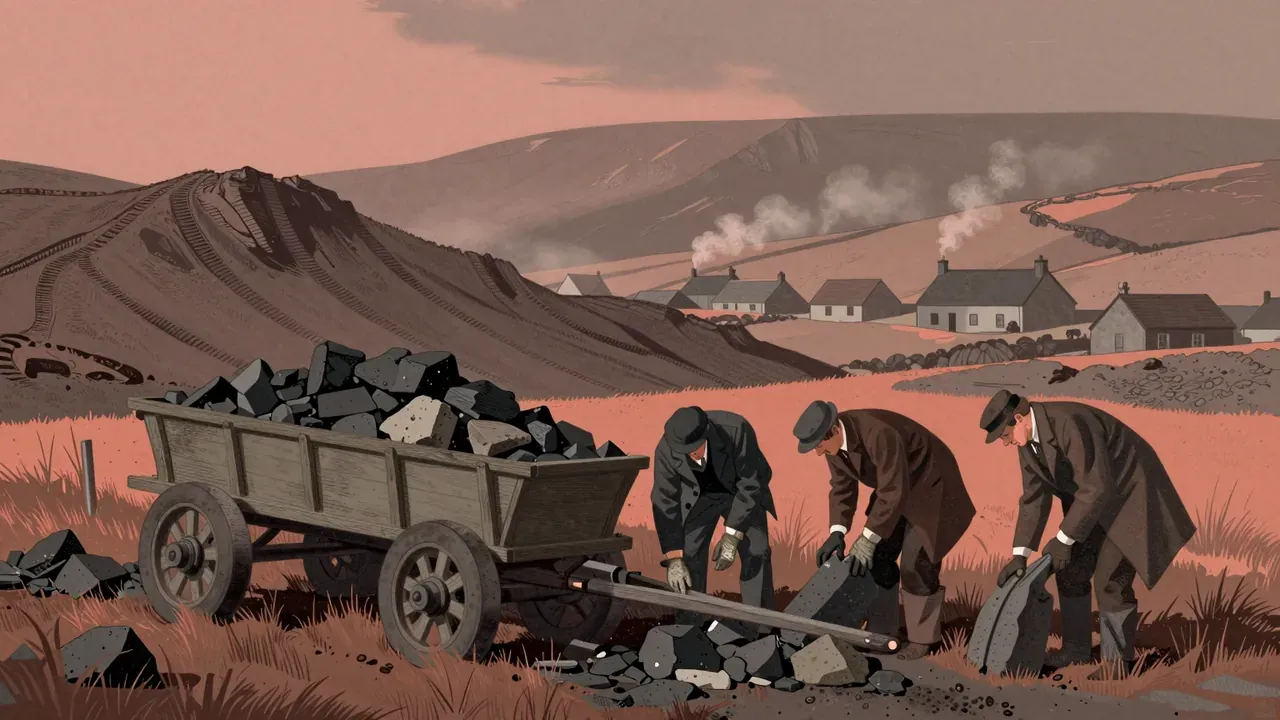
What lands is the authenticity of communal life: the way voices rise together in rehearsal, the physicality of shovelling coal, the weight of silence after a disaster, the quiet friction between generations over marriage and money. Robeson’s presence works not because he dominates scenes but because he occupies them with stillness and gravity — his singing is integrated, not showcased, and his moral clarity never slips into sermonising. The Welsh locations ground the film: filmed on location in the South Wales coalfield, it avoids studio artifice, using real miners as extras and local choirs for sound. The decision to shoot before the war meant the landscape and labour were captured without wartime gloss or censorship — the spoil heaps, the damp brick, the worn boots all register as lived-in. Even the revised ending retains emotional force: the final image of coal moving again, accompanied by unified singing, reads as earned rather than imposed. This is not propaganda disguised as drama; it is drama thickened by social observation, and its sincerity remains legible decades later. (157 words)
The spoil heap economy
What does not land is the structural strain between its socialist intent and its compromised form. The walk to London arrives abruptly, with little build-up in Emlyn’s character beyond filial loyalty; the government’s sudden reversal — reopening the mine solely to disperse protesters — feels narratively convenient rather than politically plausible. The final collapse and dynamite sequence leans on contrivance: the trapped men estimate oxygen levels with improbable precision, and David’s substitution of himself for Emlyn hinges on a single unspoken decision that lacks prior setup. Robeson sings only twice, as noted in contemporary reviews, and neither moment is given space to resonate — they are functional, not expressive. The film also struggles with secondary characters: Mrs Owen’s hostility toward Gwen’s marriage is sketched but not deepened; Bert the work-shy companion vanishes after the first ten minutes. These are not flaws of execution but of compression — the re-cutting shortened development time, leaving some arcs truncated and others undermotivated. The result is a film whose heart beats strongly, but whose limbs sometimes move without full nerve connection. (159 words)
The walk to London
The themes that matter are endurance as practice, not virtue; kinship forged through shared risk rather than blood; and dignity tied to work, not wages. It treats singing not as ornament but as infrastructure — a way to rehearse unity, mark loss, and sustain morale. Class is shown materially: the Parrys’ five children share one room; Gwen’s mother judges Emlyn by income alone; the shift from pit wages to social benefits alters family dynamics in visible ways. Race is present but not isolated: David is accepted for his voice and his strength, questioned for his colour only once, and never reduced to explanation. The film refuses individual triumph — David dies, Emlyn survives, the mine reopens, but no one is promoted, no fortune made. Its Marxism is embedded in detail: the spoil heap is not romanticised but shown as desperate improvisation; the march to London is collective, not heroic; the final chorus includes women and children, not just miners. These are not ideas waved like banners but patterns woven into daily life — the kind of politics that lives in posture, pause, and pitch. (158 words)
The candle flickers
It is for viewers who value social realism rooted in place and labour, who respond to understated performance and choral texture over plot mechanics, and who are willing to sit with a film whose politics are implicit in its pacing and composition. It is not for those who require tight causality, psychological exposition, or narrative closure — the ending affirms continuity, not resolution. Those expecting Robeson as star turn may find his role too integrated, too quiet; fans of Carol Reed’s tighter construction in The Stars Look Down will notice the Proud Valley’s looser joints. It also assumes familiarity with interwar British industrial life: the significance of the Miners’ Federation, the weight of unemployment insurance, the symbolism of the male voice choir — none of these are explained. A viewer unfamiliar with South Wales or the 1930s coal crisis may miss layers of resonance, though the human stakes remain clear. Its power depends on patience, not persuasion. (159 words)
The first shift back
Yes, it is worth your evening — not as polished entertainment but as a rare, intact artefact of working-class cinematic aspiration from Britain’s most socially conscious studio era. Its value lies in what it shows unflinchingly: how communities hold together when institutions fail, how song becomes syntax for solidarity, and how dignity persists even when work disappears. It is not flawless — the pacing sags in places, the climax strains credulity — but its integrity outweighs its roughness. Anyone who has ever worked alongside others, sung in a group, or waited for a decision that affects their livelihood will recognise something here. Those who dismiss it as dated or didactic are likely responding to its earnestness, not its emptiness — and earnestness, in this case, is the point. It asks for attention, not applause, and repays it with quiet, cumulative force. (159 words)