A reluctant errand a year after a suicide
Loving Vincent opens a year after Vincent van Gogh’s suicide, with postman Joseph Roulin asking his reluctant son Armand to deliver one of the painter’s last letters to his brother Theo. Dorota Kobiela and Hugh Welchman, who co-directed and co-wrote the film with Jacek Dehnel, built the project from a seven-minute short Kobiela first conceived in 2008 after studying Van Gogh’s letters and technique as a painter herself, and the errand plot exists largely to give a viewer a reason to move through the same towns and people Van Gogh knew in his final weeks, functioning as scaffolding for the visual project underneath it.
Witnesses assembled from Van Gogh’s actual circle
Armand’s errand becomes an investigation once he learns Theo has also died, and he is sent from Paris to Auvers-sur-Oise to find Dr. Gachet, the physician who housed Van Gogh after his release from an asylum, encountering along the way an art supplier, an innkeeper who knew Van Gogh personally, and Gachet’s sheltered daughter Marguerite. Each witness offers a different account of Van Gogh’s final mental state, some insisting he was calm and improving, others suggesting despair or even foul play, and Armand’s growing suspicion of a local boy known to harass Van Gogh gives the investigation a specific, if speculative, direction.
Sixty-five thousand paintings standing in for sixty-five thousand frames
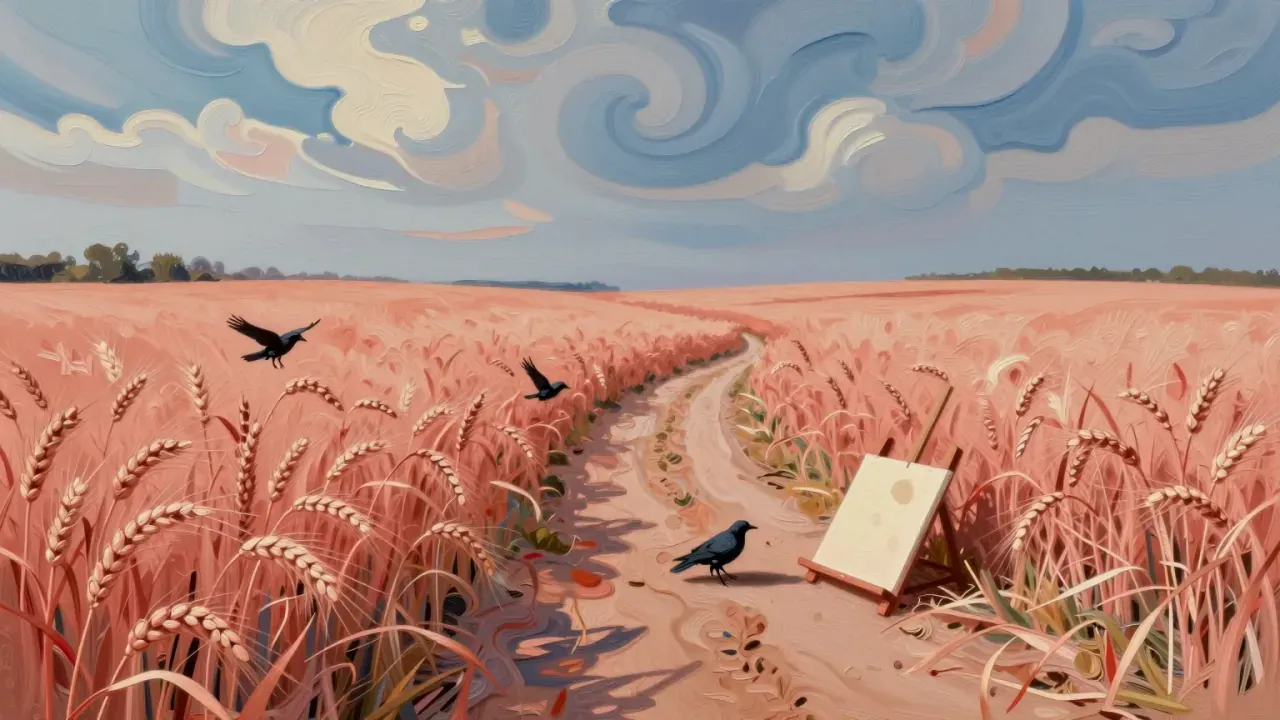
The film’s defining achievement is technical: after shooting the entire story as live action against green screen, the production had a team of a hundred and twenty-five classically trained painters, selected from around five thousand applicants across more than twenty countries, hand-paint over each of the roughly sixty-five thousand resulting frames in oil, using techniques modelled directly on Van Gogh’s own brushwork. Welchman has described it as the slowest form of filmmaking ever devised, and the six years the production took to complete reflects a genuinely unprecedented undertaking rather than a marketing claim.
A mystery plot thinner than the canvas it is painted on
Set against that achievement, the investigation plot itself is comparatively conventional, moving through a series of interviews and revelations that would not distinguish the film if it were shot in live action rather than painted. Several critics on release noted this imbalance directly, observing that the density of dialogue needed to carry a mystery plot sometimes worked against, rather than for, a film whose real interest was the paintings themselves, and the structure occasionally reads as narrative obligation layered onto a visual experiment rather than an integrated whole, as though the film needed a plot to justify the paintings rather than the other way around.
Motion borrowed from painted stillness
Because each frame originated as a live-action shot before being painted over frame by frame, the resulting motion carries a distinctive, slightly rotoscoped quality, fluid in a way pure animation rarely is, but visibly still a translation from filmed performance rather than drawn movement invented from scratch. That texture keeps a viewer’s attention returning to the technique itself throughout the film, which works in the film’s favour when the images are doing the heavy lifting and against it when a scene needs its dialogue to be the primary focus, since the eye keeps drifting to the brushwork instead of the conversation.
A film for people who want to watch how it was made
Viewers drawn to the film specifically for its visual technique, watching sixty-five thousand oil paintings assemble into motion, will find that promise delivered in full and will likely find the mystery plot a reasonable vehicle for it. Anyone expecting the investigation itself to carry comparable weight, with the twists and reveals of a well-constructed mystery, is more likely to come away wanting a tighter, more inventive script to match the ambition of the images surrounding it, since the plot mechanics do not reach the same level of achievement as the frames containing them.
Ninety-four minutes that reward patience with the images over the plot
Loving Vincent grossed several times its modest five-and-a-half-million-dollar budget and won the European Film Award for Best Animated Feature Film along with an Academy Award nomination, recognition earned largely for its innovation rather than its narrative construction, which aggregate critics scored more modestly than the visuals. At ninety-four minutes, it is worth an evening chiefly as a demonstration of what animation can look like when built entirely from oil paint, an experiment worth witnessing regardless of how tightly its mystery plot holds together around it, and one unlikely to be attempted again at this scale any time soon.