The opening shot
Swades is a Hindi-language drama film released in 2004, directed and co-written by Ashutosh Gowariker. It follows Mohan Bhargava, a NASA project manager based in Washington, D.C., who returns to rural India to locate his childhood nanny and instead becomes immersed in the material and moral realities of village life. The film attempts something uncommon in mainstream Hindi cinema of its time: to dramatise civic responsibility not as patriotic spectacle but as sustained, technical, communal labour — building a micro-hydroelectric plant in a village without reliable electricity. Its ambition is structural rather than symbolic: to show how scientific literacy, caste-awareness, and intergenerational care might converge in practice. It does not frame return migration as emotional homecoming alone, but as a recalibration of professional skill toward local need. The film’s political quietism — its avoidance of party politics, state bureaucracy, or overt protest — is deliberate. It locates agency not in institutions but in individual initiative, collective shramdaan, and pedagogical patience. That orientation shapes every choice, from pacing to casting to the refusal of villainy.
The first walk
The story unfolds across 187 minutes with unhurried deliberation: Mohan’s arrival, his slow disillusionment with urban solutions, his gradual alignment with Geeta’s school-based activism, and the long, tactile process of constructing the turbine system. Shah Rukh Khan modulates Mohan’s arc with restraint — no grand speeches, few close-ups in early scenes, his authority conveyed through posture and silence more than dialogue. Gayatri Joshi’s Geeta avoids inspirational cliché; her resistance to Mohan is rooted in practical distrust, not romantic tension. Mahesh Aney’s cinematography favours natural light and shallow depth, keeping interiors dim and exteriors sun-bleached, avoiding pictorial prettiness. A. R. Rahman’s score uses leitmotifs sparingly; the recurring ‘Yeh Jo Des Hai Tera’ theme appears only at structural turning points, never as underscore. Dialogue is functional, often understated — explanations of water flow or gear ratios are delivered without expositionary flourish. The film’s craft lies in its refusal to heighten: even the NASA sequences feel bureaucratic, not awe-inspiring; even the village conflict avoids melodrama, presenting caste exclusion as routine, unremarked fact.
The first sketch
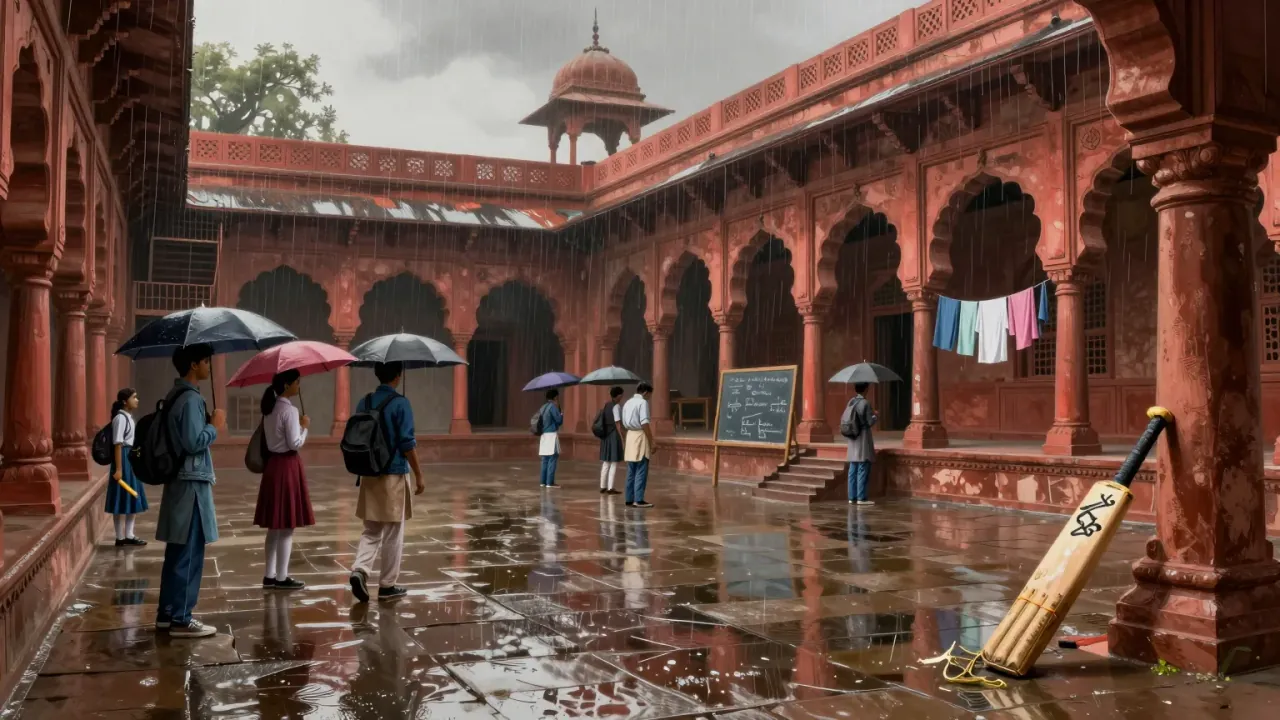
What lands most firmly is the film’s physical texture: the weight of a concrete mixer being hauled up a slope, the sound of chisels on stone, the way dust settles after a dry-season wind. These are not background details but narrative anchors — the hydro project gains credibility because its construction is shown in granular, unglamorous stages. The relationship between Mohan and Kaveri Amma works because it rests on unspoken history, not sentimentality; their silences carry more resonance than any monologue. The classroom scenes land precisely because they avoid didacticism: children’s questions about stars are answered with telescopes, not slogans. Even the film’s ideological core — Gandhian self-reliance reimagined through engineering — lands because it is embodied, not declared: when villagers haul pipes together, the idea of swadeshi is made kinetic. The film trusts its audience to infer meaning from action, not annotation. That trust pays off in moments like the first flicker of electric light in the schoolroom: no music swells, no faces turn upward — just a bulb glowing, then a child reaching out to touch the wire.
The visit to Kodi
What does not land is the film’s framing of systemic change as primarily dependent on one skilled outsider’s intervention. Though Mohan funds equipment and designs the system, the film underplays the pre-existing knowledge of local masons, carpenters, and farmers — their expertise is absorbed into his leadership rather than foregrounded as collaborative authorship. The upper-caste antagonists remain vague: Haridas’s landlord is never named, never seen, never spoken to directly — oppression arrives as ambient condition, not contested presence. This flattens the social terrain. Similarly, the resolution feels structurally tidy: the hydro plant works on first test, blackouts cease, caste barriers soften almost imperceptibly — all within three weeks. The film sidesteps the friction of maintenance, the risk of sabotage, the likelihood of political co-option. Geeta’s character, though grounded, is ultimately defined by her proximity to Mohan’s arc; her own intellectual lineage — her training, her reading, her network beyond Charanpur — remains opaque. The NASA subplot dissolves too cleanly, its ethical weight undercut by the ease of Mohan’s resignation.
The first light
The themes that matter are infrastructure as ethics, education as continuity, and return as recalibration rather than reversal. Swades treats electricity not as convenience but as a threshold: once light reaches the schoolroom, geometry lessons extend into night, women gather to read aloud, elders recount oral histories under bulbs instead of oil lamps. The film links technical capacity to dignity — not abstractly, but through specific acts: a girl learning to wire a switch, a boy calculating head pressure for a turbine, a teacher mapping rainfall patterns on a chalkboard. It treats caste not as moral failing but as embedded practice — undone not by confrontation but by shared labour, by assigning equal tasks to hands previously segregated. Gandhi’s influence is present not in ashrams or spinning wheels but in the insistence that development must begin where people are, using what is at hand. The film’s quietest theme is time: Mohan’s American schedule — deadlines, launches, quarterly reviews — collides with village time, measured in monsoons, harvests, and the slow accumulation of trust. That collision is where the film’s real argument resides.
The refusal
This film is for viewers who value procedural realism over narrative velocity, who find patience cinematic rather than punitive, and who accept that moral clarity often arrives in increments, not epiphanies. It suits those familiar with Indian rural life — or willing to sit with its rhythms without translation — and those attentive to how power operates in silence, not speeches. It is not for viewers who require clear antagonists, rapid plot turns, or emotional payoff within ninety minutes. Those expecting a diaspora romance or a polemic against corruption will find Swades withholding. Its pace and emphasis on collective work over individual triumph may frustrate audiences accustomed to Hollywood-style escalation. A viewer who values tight plotting over cumulative effect, or who reads technical detail as digression rather than substance, will likely disengage. The film assumes its audience can hold multiple registers at once: the personal, the political, the mechanical — and that willingness is the first filter.
The final kick
Yes, it is worth your evening — provided you watch it whole, without pause, and without expectation of conventional catharsis. Its 187-minute runtime is not indulgence but architecture: the length allows the village to become legible, its hierarchies tangible, its resistances earned. To cut it short is to miss the shift from Mohan’s detached observation to his bodily participation — the moment he lifts a shovel, not as gesture but as habit. Those who dismiss it as ‘slow’ mistake duration for dilution; its slowness is methodological, not aesthetic. Critics who found it ‘preachy’ likely conflated its clarity of purpose with lack of ambiguity — but the film’s moral certainty is earned through specificity, not assertion. Anyone who has ever tried to build something real with others will recognise its truth: the fatigue, the miscommunication, the sudden breakthrough, the quiet pride in a functioning system. That truth holds up, unchanged, twenty years on.