The premise
Risky Business is a suburban coming-of-age satire set in Glencoe, Illinois, built around the premise of a high-achieving teenage boy left alone for a week while his parents travel. It attempts to map the collision between adolescent desire and adult systems—academic expectation, financial consequence, sexual negotiation—using comedy not as relief but as structural logic. Paul Brickman’s script treats privilege not as backdrop but as operating system: Joel’s access to money, cars, space and impunity is the condition that makes both his missteps and his recovery possible. The film does not ask whether he is ‘good’ or ‘bad’, but how identity forms when social scripts—student, son, future Princetonian, client, entrepreneur—are all simultaneously available and unstable. It leans into tonal dissonance: a Tangerine Dream synth score under scenes of moral improvisation; a polished domestic interior hosting transactions that would be illegal elsewhere. Its ambition is narrower than it appears: less a universal portrait of youth than a precise calibration of class, timing and consequence in early-1980s American affluence. It is not about rebellion, but about the moment when responsibility becomes optional—and then unavoidable again. Word count: 148
The performance
The story moves with calibrated momentum: each escalation—Jackie’s arrival, Lana’s entrance, the Porsche’s descent, the brothel party—is triggered by a small choice that compounds. Tom Cruise’s performance anchors this, locating Joel’s anxiety in physical restraint before releasing it in bursts of manic energy, most famously in the ‘Old Time Rock and Roll’ sequence. Rebecca De Mornay plays Lana with quiet agency, never reducing her to plot device or fantasy; her presence recalibrates every scene she enters. Bruce Surtees and Reynaldo Villalobos shoot Glencoe’s interiors with cool precision—light pooling on marble floors, reflections in glass cabinets—making wealth feel tactile, not abstract. Richard Chew’s editing sustains rhythm without hurry, letting pauses breathe between lines. Tangerine Dream’s score avoids melody in favour of atmospheric pulse, underscoring unease rather than emotion. The dialogue is dense with subtext: characters speak past each other, negotiate in euphemism, defer meaning until it can no longer be avoided. There are no supporting performances that falter; even minor roles—Miles, Guido, Barry—register with economy and specificity. Word count: 152
The escalation
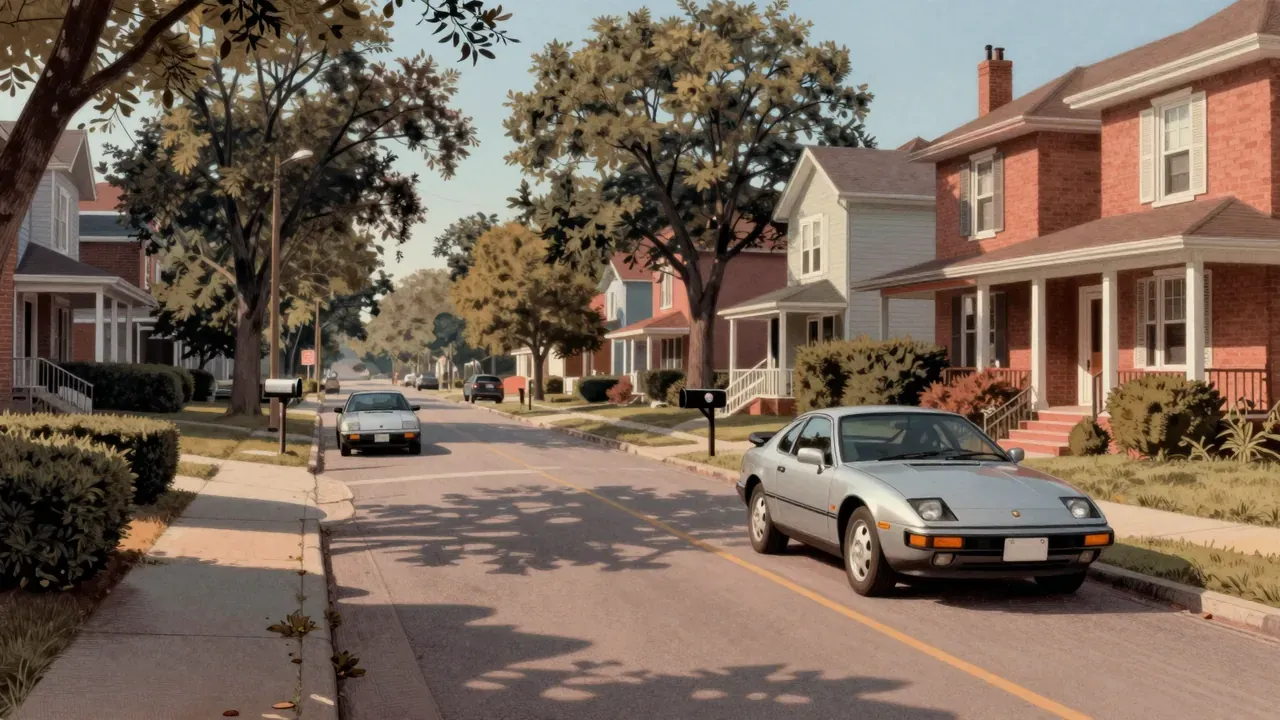
What lands is the film’s unblinking attention to consequence as process. The sinking Porsche is not spectacle but slow-motion inevitability—the car doesn’t crash, it drifts, then drops, then disappears. The brothel party works because it is not played for farce but for logistical realism: Joel arranges chairs, sets prices, fields interruptions, sweats over timing. His interview with the Princeton officer is interrupted not by slapstick but by actual teenagers asking for drinks, making institutional aspiration collide with lived chaos. The film’s best moments are those where tone holds steady while content tilts: Lana packing her bag after the first night, Joel staring at his reflection in a car window after the chase, the crack in the Steuben egg revealed only in the final minutes. These are not ‘messages’ but observations—about how power shifts in private rooms, how money reshapes relationships overnight, how adulthood arrives not as a threshold but as accumulated compromise. The film earns its comparisons to The Graduate not through similarity but through shared rigour in tracking the cost of self-invention. Word count: 156
The shortcuts
What does not land is the film’s occasional reliance on shorthand that now reads as dated or reductive. The cross-dressing escort Jackie functions as a single-joke pivot, his character defined entirely by surprise and discomfort, with no interiority or narrative weight beyond moving Joel toward Lana. The subplot involving Future Enterprisers feels tacked on, a thematic placeholder rather than an organic thread. Some supporting characters—Barry, Vicki—exist only to populate scenes, their motivations unexamined. The ending, particularly the studio version, resolves too neatly: Joel’s admission to Princeton and his ambiguous reunion with Lana suggest a reconciliation of opposites that the rest of the film has carefully refused. The film’s critique of privilege remains observational rather than interrogative—it shows Joel’s safety net but does not test its limits. It assumes the audience shares its frame: that Glencoe’s world is legible, consequential, worth satirising. That assumption narrows its reach, especially for viewers outside its specific cultural and economic coordinates. Word count: 153
The economy
The themes that matter are risk as currency, performance as survival, and autonomy as conditional. Joel trades one kind of performance—studious compliance—for another—entrepreneurial control—but neither is free of script. His briefs-and-socks dance is not liberation but rehearsal: he is trying on versions of himself in front of a mirror he thinks is empty. The film treats sex, money and status not as separate domains but as interchangeable units in a single economy. Lana understands this better than anyone: she names her fee, negotiates terms, walks away when the deal ends. The real tension is not between right and wrong but between visibility and invisibility—what happens behind closed doors versus what must be restored before the parents return. Class is not spoken of directly but encoded in every prop: the Porsche, the Steuben egg, the Ray-Bans, the Princeton brochure. The film’s quietest theme is time: the compressed week, the ticking clock of the party, the delayed consequences that arrive just as normal life resumes. It asks what adulthood looks like when it arrives not as maturity but as damage control. Word count: 151
The audience
This film is for viewers who recognise the grammar of 1980s American suburbia—not as nostalgia but as infrastructure—and who value writing that trusts them to follow implication. It rewards attention to pacing, to silence between lines, to how light falls on a hallway floor. It is not for those who require moral clarity, psychological exposition or resolution that feels earned rather than convenient. Anyone put off by the film’s comfort with ambiguity, its refusal to condemn or endorse Joel’s choices, or its treatment of sex as transactional will find it alienating. Those expecting a straightforward teen comedy will miss its satirical architecture. A viewer who values character depth over plot mechanics may find the secondary figures thin. But its core argument—that privilege insulates not from consequence but from its immediacy—remains legible across decades. Change the setting to a different affluent enclave, update the soundtrack, keep the structure, and the film’s logic holds. Word count: 150
The verdict
Yes, it is worth your evening—not because it is flawless, but because it operates with such consistent intelligence about how young people navigate systems they did not build. Its ninety-five minutes pass with the quiet urgency of a plan unfolding just ahead of disaster. It repays rewatching: the second time, you notice how often Joel is framed behind glass, or how rarely the camera leaves Glencoe’s boundaries. Those who dismiss it as period artefact overlook how precisely it maps the mechanics of advantage—how opportunity arrives disguised as accident, how safety nets are invisible until they catch you. Critics who found it shallow in 1983 were reacting to its refusal to moralise; today, that restraint reads as strength. It is not timeless, but it is durable: its concerns—autonomy, consequence, performance—have not aged. To skip it is to miss a key text in the grammar of American cinematic satire. Word count: 149