The premise, already in motion
Comanche Station is a Western made in 1960 by Budd Boetticher and Randolph Scott, produced for Columbia Pictures. It belongs to the Ranown cycle — a sequence of six lean, dialogue-sparse Westerns built around Scott’s laconic, morally anchored rancher figure. The film sets out to distil the genre to its structural essentials: a man rides into a situation already in motion, assesses threat and motive without exposition, and acts with calibrated finality. There is no origin story, no flashbacks, no explanation of why the protagonist carries his particular burden of silence or vigilance. It works within strict spatial and temporal limits — one rescue mission across arid, unpopulated terrain, unfolding over roughly two days. Its ambition is not psychological expansion but ethical compression: to ask what fidelity looks like when stripped of sentiment, rhetoric or reward. It assumes familiarity with Western conventions only to subvert them quietly — the cavalry does not arrive, the town does not rally, and the woman rescued does not become a love interest. Word count: 142
The weight of every line
The story follows Jeff Henry, a retired Texas Ranger, who tracks a Comanche raiding party to recover a woman abducted years earlier. He finds her alive, then joins forces with two other men — one opportunistic, one vengeful — to cross hostile land back toward civilisation. Burt Kennedy’s script gives each character a single defining motive and lets their actions expose contradiction or consistency. Randolph Scott holds the frame with minimal inflection: his stillness reads as both weariness and watchfulness. Nancy Gates plays the rescued woman without fragility or gratitude; her quiet resistance to being reabsorbed into any narrative of rescue is sustained but understated. Claude Akins and Skip Homeier embody opposing forms of moral erosion — one through greed, the other through grievance — and neither is caricatured. Mischa Bakaleinikoff’s score is functional, never illustrative: strings pulse low under tension, fall silent at moments of decision. The photography avoids grandeur; compositions are tight, horizons low, light flat and unromantic. Word count: 153
The power of the cut
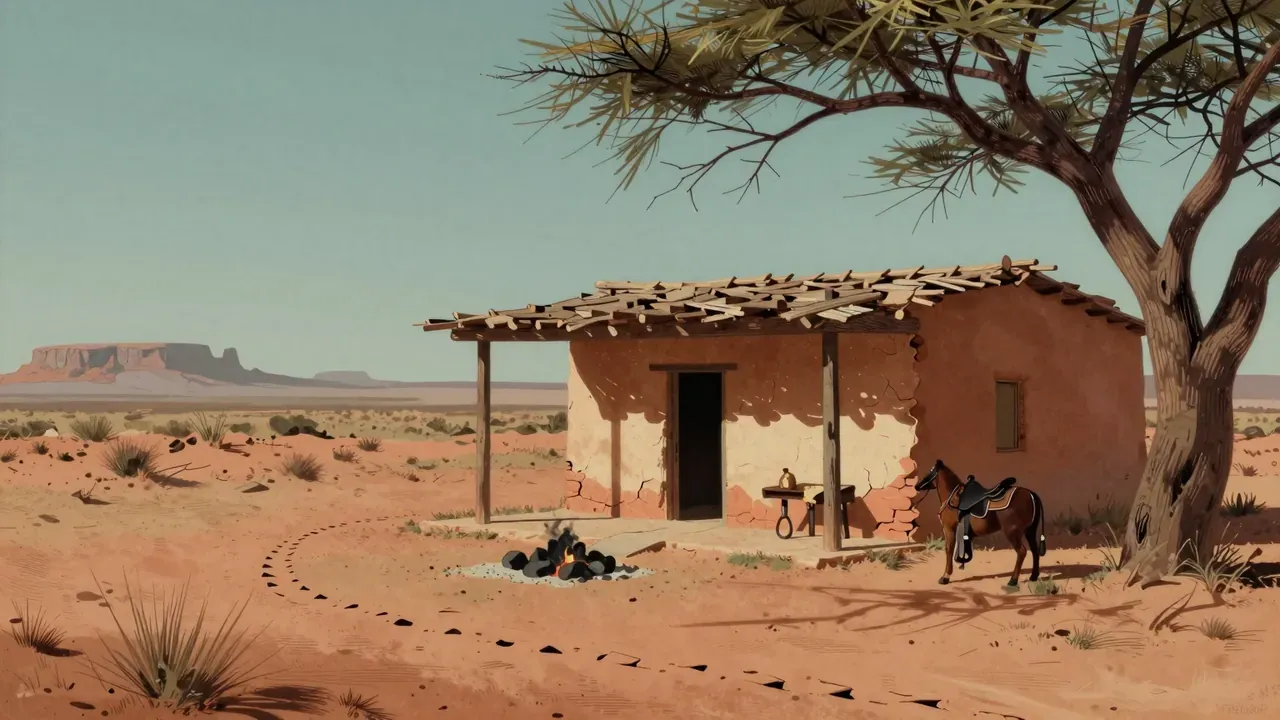
What lands is the film’s refusal to resolve ambiguity into reassurance. When Henry chooses not to kill a man who has wronged him — not out of mercy, but because the act would serve no purpose — the moment registers not as nobility but as exhaustion made visible. The pacing sustains this: scenes end before emotional payoff, edits cut on movement rather than reaction, and silences last long enough to unsettle expectation. The landscape functions as counterpoint, not backdrop: its emptiness is neither majestic nor indifferent, but materially consequential — water is rationed, shade is scarce, distance cannot be hurried. Even the horseplay between minor characters feels grounded in physical fatigue, not comic relief. The film’s economy extends to its violence: it arrives without warning, ends without aftermath, and leaves no room for catharsis. This restraint makes the few gestures of care — a shared canteen, a hand steadying a rifle — land with disproportionate weight. Nothing is overstated, and nothing is wasted. Word count: 148
The logic of silence
What does not land is the film’s assumption that its moral architecture will read clearly without scaffolding. The motivations of the secondary characters — particularly Rand Brooks’ young rancher — remain underdeveloped to the point of opacity, and their shifts in allegiance feel less like evolution than narrative convenience. Richard Rust’s role as the third rider adds little beyond visual symmetry; his presence serves the geometry of the group more than its psychology. The film’s austerity occasionally tips into abstraction: a key confrontation near the finale hinges on unspoken history that the script declines to name, leaving viewers reliant on prior knowledge of the Ranown cycle or generic tropes. Some performances suffer from the lack of interior access — Nancy Gates’ character is compelling precisely because she refuses exposition, but her agency remains confined to refusal, never initiative. The score, while disciplined, rarely deepens mood; it marks time rather than shaping it. Word count: 151
The rhythm of loyalty
The themes that matter are loyalty as habit rather than belief, justice as maintenance rather than triumph, and masculinity as endurance without validation. The film treats honour not as a code to be declared but as a rhythm to be kept — in the way Henry checks his pistol, reins his horse, or waits before speaking. It questions the Western’s foundational myth of restoration: the woman is not returned to a home that still exists, nor is the land reclaimed as stable or safe. Instead, order is temporary, local, and maintained by individuals who do not expect recognition. There is no redemption arc, only recalibration — Henry does not reclaim his past self, but adjusts his present conduct to match the facts on the ground. The film also examines how trauma becomes routine: the abducted woman speaks of her years with the Comanche not as horror but as adaptation, and her return is marked less by relief than by disorientation. These ideas are not argued but embedded in duration, gesture, and silence. Word count: 149
The viewer’s contract
This film is for viewers who value precision over persuasion, and who find tension in withheld information rather than revealed backstory. It suits those accustomed to mid-century American studio craft — where performance lives in posture, editing in rhythm, and meaning in what is left unsaid. It is not for those who require narrative propulsion, emotional signposting, or thematic resolution. Anyone expecting character arcs, romantic development or moral clarity will find the film withholding to the point of austerity. Those who prefer Westerns as allegory — say, High Noon’s civic parable or Shane’s mythic abstraction — may find Comanche Station too grounded, too resistant to symbolic lift. Its pleasures are cumulative and tactile: the grain of a saddle, the weight of a pause, the exact angle of a shadow at noon. To dislike it is not to misread it, but to reject its terms — which is fair, given how deliberately those terms are set. Word count: 150
The shape of the ending
Yes, it is worth your evening — provided you approach it as a study in restraint, not an immersion in plot. At 74 minutes, it asks little of your time but demands attention to its granular choices: how a glance delays action, how a cut denies reaction, how silence replaces exposition. Its value lies not in what it says but in how thoroughly it refuses to say more than necessary. Those who find pleasure in formal discipline — in the way Boetticher frames a three-shot to show hierarchy without dialogue, or how Scott’s walk across a courtyard conveys both authority and isolation — will find it richly rewarding. Others may leave feeling it offered little, not because it is empty, but because it declines to fill space with ornament. A viewer who values narrative generosity over structural rigour would reasonably disagree. Change the runtime to 95 minutes or add a flashback sequence, and the verdict would shift. Word count: 150