A network turns a breakdown into a ratings hit
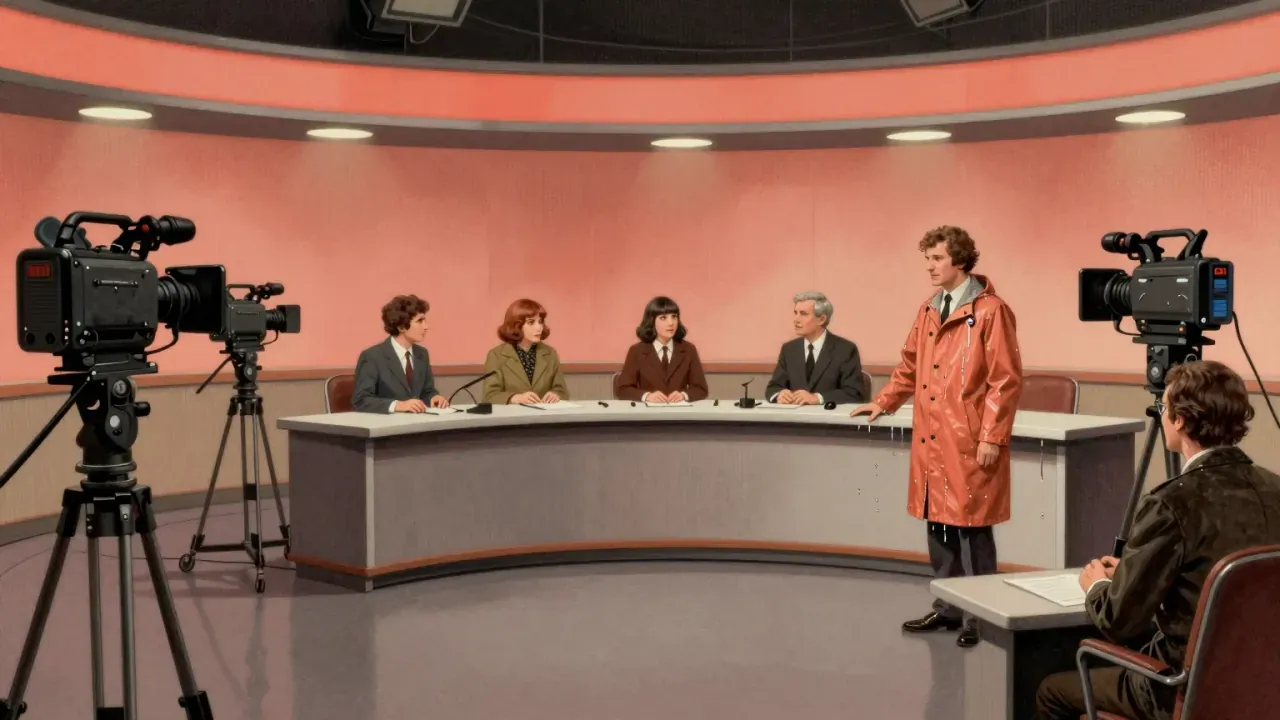
Network follows a television network that turns its longtime news anchor’s on-air mental breakdown into a ratings phenomenon rather than a crisis to be managed. Sidney Lumet directed a script by Paddy Chayefsky, released in 1976 and produced by MGM with United Artists distributing. Howard Beale, played by Peter Finch, announces he will kill himself live on air after being told he’s being fired for poor ratings; instead of pulling him, the network’s programming chief Diana Christensen, played by Faye Dunaway, builds an entire show around his unravelling. Chayefsky wrote the script as a satire, not a documentary, and Lumet has said flatly that Beale was never modelled on any specific real broadcaster, whatever parallels viewers have since drawn to actual on-air tragedies of the period.
Faye Dunaway, William Holden, and a script built to seethe
Chayefsky and Lumet went through a long list of actors before settling on their cast: Henry Fonda, James Stewart and real newscasters Walter Cronkite and John Chancellor all turned down or were passed over for Beale before Peter Finch, an Australian actor, paid his own way to New York to audition and won the part on the strength of tapes he’d made mimicking American news readers. William Holden plays Max Schumacher, the one character allowed any weariness rather than appetite, opposite Dunaway’s Diana, whom Lumet insisted be shot without any softening: he told her he would cut any moment that read as sympathetic. Robert Duvall, cast as network executive Frank Hackett, plays the role as a ruthless version of Gerald Ford, in his own description. Ned Beatty, brought in on Robert Altman’s recommendation, delivers a four-page monologue as corporate chairman Arthur Jensen after a single day’s preparation.
What the satire nails
The film’s four acting Oscars, Finch posthumously for Best Actor, Dunaway for Best Actress, Beatrice Straight for a single scene as Max’s wronged wife, and Chayefsky for the screenplay, reflect how much of the film’s force sits in direct-to-camera speeches rather than plot mechanics. Beatty’s Jensen monologue, delivered to a cowed Beale in a darkened boardroom, works as the film’s real thesis statement: that corporate power has replaced ideology entirely, delivered with none of the anchor’s earlier hysteria. Beale’s on-air call for viewers to shout their fury out of open windows became the moment audiences carried out of the cinema, turning a $3.8 million production into $23.7 million at the box office. Owen Roizman’s cinematography keeps the newsroom and boardroom scenes flatly lit and procedural, which makes the outbursts inside them land harder by contrast.
Where the film overreaches
The romance between Max and Diana is the weakest thread: it exists mainly to let Chayefsky stage a debate about television’s effect on human feeling, and Diana’s inability to be moved by anything outside ratings is stated so directly, in scenes built almost entirely from monologue, that it leaves her closer to an argument than a person. Beatrice Straight’s celebrated scene as Louise, confronting Max over his affair, runs so hot that some viewers find it tips into the same hysteria the film is otherwise satirising in its network executives. The film’s satirical targets, a variety show built around psychics and a terrorist collective willing to film its own crimes for broadcast rights, are pitched broadly enough that the comedy occasionally undercuts the sharper, quieter argument about ratings replacing journalism.
Anger as entertainment, then and now
Chayefsky wrote the script after visiting real network offices and being struck that the executives commissioning television barely watched it themselves; his conclusion, that American audiences wanted anger rather than reassurance, was shaped by the surrounding backdrop of Watergate and Vietnam rather than any single incident. The film’s real subject is less Beale’s breakdown than how quickly institutional power will repackage any raw human event, including a man’s collapse, as a marketable product once it draws an audience. Arthur Jensen’s boardroom speech pushes that argument to its most explicit point, framing corporations rather than nations as the true seat of authority. Four decades on, the film’s premise, networks profiting from unfiltered rage, reads less like satire and more like description, which is a large part of why it keeps being cited.
Who should watch it, and who might not connect
Network suits viewers who enjoy dialogue-driven satire delivered at full volume, and anyone interested in how television as an industry has been portrayed by people who actually worked inside it. Chayefsky’s screenplay, still cited by the Writers Guild as one of the best ever written, is reason enough on its own for anyone studying screenwriting. It will feel overstated to viewers who prefer restraint or naturalism, since almost every major scene is built as a speech rather than a conversation, and those looking for a grounded, character-first drama rather than a satirical broadside may find the film’s positions too openly stated to leave much room for their own interpretation.
A sharp two hours, still relevant
At 121 minutes, Network moves briskly for a film this dense with monologue, and its four Oscar-winning performances are reason enough to give it an evening even if the satire’s targets have shifted since 1976. Rotten Tomatoes lists an 8.4 out of 10 average score and a 90% Tomatometer rating, and Metacritic scores it 83 out of 100, numbers that track a film critics still rank among the era’s sharpest. It’s best watched by viewers happy to take a film at its most heightened register rather than expecting subtlety, and for that audience it remains one of the more purely enjoyable angry films of its decade.