The look of it
My Beautiful Laundrette is a British romantic comedy-drama set in South London in the mid-1980s, written by Hanif Kureishi and directed by Stephen Frears. It attempts to hold several contradictions at once: a gay love story between two working-class men, a critique of Thatcherite aspiration, a portrait of Pakistani-British family life, and a satire of entrepreneurial hustle — all within a low-budget, naturalistic frame. It does not aim for historical completeness or sociological balance but for specificity: the texture of damp brickwork in Vauxhall, the clatter of coin-operated machines, the unspoken weight of migration and generational silence. Its ambition is modest in scale but precise in focus — to show how intimacy and ideology collide in ordinary places. It treats politics as lived habit, not debate; economics as rent due, not theory. The film’s formal restraint — shot on 16 mm for Channel 4 before cinema release — matches its thematic refusal of grand pronouncement. It speaks through gesture, glance, and withheld dialogue rather than exposition. Its project is not to explain Britain in 1985 but to locate, with quiet exactness, where Omar and Johnny stand inside it. (159 words)
How it moves
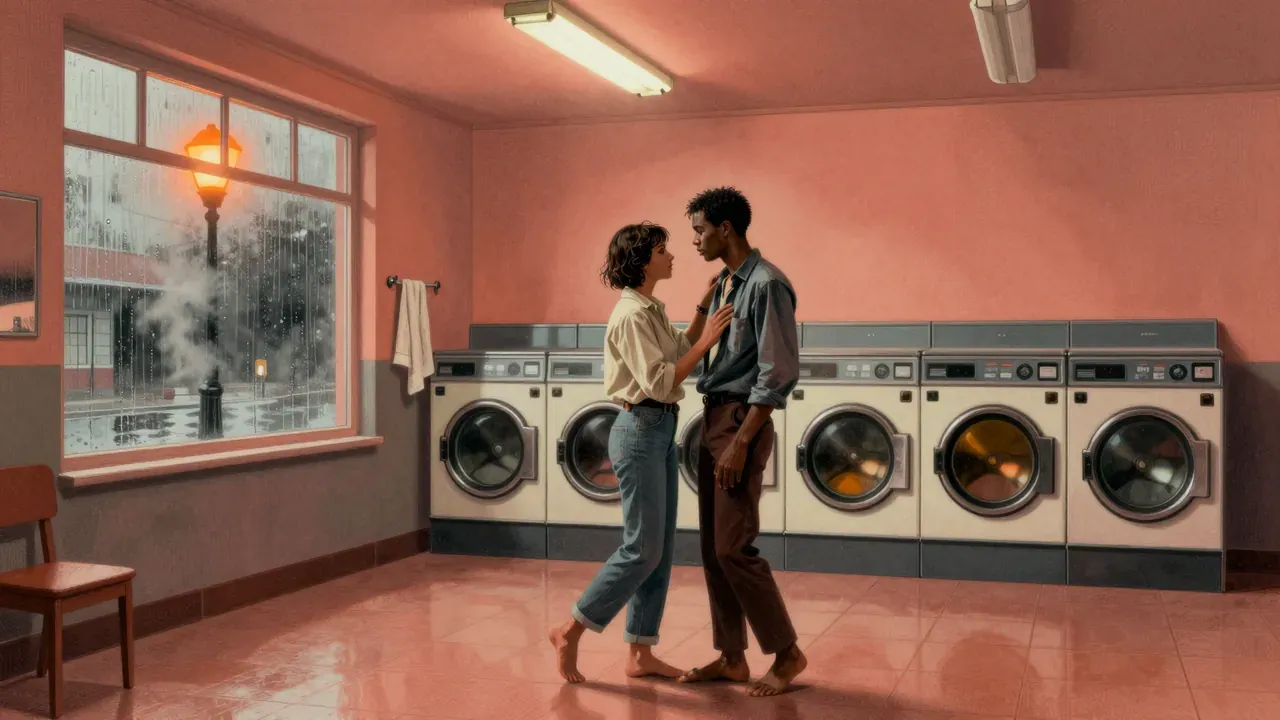
The story follows Omar Ali, a young British-Pakistani man, as he renovates a laundrette with Johnny, his estranged childhood friend and now lover. Hanif Kureishi’s script moves with economical precision: scenes pivot on small decisions — a job offer, a drug delivery, a dance in a tiled room — that accumulate moral weight without fanfare. Gordon Warnecke plays Omar with watchful stillness; Daniel Day-Lewis gives Johnny a coiled physicality, all knuckles and sudden laughter. Oliver Stapleton’s cinematography keeps the light flat and the framing tight, favouring medium shots that hold both characters in the same frame even when they are not speaking. Mick Audsley’s editing avoids rhythm for its own sake; cuts land where attention shifts — from a father’s slumped shoulders to a cousin’s unreadable gaze. Stanley Myers’ score uses waltz fragments and Puccini motifs not for irony but for contrast: elegance against grit. The production design — peeling paint, mismatched tiles, second-hand dryers — feels sourced, not assembled. There are no establishing shots of Parliament or stock footage of strikes; the era arrives via a radio report, a newspaper headline glimpsed in passing, the cut of a blazer. (158 words)
Where the feeling lives
What lands most firmly is the film’s refusal to separate personal desire from political circumstance. Omar’s romance with Johnny is never abstracted from the garages, launderettes, and council estates that shape their options. Their relationship gains force because it is tethered to material reality: money owed, space shared, violence anticipated. The scene where Johnny refuses to fight back during the attack lands not as martyrdom but as exhaustion — a choice made after too many compromises. The laundrette itself becomes legible as both refuge and compromise: clean, functional, quietly defiant. Even minor characters register with economy — Saeed Jaffrey’s Nasser radiates pragmatic charm, Roshan Seth’s Salim carries menace without caricature. The film’s tone — wry but unsentimental — holds steady across tonal shifts: a slapstick chase, a drunken proposal, a ritual curse dismissed with a shrug. It trusts the audience to follow emotional logic without underlining it. The final image — two shirtless men splashing water — works because it arrives after ninety minutes of withheld vulnerability, not as release but as continuation. Nothing here feels earned by narrative obligation; everything feels earned by behaviour. (157 words)
What stays unsaid
What does not land is the film’s occasional drift into schematic contrast. The parallel between Hussein’s left-wing disillusionment and Nasser’s entrepreneurial success remains underdeveloped — less dialectic than juxtaposition. Neither man is given enough interiority to make their differences feel like lived positions rather than plot functions. Similarly, Tania’s role as cousin-bride-to-be registers more as narrative pressure than character: her motivations narrow as the film progresses, until her departure feels abrupt rather than inevitable. The subplot involving Rachel’s skin rash and the ‘ritual curse’ gestures toward cultural tension but lacks grounding — it appears and recedes without consequence, unlike the drug trade or the laundrette’s renovation, which drive action forward. Some exchanges — particularly those between Omar and Johnny about politics — risk sounding like Kureishi’s voice overwriting theirs, especially when delivered without the same physical specificity as other scenes. The film’s brevity works against it here: there is no time to let these threads breathe, so they read as gaps rather than omissions. A longer runtime might have allowed ambiguity; at ninety-three minutes, what is implied needs to be felt, not just signalled. (156 words)
What it’s really about
The themes that matter are inheritance and reinvention — not as abstractions but as daily labour. Omar inherits his father’s silence, his uncle’s pragmatism, and his community’s expectations, yet chooses to launder clothes rather than ideologies. The laundrette is literal and metaphorical: a place where things are cleaned, sorted, and returned — not transformed, but made usable again. Class operates not as backdrop but as grammar: the difference between washing cars and owning dryers, between delivering drugs and laundering money, between living with a father who reads Marx and one who reads property listings. Race is present not as subject but as condition — in who opens doors, who gets searched, who is assumed to belong where. Sexuality is treated with the same matter-of-factness: Omar and Johnny’s relationship is neither hidden nor announced, but folded into the rhythm of work and care. The film’s quietest theme is agency within constraint — how much self-determination is possible when your options are shaped by immigration status, economic policy, and familial duty. It does not ask whether Omar should choose Johnny or Tania, but whether either choice can exist outside the structures that define them. That question lingers long after the final splash of water. (159 words)
Who it’s for
This film is for viewers who value writing that trusts subtext, performances that resist explanation, and social observation that avoids diagnosis. It rewards attention to gesture, pause, and setting — not as decoration but as argument. It is not for those who require clear moral alignment, linear cause-and-effect, or resolution that names itself. Anyone expecting a conventional romance or a polemic about Thatcherism will find neither: the politics are embedded, the love story understated. Those who dislike ambiguity in motivation or who need characters to articulate their inner lives aloud may find the film withholding. It assumes familiarity with British class markers and post-colonial urban geography — not as barriers, but as textures. A viewer unfamiliar with 1980s London may miss some of the satire’s bite, though the human dynamics remain legible. The film’s power rests on its refusal to translate itself. To dismiss it as ‘dated’ or ‘niche’ would mistake its specificity for limitation — but someone who prefers exposition over implication, or catharsis over continuity, will likely leave unsatisfied. (159 words)
Is it worth your evening?
Yes, it is worth your evening — not as escapism, but as calibration. At ninety-three minutes, it occupies time without wasting it; every scene serves the central tension between belonging and becoming. Its pacing feels urgent but unhurried, its tone consistent without being monotonous. It repays rewatching not for hidden clues but for accumulated detail: how Johnny’s posture changes across locations, how the laundrette’s lighting shifts with each visit, how dialogue avoids stating what the actors already convey. Those who find its realism too muted or its politics too implicit may prefer something more declarative — but that is not a flaw in the film, only a mismatch in expectation. The verdict does not change if you know Kureishi’s later work or Frears’s filmography; this stands on its own terms. Its endurance lies in how little it insists, and how much it implies. It earns its reputation not by shouting its importance, but by refusing to look away from the ordinary. That makes it worth watching — and worth remembering. (159 words)