What it is
Beasts of No Nation is a dramatisation of child soldiering in an unnamed West African civil war, adapted from Uzodinma Iweala’s 2005 novel. It does not aim to document a specific conflict but to render the psychological and moral erosion of a boy named Agu as he is conscripted, brutalised, and instrumentalised by armed factions. The film avoids naming countries or historical dates; its geography is generic — jungle, village, mine, brothel — and its politics are reduced to slogans and shifting allegiances. Fukunaga’s intention, stated in interviews, was to enter the subject through the novel’s ‘elegant and concise’ voice, preserving its Krio-inflected dialogue and first-person interiority. This is not a geopolitical primer nor a journalistic reconstruction. It is a sustained, unflinching immersion in one child’s disintegration and slow, incomplete reassembly. The film treats war not as strategy or ideology but as atmosphere: heat, noise, exhaustion, chemical haze, and the quiet horror of routine atrocity. Its ambition is ethical rather than explanatory — to hold attention on what is done, and what is done to, a child who remains articulate even as his world collapses.
How it works
The story unfolds in linear, unbroken chronology, anchored by Abraham Attah’s performance as Agu: physically slight, face often still, eyes registering shifts in threat or trust before his body catches up. Idris Elba’s Commandant is less a caricature of evil than a volatile compound of charisma, grievance, and performative authority — his power rests on proximity, unpredictability, and the ritual repetition of violence. Fukunaga’s cinematography avoids stylisation: handheld but steady, compositions tight in interiors, wide but unromantic in jungle scenes. Dan Romer’s score uses sparse piano, distorted vocal fragments, and low-frequency pulses — it underscores without emoting. Editing by Pete Beaudreau sustains duration: ambushes last long enough to feel chaotic and tedious; silences after killings stretch beyond comfort. The costume design — patched uniforms, mismatched boots — signals ad hoc militarism. There is no voiceover, no exposition dump, no cutaways to generals or journalists. Everything is filtered through Agu’s perception, which grows narrower, then slower, then more porous as withdrawal and memory intrude.
What lands
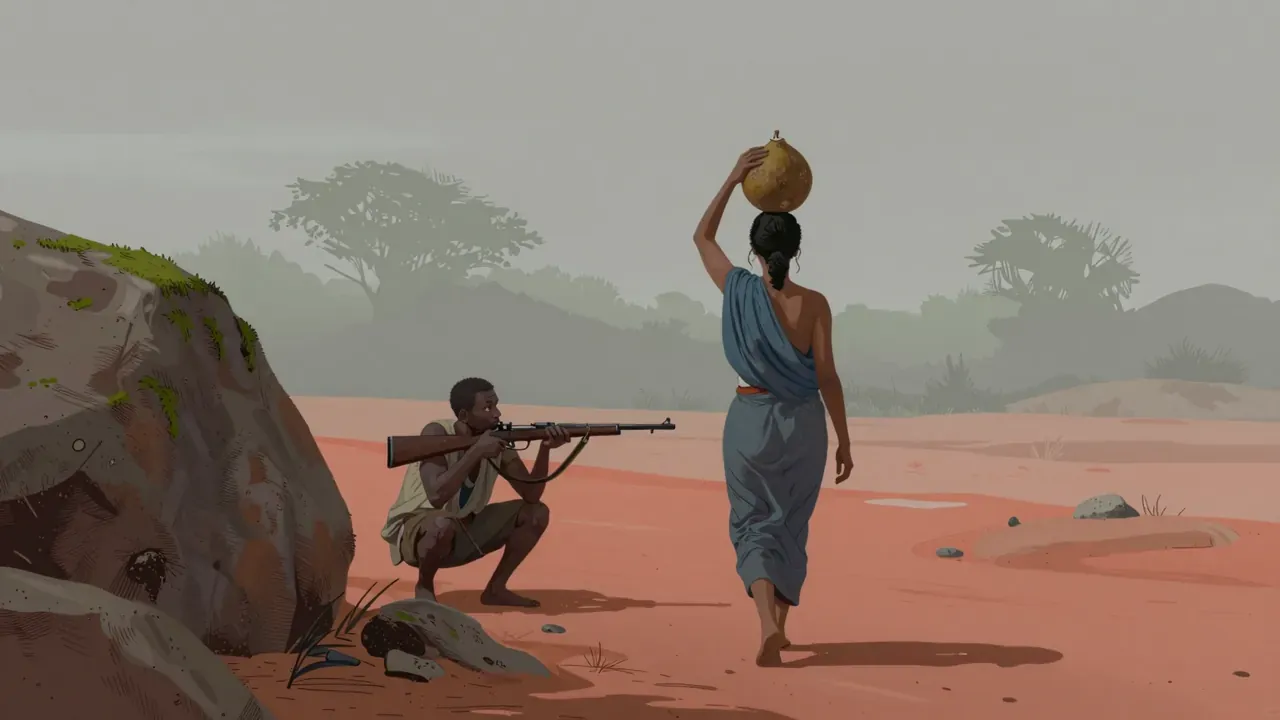
What lands most firmly is the film’s refusal to aestheticise suffering or offer catharsis. Agu’s initiation — the machete killing — is shot at medium distance, with no music, no slow motion, no cut away: just the sound of impact, breath, and a man’s final grunt. Later, when Agu shoots the woman he mistakes for his mother, the camera stays on his face as he registers confusion, then revulsion, then numbness — not guilt, not yet. The brothel sequence lands because it shows how institutional betrayal metastasises: the Commandant’s humiliation is not abstract, but embodied in his sudden, petty cruelty toward women who have no agency in the system. The final school scenes avoid redemption tropes: Agu does not smile, does not speak freely, does not embrace the other boys until the very last frame — and even then, the ocean is vast, indifferent, and the swim is silent. These moments work because they withhold interpretation, trusting the viewer to sit with discomfort rather than resolve it.
What does not
What does not land is the Commandant’s interior life beyond performance. Though Elba gives him texture — fatigue, flickers of tenderness, tactical calculation — the script offers no origin, no motive beyond wounded pride and the logic of command. His rape of Agu is presented as fact, not explored as consequence or pattern; Strika’s muteness and Preacher’s brown-brown dependency remain atmospheric, not developed. The rebel faction’s internal politics — Dada Goodblood’s media-aware pragmatism, Two I-C’s ambition — arrive too late and too thinly to register as anything but plot mechanics. The film’s fidelity to the novel’s narrow perspective means some structural elements — the gold mine interlude, the air strikes — feel episodic rather than cumulative. There is no sense of scale beyond Agu’s battalion, no wider context for why this war persists or who benefits. That is a deliberate choice, but it leaves certain narrative pivots — like the Commandant’s fall — feeling abrupt rather than inevitable.
The themes that matter
The themes that matter are not war or Africa but the corrosion of language, the fragility of selfhood under systemic coercion, and the asymmetry of care. Agu’s narration — written in Krio, spoken plainly — is the only stable thing in the film: it persists through trauma, drug use, and dissociation, becoming both lifeline and evidence of survival. His identity is not erased but layered: son, soldier, rapist, witness, patient — none cancelling the others. The film treats childhood not as innocence but as a set of capacities — observation, mimicry, adaptation — that can be weaponised. Care appears only in fragments: the mother’s hand on Agu’s head before flight, Strika’s silent touch after rape, the missionary’s quiet listening without judgment. These gestures do not heal, but they mark thresholds — points where the machinery of dehumanisation pauses, however briefly. The title’s irony is structural: ‘beasts’ is what the world calls them, but the film insists on their human grammar — fear, loyalty, shame, boredom, longing — even when those words fail.
Who should watch it
This film is for viewers who can tolerate sustained psychological intensity without narrative relief, who value restraint over exposition, and who accept that some traumas leave no clean resolution. It is not for those who require moral clarity, character arcs with closure, or visual relief from grimness. Parents of young children may find its depiction of child violence ethically difficult, not because it is sensationalised but because it is methodical and unadorned. Some critics objected to its Western authorship and framing of African conflict — a valid concern given the film’s silence on colonial legacies or extractive economics — though the film itself makes no claim to representational authority. A viewer who values historical specificity over subjective immersion will likely reject it. The verdict changes if the film were positioned as documentary or testimony; as fiction, its narrow focus is its strength and its limit.
Is it worth your evening
Yes, it is worth your evening — but only if you are prepared to hold still for its duration and its weight. At 137 minutes, it asks for endurance, not entertainment. It repays attention not with plot twists or emotional pay-offs but with accumulating detail: the way light falls on mud, how a boy’s posture changes when he first holds a rifle, the rhythm of Krio syntax under stress. Its value lies in its refusal to simplify, to flatter, or to look away — qualities rare in mainstream war films. Those who expect catharsis or uplift will leave unsettled. Those who seek craft rigour — in performance, sound design, editing discipline — will find it exacting and precise. It is not a film to watch casually, nor one to watch twice in quick succession. But its moral gravity and formal control make it a necessary, uncomfortable, and ultimately humane reckoning with what war does to the smallest among us — not as symbols, but as people who remember their own names, even when they forget how to use them.