The title’s defiance
Mother India is a Hindi-language drama film released in 1957, directed and produced by Mehboob Khan at his own Mehboob Studio. It is a reworking of Khan’s 1940 film Aurat, adapted by S. Ali Raza with input from Wajahat Mirza. The film sets out to counter American author Katherine Mayo’s 1927 polemical book of the same name — a text widely condemned in India for its colonial caricature of Indian society — by recasting ‘Mother India’ as a symbol of moral fortitude, national resilience, and post-independence self-definition. Its narrative centres on Radha, a woman who endures drought, debt, widowhood, and betrayal while upholding dharma amid systemic exploitation. The title is not descriptive but declarative: an act of reclamation. The film attempts to anchor nation-building in agrarian virtue, Hindu mythic framing, and maternal sacrifice — positioning rural womanhood as the ethical core of the new republic. It does so through studio-bound interiors and location shooting across Maharashtra, Gujarat, and Uttar Pradesh, blending vernacular realism with allegorical weight. (158 words)
The rhythm of endurance
The story follows Radha from marriage through widowhood to matriarchal authority, punctuated by three major crises: flood, famine, and filial rebellion. Nargis carries the arc with physical specificity — her posture shifts across decades, her hands work soil and cradle infants with equal conviction. Sunil Dutt’s Birju moves from impulsive youth to vengeful outlaw without caricature; Raaj Kumar’s Shamu offers quiet, grounded counterpoint. Faredoon Irani’s cinematography balances studio control and documentary texture: daylight scenes in villages are unvarnished, interiors dimmed to heighten emotional weight. Naushad’s score integrates Western orchestration with Hindustani ragas, using leitmotifs for land, labour, and loss. Dialogue is in vernacular Hindi, written in Urdu script by Mirza and Raza, favouring rhythmic cadence over exposition. Editing avoids montage flourishes; sequences unfold at a measured pace, allowing silence and gesture to carry meaning. The film’s craft is cumulative rather than showy — its power accrues in repetition: ploughing, sowing, weeping, waiting. (159 words)
The weight of choice
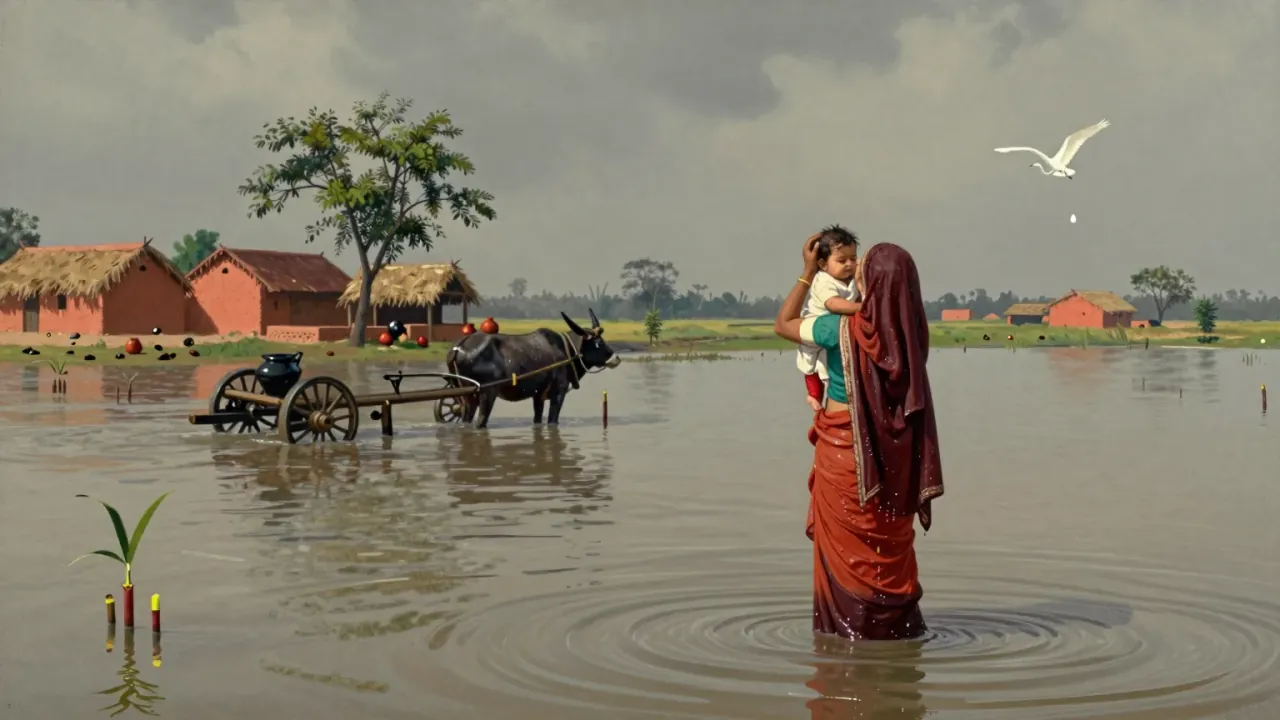
What lands most firmly is Radha’s final act — not as submission but as sovereign choice — and the film’s refusal to sentimentalise poverty. Her rejection of the moneylender’s advances, her endurance during the flood sequence shot in real affected districts, and the unflinching depiction of debt bondage all register with moral clarity. The village ensemble functions as chorus and community: Jilloo Maa’s elder voice, Kanhaiyalal’s comic relief, Mukri’s warmth — none are decorative. Naushad’s ‘Duniya Mein Hum Aaye Hain’ anchors the film’s humanist claim without piety. The agricultural imagery — sickles, bullocks, furrowed fields — gains symbolic force through repetition and scale, never straying into abstraction. Even the climactic confrontation between Radha and Birju lands because it refuses catharsis: there is no forgiveness, only consequence. The film’s nationalism feels earned, not imposed, rooted in soil and sweat rather than rhetoric. Its moral architecture holds because it treats dignity as non-negotiable, even when stripped of material security. (157 words)
Where myth overtakes person
What does not land is the structural rigidity of its allegory. Characters too often serve abstract functions — Ramu as dutiful son, Birju as corrupted impulse, the moneylender as pure avarice — limiting psychological nuance. The film’s adherence to mythic templates occasionally flattens motivation: Birju’s turn toward violence arrives without sufficient interior scaffolding, relying instead on visual shorthand — darkened lighting, dissonant strings. Some set pieces, particularly the harvest festival song-and-dance, feel tonally dissonant against the prevailing gravity, their choreography and costuming more studio-conventional than regionally grounded. The script’s Urdu literary inflection, while rich in cadence, can distance contemporary viewers unfamiliar with its idioms. The film’s length — 172 minutes — tests patience not through slackness but through insistence: every hardship repeats, every lesson restates, every moral point doubles back. It assumes a shared cultural grammar — of dharma, of bhakti, of village hierarchy — that modern audiences may lack or question. Its vision of empowerment remains tightly bound to sacrifice, offering no alternative model of agency. (159 words)
The land as covenant
The themes that matter are sovereignty over one’s body and choices, the ethics of debt, and the gendered labour of nation-building. Radha’s resistance to sexual coercion is framed not as personal virtue but as social necessity — a line drawn against exploitation that predates and exceeds the moneylender’s advances. The film treats land not as property but as covenant: tilling it is devotion, losing it is spiritual rupture. Its nationalism is agrarian, not militaristic — built on cotton-picking, irrigation, and communal threshing, not parades or speeches. Hindu mythic allusion operates structurally: Radha echoes Sita and Durga simultaneously, embodying both exile and wrath. Yet the film resists easy readings — her killing of Birju is neither triumph nor tragedy, but a boundary enforced. The theme of intergenerational continuity is present but uneasy: Ramu inherits land but not trauma; Birju inherits rage but not land. What persists is not lineage but principle — the idea that moral order must be actively, painfully, daily upheld. (156 words)
Who the film presumes
This film is for viewers prepared to sit with its pace and its moral architecture — those familiar with mid-century Indian cinema’s conventions, or with postcolonial literature’s preoccupations with reclaiming narrative sovereignty. It rewards attention to gesture, silence, and recurring image. It is not for those seeking psychological realism, narrative economy, or irony — its tone is solemn, its symbolism unambiguous, its judgments absolute. Those who find allegory alienating, or who reject the conflation of motherhood with national virtue, will find its logic exclusionary. A viewer who values ambiguity over assertion, or who reads sacrifice as complicity rather than strength, would rightly dissent. The verdict changes only if the film were re-cut to tighten its repetitions or re-contextualised with critical framing — but as released, its power lies precisely in its unwavering stance. (159 words)
Why it takes its time
Yes, it is worth your evening — not as light diversion but as historical and aesthetic encounter. Its 172 minutes ask for commitment, but repay it with formal coherence and moral weight few films sustain at that length. You do not need prior knowledge of Hindi cinema, but you do need willingness to meet it on its terms: as myth, not memoir; as testament, not thriller. Its relevance endures because its questions remain live — about who tells national stories, whose labour builds nations, and what price dignity demands. Those who dismiss it as dated miss how deliberately it constructs time: its past is not nostalgic but diagnostic. Its music, performances, and visual grammar have aged less than its ideological certainties — yet even those feel urgent, not archaic, in an era of renewed cultural reclamation. To watch it is to witness a foundational moment in Indian cinematic language, forged with care, expense, and conviction. (158 words)