The shape of time
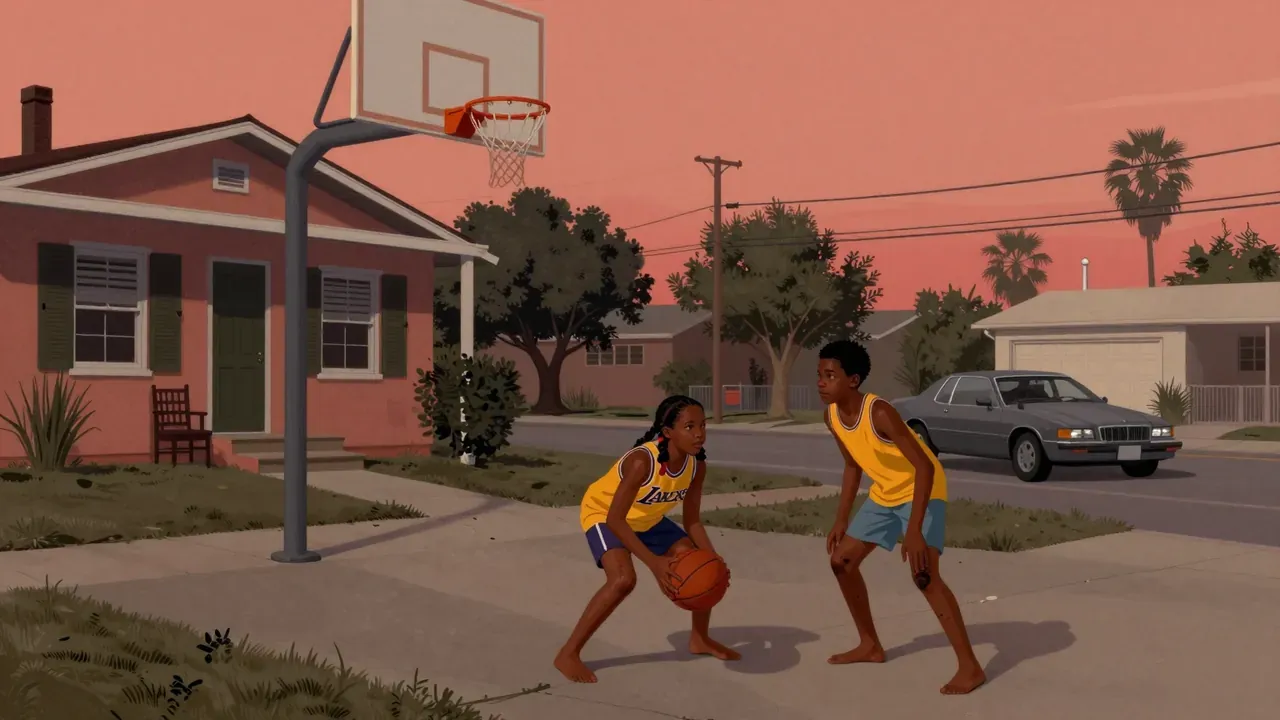
Love & Basketball is a romantic sports drama structured as a dual coming-of-age story, following Monica Wright and Quincy McCall from childhood in South Central Los Angeles through their parallel careers in basketball and the slow, uneven evolution of their relationship. Gina Prince-Bythewood’s debut feature attempts something precise: to place Black middle-class interiority at the centre of a genre usually reserved for white male aspiration, using basketball not as backdrop but as grammar — the rhythm of practice, the weight of expectation, the physical language of competition shaping how love is spoken, deferred, tested and reclaimed. It is semi-autobiographical, modelled on Prince-Bythewood’s own experience as a collegiate athlete, and consciously pitched as a Black counterpart to When Harry Met Sally — not in tone or structure, but in its commitment to charting intimacy across time with fidelity to character over plot mechanics. The film refuses to treat sport as metaphor alone; it treats it as vocation, discipline, identity, and inheritance — all things that accrue meaning slowly, like muscle memory. (159 words)
The look of it
The film unfolds in four chronological ‘quarters’, each anchored by a pivotal basketball encounter between Monica and Quincy. Reynaldo Villalobos’ cinematography favours natural light and medium framing, keeping faces legible and bodies grounded — no heroic slow-motion, no swooping crane shots. Terence Blanchard’s score leans into warm, lyrical jazz motifs rather than anthemic cues, underscoring quiet moments more often than climaxes. Sanaa Lathan and Omar Epps carry the film with unshowy consistency: Lathan conveys Monica’s guarded ambition through posture and silence as much as dialogue; Epps gives Quincy a quiet gravity, his charisma held in check by deference to his father and the burden of being seen as ‘the one who makes it’. Terilyn A. Shropshire’s editing avoids montage shortcuts, letting scenes breathe — a hospital corridor walk, a kitchen argument, a driveway conversation — all paced with the patience of lived time. Supporting performances are tightly calibrated: Dennis Haysbert as Zeke McCall registers paternal disappointment without melodrama; Alfre Woodard as Camille Wright delivers authority and withheld tenderness in equal measure. (158 words)
What sticks
What lands most firmly is the film’s refusal to reduce either protagonist to function — Monica is never just ‘the girl who waits’, nor Quincy ‘the star who strays’. Their conflicts arise from competing definitions of success, not moral failure. The basketball sequences feel authentic because they are filmed with attention to skill level, fatigue, and tactical awareness — Monica’s early frustration with Coach Davis, Quincy’s discomfort under media scrutiny, their mutual exhaustion during college — all register as lived friction, not narrative convenience. The domestic spaces — the McCall living room with its worn sofa, the Wrights’ tidy kitchen where Camille folds laundry while delivering hard truths — anchor the story in a recognisable Black LA middle-class world rarely rendered with such unembellished specificity. The film’s emotional logic holds because its characters make choices that follow from their upbringing, their pride, their fear of inadequacy — not from screenwriting mandates. Even the final one-on-one game works not as spectacle but as culmination: a ritual reassertion of agency, of self-definition outside institutional validation. That Monica chooses to play again after quitting — not for fame or money, but for herself — lands with quiet force. (157 words)
Where it slips
What does not land is the structural conceit of the four quarters: the transitions between them rely too heavily on title cards and voiceover, creating a schematic feel that occasionally flattens emotional continuity. Some secondary characters remain underdeveloped — Tyra Banks’ Kyra, for instance, functions almost entirely as symbolic opposition, her engagement to Quincy serving narrative purpose rather than psychological plausibility. The college section, particularly Monica’s clashes with Coach Davis, risks simplifying institutional sexism into a single antagonist rather than a systemic condition. A few scenes — notably an early high school party sequence — employ dialogue that feels rehearsed, leaning into exposition over subtext. The film’s restraint sometimes tips into reticence: Quincy’s internal conflict about his father’s infidelity is conveyed through a single glance, which may register as ambiguity to some viewers but as evasion to others. The ending, while emotionally satisfying, leans on convention — the wedding cancellation, the reunion, the daughter playing basketball — without fully interrogating what changes in either character to make the second chance credible beyond affection. It affirms love but leaves its recalibration somewhat implied. (159 words)
What it’s really about
The themes that matter are ambition as gendered labour, the cost of visibility for Black athletes, and the quiet violence of expectation — familial, cultural, athletic. Monica’s struggle is not against lack of talent but against being told her body is wrong for the game, her temper inappropriate for leadership, her ambition unbecoming. Quincy’s arc traces the erosion of self under the pressure to embody stability — for his family, his team, his community — until he mistakes endurance for identity. The film treats basketball not as escape but as extension: the court is where Monica learns to claim space, where Quincy learns to read intention, where both learn the difference between winning and being seen. Parental influence is neither caricatured nor absolved — Zeke’s stoicism and Camille’s conditional warmth shape their children’s emotional vocabularies. Class operates as texture, not theme: the McCall home has hardwood floors and framed photos; the Wrights’ house has bookshelves and piano lessons. Neither is idealised, neither exoticised. What matters is how these environments produce particular kinds of resilience — and particular kinds of silence. (156 words)
Who it’s for
This film is for viewers who value character-driven storytelling over plot propulsion, who recognise the weight of a held breath or a delayed reaction as dramatic action, and who seek romance narratives where desire and duty coexist without resolution. It rewards patience with emotional precision. It is not for those who require constant narrative escalation, stylised visuals, or irony as tonal buffer. Anyone expecting a sports film built on training montages or underdog triumphs will find its pace too deliberate; anyone seeking broad social commentary will find its focus too intimate. Critics who dismissed it as ‘soap opera’ — a charge made in some early reviews — mistake its domestic scale for triviality. Its power lies precisely in refusing grand pronouncements in favour of small, accumulative truths. A viewer who values craft over flash, authenticity over archetype, and whose idea of romance includes shared history, miscommunication and the quiet courage of choosing again — this film is for them. Those who need catharsis delivered in undercuts or clarity served in slogans will leave unsatisfied. (159 words)
Is it worth your evening
Yes, it is worth your evening — not as escapism, but as calibration. Its 124 minutes unfold with the unhurried certainty of a well-practised layup: familiar, grounded, technically sound. It asks for attention, not surrender, and repays it with emotional fidelity rare in mainstream American romance. It is not flawless — the pacing sags in the third quarter, some supporting roles lack dimension — but its central performances and Prince-Bythewood’s control over tone and texture hold firm. Anyone who has ever loved someone while also loving something else — a craft, a cause, a calling — will find recognition here. Those who dismiss it as ‘just a love story’ misunderstand its architecture: it is about how love survives when ambition is not shared but parallel, when success arrives on different timetables, and when reconciliation requires not forgiveness but redefinition. It earns its quiet ending not through sentiment but through accumulated detail — the way Monica ties her shoes, the way Quincy watches her from the bleachers, the way their daughter picks up the ball without being told. That is worth ninety minutes. (158 words)