The shape of the story
The Phantom Carriage is a Swedish silent film from 1921, adapted by Victor Sjöström from Selma Lagerlöf’s 1912 novel Körkarlen. It sets out to dramatise a moral reckoning through supernatural means: a drunken man, David Holm, dies on New Year’s Eve and is forced by the ghost of a former friend to witness his own past failures — his abandonment of family, his cruelty toward others, and his role in spreading disease and despair. The film does not aim for realism but for spiritual clarity, using the legend of Death’s carriage as a structural device to organise memory, consequence, and redemption. Its ambition is theological and social at once: to show how individual vice ripples across lives, and how grace might still intervene — not as divine fiat, but as human choice made possible by remorse. It treats alcoholism not as personal failing alone, but as a condition embedded in poverty, isolation, and failed care systems. The film’s frame is starkly Christian in vocabulary — salvation, repentance, intercession — yet its concerns are secularly urgent: public health, social responsibility, the material conditions of suffering. It is a parable built with documentary precision.
The structure of time
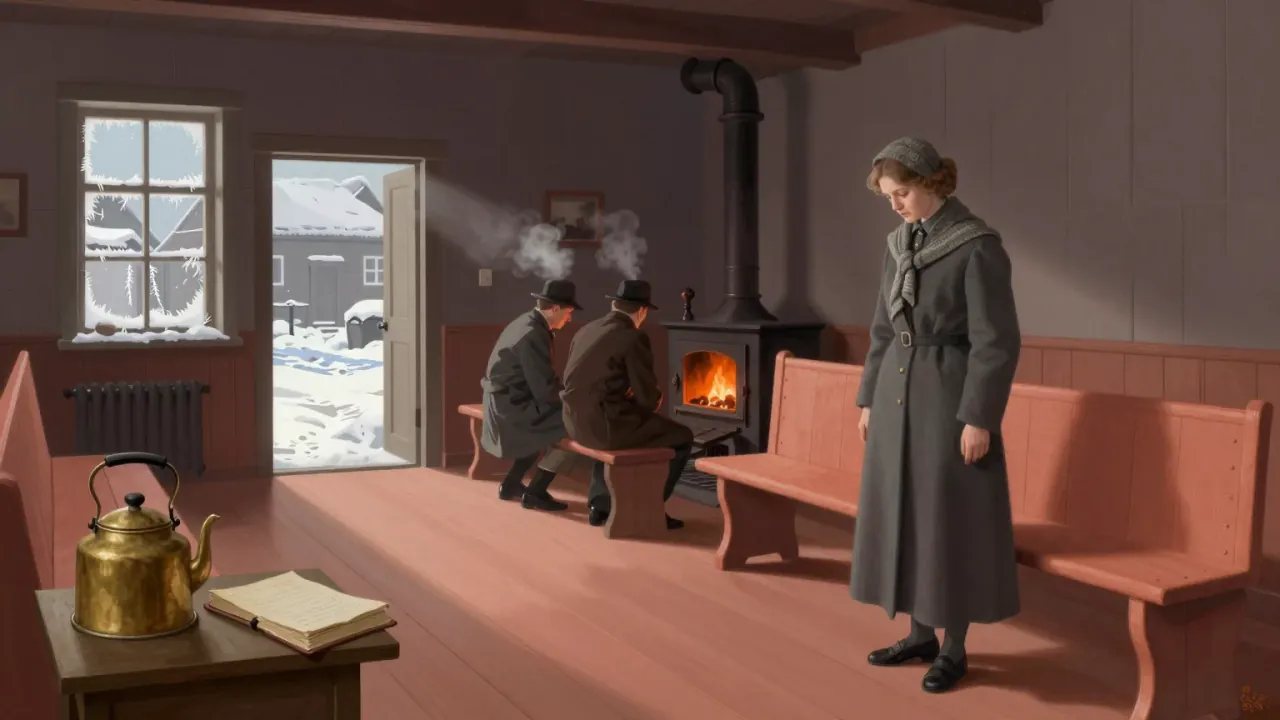
The story unfolds through nested flashbacks, each triggered by David’s confrontation with his own history, and sustained by Julius Jaenzon’s cinematography: deep shadows, layered double exposures, and careful blocking that makes ghosts move through solid space as if breath and bone were negotiable. Victor Sjöström plays David with physical specificity — slumped shoulders, unsteady gait, eyes avoiding contact — never gesturing toward redemption but embodying resistance to it. Hilda Borgström’s Edit carries quiet authority without sentimentality; her exhaustion is visible in posture and timing, not expression alone. The production design grounds the fantasy in recognisable early-twentieth-century Stockholm: cramped apartments, Salvation Army halls, snow-dusted cobbles. Jaenzon’s in-camera effects required exact hand-cranking consistency across multiple passes — a technical discipline that gives the ghosts weight and intention, not mere blur. Editing avoids rhetorical cuts; transitions between timelines are marked by dissolves or shifts in light, preserving temporal ambiguity. There is no musical score composed for the film’s original release; Jonathan Richman’s later contribution is anachronistic and irrelevant to how the film functions as made.
The look of it
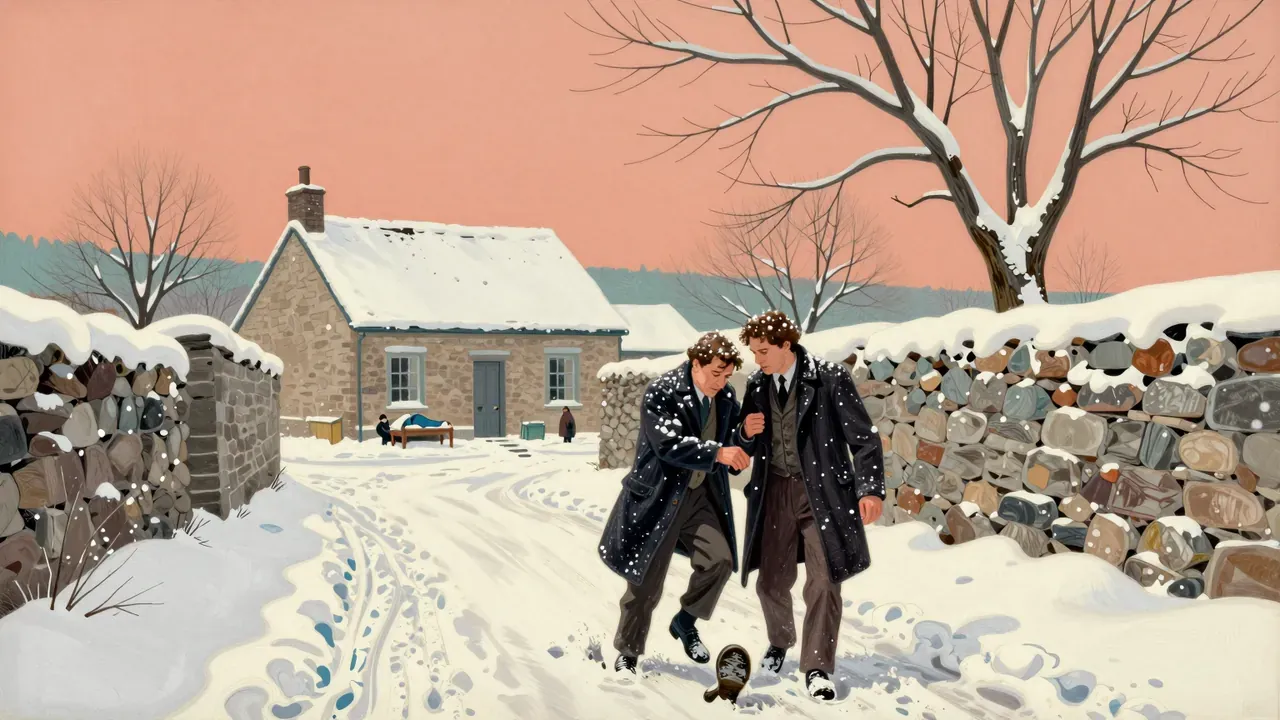
What lands is the cumulative pressure of consequence. Every flashback is calibrated to deepen David’s culpability without excusing it: his brother’s imprisonment, Anna’s flight, Edit’s coughing fits — all shown without commentary, only duration and proximity. The film’s moral architecture holds because it refuses to let David off the hook even when he weeps; his reform is earned in real time, not granted. The visual grammar reinforces this: interiors are low-lit and claustrophobic, exteriors washed in grey winter light, faces often half-obscured by doorways or smoke. When David finally rushes to Anna, the camera stays tight on his hands — shaking, fumbling, gripping — not his face. That restraint makes the moment land harder. The film’s influence on Bergman is legible not in mimicry but in shared preoccupations: time as moral ledger, silence as ethical space, the body as evidence. Its narrative structure — flashback within flashback within framing device — feels less like innovation for its own sake and more like the only way to render memory as recursive, non-linear, and inescapable.
The weight of change
What does not land is the film’s occasional reliance on symbolic shorthand that now reads as blunt: the carriage itself, while potent, appears without spatial logic or consistent scale; its presence is asserted rather than integrated. Some character motivations remain opaque — particularly Georges’ shift from friend to spectral taskmaster — because the script assumes familiarity with Lagerlöf’s novel and its moral cosmology. The Salvation Army’s role is presented as benevolent infrastructure, but the film offers no critique of its institutional limits or class assumptions, leaving its theology unexamined. A few performances verge on theatrical gesture — Olof Ås’s Gustafsson, for instance, registers as earnest but underwritten, his conversion occurring off-screen. The pacing, too, drags in the middle stretch where David’s wanderings repeat thematic beats without adding new dimension. These are not flaws in craft but in dramaturgy: moments where the allegory overtakes the person, and the film’s moral urgency gives way to didactic rhythm. Later viewers may find the ending’s pivot from despair to hope too abrupt, lacking the psychological scaffolding modern audiences expect.
The body’s ledger
The themes that matter are mortality as social fact, not private event; addiction as contagion, literal and moral; and redemption as labour, not revelation. The film treats consumption — both tuberculosis and alcohol — as diseases of environment and neglect, not weakness. David’s drinking is never isolated from unemployment, housing insecurity, or the absence of public health support. Edit’s illness spreads through proximity and care, not sin — she catches it from David, then passes it to Anna, who in turn risks passing it to her children. This chain is shown, not named. Equally central is the idea of time as debt: David owes Anna years, owes Edit trust, owes his children safety — and the film structures its narrative as audit, not anecdote. The carriage is less a vehicle of doom than a metaphor for obligation deferred. There is also a quiet theme of gendered labour: women mend coats, tend the sick, broker reconciliation, while men destroy, depart, or delay. The film does not moralise this imbalance but renders it materially — in empty rooms, torn fabric, unopened letters — making it structural, not incidental.
The terms of attention
This film is for viewers who accept silence as expressive, who tolerate slow accumulation over exposition, and who do not require psychological realism to feel moral weight. It rewards attention to texture — the grain of film stock, the tilt of a head, the pause before a hand reaches out. It is not for those who need clear cause-and-effect causality, or who find moral allegory inherently reductive. Anyone expecting horror as genre — jump scares, dread as atmosphere — will be disappointed; its chills come from recognition, not surprise. Those put off by early cinema’s theatrical acting style or intertitle dependence may struggle, though the performances here are more restrained than many contemporaries. A viewer who values narrative economy over emotional escalation, or who finds power in restraint rather than release, will connect with it deeply. Those who require explicit character motivation or modern editing rhythms will likely disengage before the third flashback. Its demands are formal and philosophical, not technical or sensational.
The measure of worth
Yes, it is worth your evening — not as entertainment but as calibration. One hundred and six minutes spent with The Phantom Carriage recalibrates what cinema can hold: grief without spectacle, reform without fanfare, consequence without sermon. It asks you to sit with discomfort longer than most films allow, and rewards that patience with a rare kind of clarity. Its power lies in what it refuses: explanation, forgiveness on easy terms, catharsis as relief. That makes it demanding, but not obscure. It is not for casual viewing, nor for those seeking diversion — but for anyone willing to treat a silent film not as relic but as argument. Critics who found it overly sober — like Justin Fox in 1976 — judged it against German Expressionism’s stylisation, missing its Swedish commitment to social texture over symbolic distortion. Change the verdict? Only if you reject moral seriousness as a cinematic value — or believe that redemption must be earned in real time, not edited into a montage.