The premise of mirrors
Infernal Affairs is a Hong Kong crime film that sets out to dramatise the psychological erosion of identity under prolonged deception. It does not aim for procedural realism or moral grandstanding, but for a tightly coiled study of two men trapped in mirrored roles: one a police officer embedded in a triad, the other a triad recruit embedded in the police force. The film’s ambition lies in its structural symmetry — ten years of parallel double lives, converging on a single point of mutual exposure — and its refusal to resolve that tension through action alone. It avoids the genre’s habitual catharsis of violence or redemption, instead anchoring itself in quiet moments of disorientation: a glance held too long, a name mispronounced, a pause before answering ‘who are you?’. Its formal discipline — restrained pacing, deliberate framing, minimal score intrusion — serves that aim. It is not trying to entertain through escalation, but to unsettle through equivalence: the cop and the criminal are not opposites, but reflections, each dependent on the other’s existence to sustain their own.
The look of it
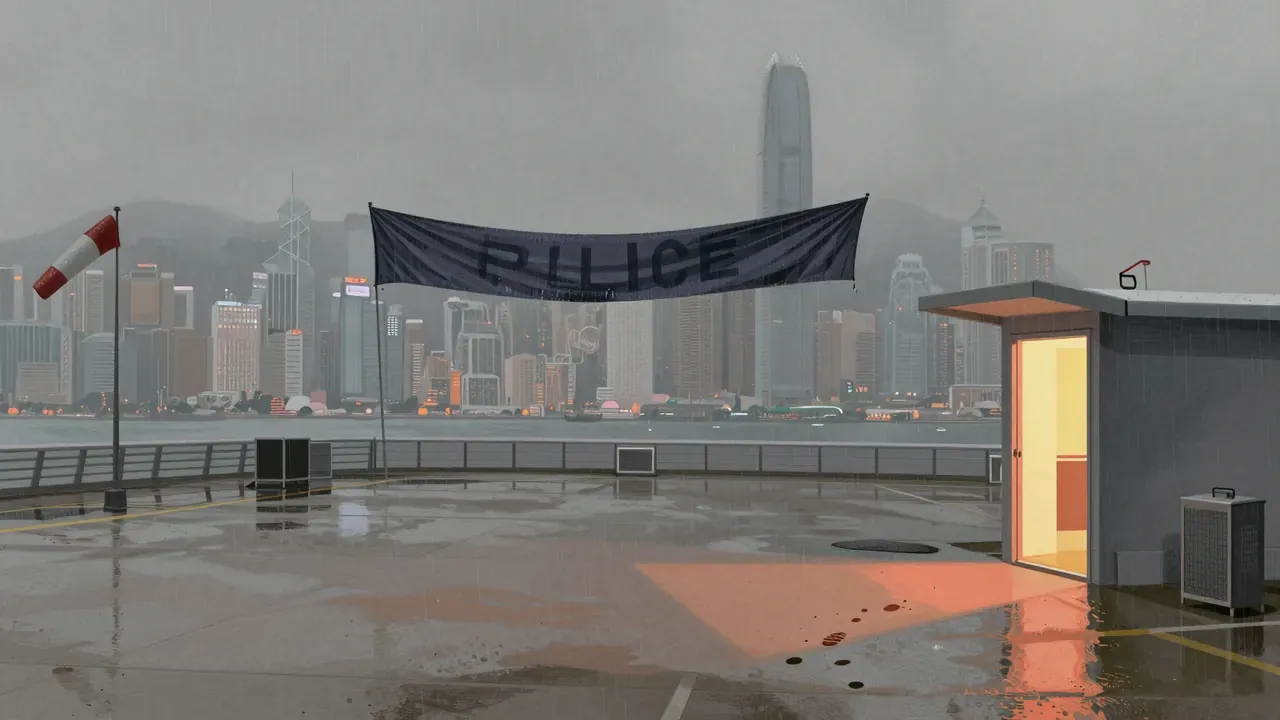
The story unfolds with surgical economy: no exposition beyond what dialogue and gesture supply, no flashbacks that do not serve immediate psychological clarification. Andy Lau and Tony Leung perform with calibrated restraint — Lau’s Lau Kin-ming moves through police bureaucracy with ingrained ease, his authority never questioned; Leung’s Chan Wing-yan carries a low-grade tremor in his posture, a hesitation in his laugh, the physical residue of ten years spent mimicking menace. Andrew Lau and Lai Yiu-fai’s cinematography avoids flourish: interiors are lit with flat, neutral tones; exteriors use overcast daylight to mute distinction between street and alley, cop and gangster. Danny Pang Phat and Curran Pang’s editing sustains rhythm without hurry — cuts land on silence more often than on speech. Chan Kwong-wing’s score deploys strings sparingly, reserving full orchestration for moments of irreversible choice. The rooftop confrontation contains no choreographed combat, only three men speaking in lowered voices while rain slicks the concrete — a decision made by Leung and Felix Chong on set, and one that defines the film’s tonal grammar.
What sticks
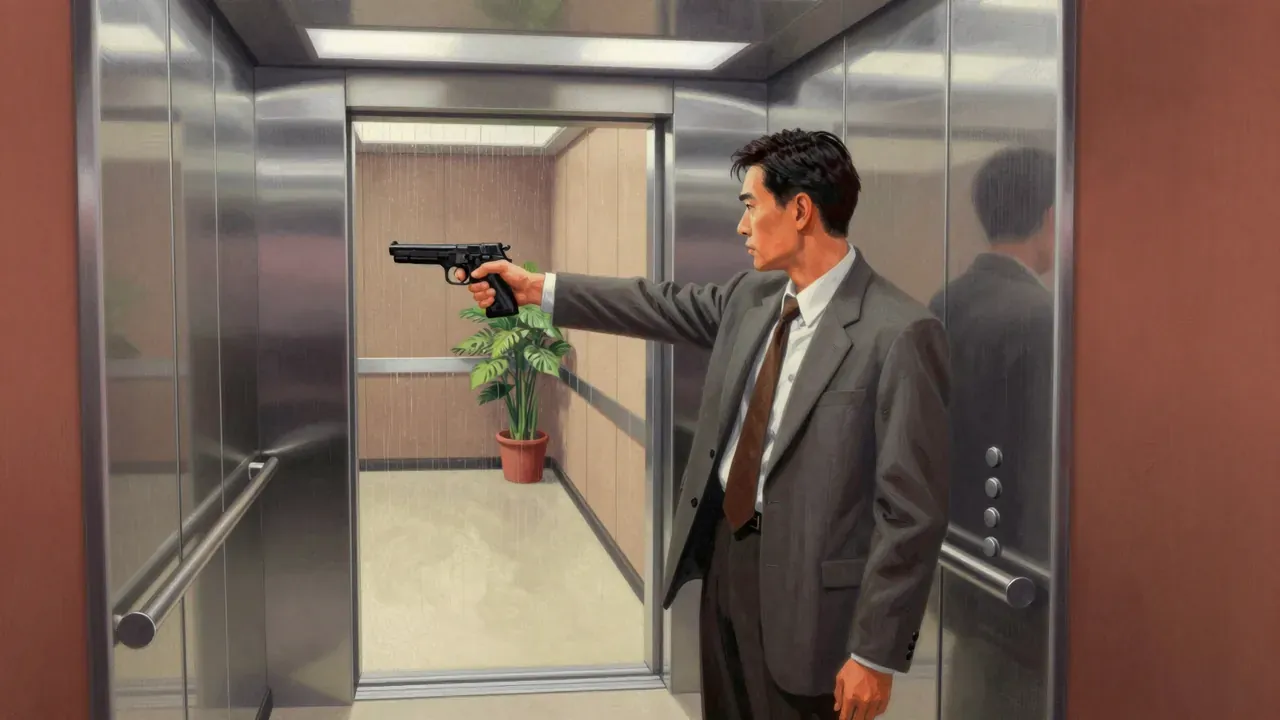
What lands most decisively is the cumulative weight of duality. The film makes the audience feel the fatigue of sustained pretence not through monologue but through repetition: the same corridor walked by both men at different times; the same police badge handled by hands trained in different disciplines; the same question — ‘Who are you?’ — asked first as formality, then as threat, then as plea. The final lift sequence works because it refuses resolution: Lau kills Big B not as triumph but as reflex, a gesture so automatic it confirms he has no self left to recover. The funeral scene lands not through sentiment but through omission — no eulogy, no music, just Lau’s salute and Lee’s quiet discovery of the file. Even the alternate ending (shot for mainland compliance) underscores what works: the original’s ambiguity is its strength. The film’s restraint allows small details — Mary’s inadvertent listening, the CD’s unmarked label, the way Chan’s hand shakes only when he lowers the gun — to carry disproportionate emotional force. Nothing feels inserted; everything accrues.
What slips
What does not land is the scaffolding around the central dyad. Anthony Wong’s Superintendent Wong Chi-shing, though awarded Best Supporting Actor, remains functionally schematic — a paternal figure whose death serves plot mechanics more than thematic expansion. Eric Tsang’s Hon Sam is similarly contained: a presence rather than a psychology, his menace conveyed through stillness and volume rather than interiority. The supporting triad members — Dion Lam, Shawn Yue, Chapman To — operate within genre shorthand, their loyalties and motives rarely probed beyond utility to the main arc. The psychiatrist Lee Sum-yee (Elva Hsiao) functions less as a character than as a narrative pressure valve, her scenes bookending Chan’s descent without deepening it. The film’s tight focus means little room for world-building: the Hong Kong of 2002 appears as backdrop — neon-lit but emotionally neutral — rather than as a social or political texture shaping the characters’ choices. The script’s three-year gestation shows in its core architecture, but some secondary figures feel like placeholders awaiting fuller articulation.
What it’s about
The themes that matter are identity as performance, loyalty as habit, and institutional trust as fiction. The film treats the police force and the triad not as moral opposites but as parallel bureaucracies, each with its own codes, hierarchies, and rituals of belonging. Loyalty is shown as something learned, not felt — Lau recites police procedure with fluency because he has rehearsed it; Chan quotes triad maxims because they have become second nature. The title’s reference to Buddhist ‘unceasing path’ is not metaphorical but structural: there is no exit from the cycle of deception once entered, only substitution — one mole for another, one funeral for another, one lift ride for another. The film resists psychological determinism: neither man is ‘broken’ by his role, nor ‘corrupted’ by it; they are reshaped by its duration. What matters is not who they were, but who they become when no one is watching — and how little difference remains between the two states when surveillance is total and self-knowledge is deferred.
Who it’s for
It is for viewers who value precision over propulsion, who find tension in withheld information and resonance in unresolved endings. It suits those accustomed to non-linear emotional pacing — people who watch films for the weight of a glance, not the speed of a chase. It is not for those who require clear moral coordinates, narrative closure, or protagonists whose inner lives are verbally mapped. Fans of Hollywood crime thrillers may find its pace withholding, its violence muted, its stakes internal rather than external. Those expecting the kinetic energy of John Woo or the operatic fatalism of Ringo Lam will be disappointed. But anyone willing to sit with discomfort — to let a scene breathe, to accept that a character’s motivation may remain partial, to trust that silence can carry more freight than exposition — will find it rigorously rewarding. A viewer who demands catharsis or explanation will leave unsatisfied; one who values implication over instruction will return to it.
Is it worth your evening
Yes, it is worth your evening — not as diversion, but as calibration. Its 97 minutes recalibrate expectations of what a crime film can hold: not just suspense, but stasis; not just betrayal, but mutual dependency; not just climax, but consequence. It repays attention not with revelation but with recurrence — motifs reappear with shifted emphasis, lines echo across time zones of memory and regret. Its power lies in accumulation, not acceleration. Someone who watches primarily for plot mechanics or star charisma may find it austere. But for anyone interested in how institutions shape identity, or how long a person can live inside a lie before the lie begins living inside them, it remains unmatched in its economy and exactness. Its endurance is not historical but functional: it works now, as precisely as it did in 2002, because its subject — the fragility of self under institutional demand — has not aged.