The moral frame
I Figli di nessuno is a 1951 Italian-French drama produced by Titanus and directed by Raffaello Matarazzo, working from a script he co-wrote with Aldo De Benedetti. It belongs to a cycle of popular postwar melodramas built around the pairing of Amedeo Nazzari and Yvonne Sanson. The film attempts to dramatise moral conflict through domestic rupture: a marble quarry owner’s relationship with an employee’s daughter produces a child, then unravels under pressure from his mother, a Contessa whose disapproval triggers cascading consequences. Its aim is not psychological realism but emotional legibility — clear moral stakes, unambiguous suffering, and a structure calibrated for catharsis rather than ambiguity. It operates within the conventions of mid-century Italian commercial cinema: studio-bound sets, measured pacing, and performances pitched to register in medium shot and close-up without naturalistic restraint. The film does not seek to interrogate class or gender as systems; it treats them as fixed conditions against which individual virtue or vice is tested. (142 words)
The look of it
The story unfolds in three acts: courtship and conception, social rejection and retreat, then institutionalisation and spiritual reckoning. Rodolfo Lombardi’s cinematography keeps interiors dim but legible, favouring shallow focus on faces during confrontations and wider framing in convent scenes to stress isolation. Mario Serandrei’s editing sustains rhythm without urgency — cuts land on reaction shots, not action. Performances are stylised: Nazzari projects wounded authority, Sanson a mixture of fragility and resolve, Rosay a cold, immovable presence. Folco Lulli and Gualtiero Tumiati offer grounded counterpoints as working-class friend and priest. Salvatore Allegra’s score uses strings and piano motifs to underscore shifts in tone, never overwhelming dialogue. There is no visual experimentation, no narrative digression — every scene serves exposition or emotional escalation. The craft is consistent, functional, and unobtrusive: lighting avoids harsh contrast, sound design is minimal, and costume signals status without irony. This is not a film that draws attention to its making, but one that assumes its audience shares its moral grammar. (158 words)
The weight of silence
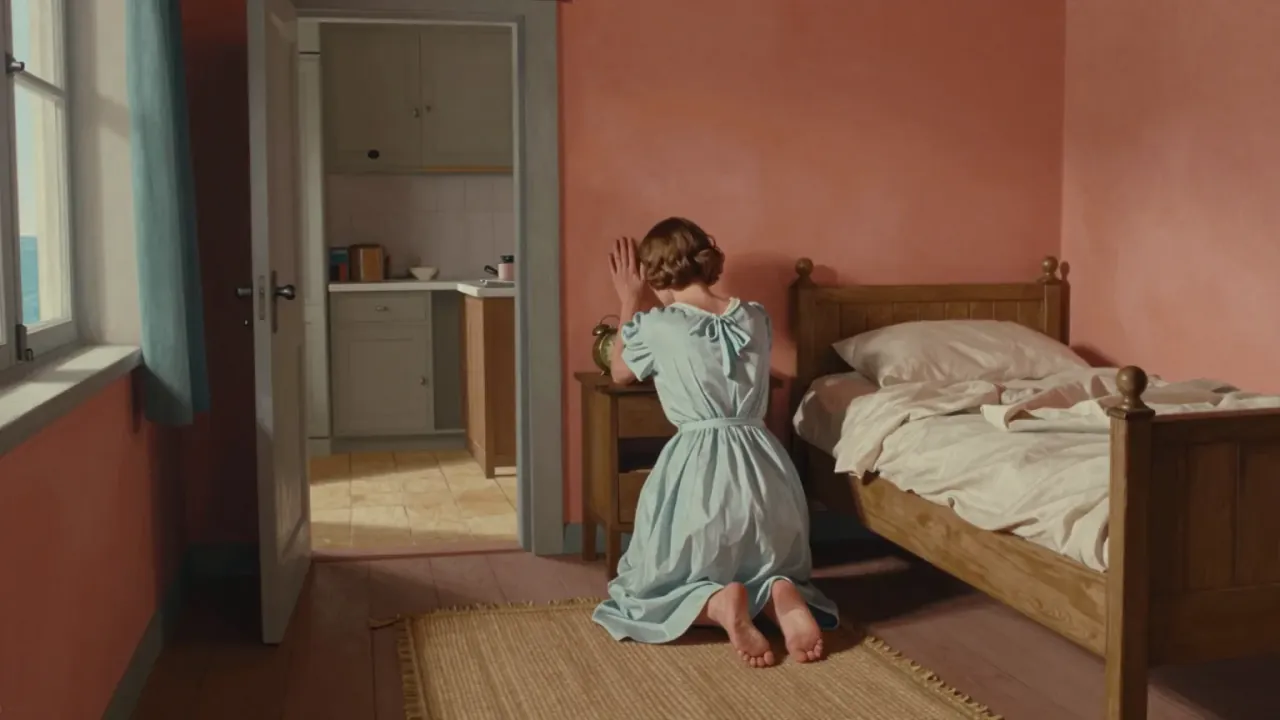
What lands is the weight of consequence. When Luisa enters the convent as Sister Addolorata, the shift from secular vulnerability to cloistered discipline carries tangible gravity — not because the institution is idealised, but because it offers the only available refuge from public shame and private grief. The scenes between Sanson and Rosay have a formal rigour that makes their antagonism feel structural, not personal. The baby’s death is handled without sentimentality: a single off-screen announcement, followed by silence and a slow pan across an empty cradle. Even minor characters land with precision: Teresa Franchini’s Marta speaks plainly about social hypocrisy, and Olga Solbelli’s Mother Superior delivers her lines with quiet, unflinching authority. The film’s restraint in these moments — refusing to overstate, never to explain — gives them durability. The convent sequences, in particular, avoid piety or critique; they present ritual as routine, faith as habit, sorrow as something carried, not performed. These passages do not ask for empathy so much as recognition: this is how people endure what cannot be undone. (146 words)
The unexamined authority
What does not land is the moral scaffolding holding the plot upright. The Contessa’s opposition lacks motive beyond inherited prejudice — she is not cruel, not calculating, merely immovable, and her influence feels disproportionate to her screen time. The quarry setting, though named repeatedly, remains abstract: we see no labour, no machinery, no economic reality — only a backdrop for romance and ruin. Guido’s transformation from confident industrialist to broken penitent happens off-screen, leaving his arc emotionally unmoored. Some supporting roles blur: Aristide Baghetti’s father is introduced with gravitas but dissolves into generic concern; Enrico Glori’s Rinaldi has no discernible function beyond delivering exposition. The film also misjudges its own pacing in the second act: a prolonged sequence of letters and visits stretches tension thin without deepening character. There is no irony, no self-awareness, no undercutting — and without those tools, the film cannot compensate for gaps in motivation or logic. It asks the viewer to accept its premises wholesale, and when those premises waver, the emotional architecture sags. (151 words)
Nobody’s children
The themes that matter are filiation and erasure: who claims you, who disowns you, and what remains when both happen. The title — ‘Nobody’s Children’ — applies not only to the infant but to Luisa, stripped of family, status, and name; to Guido, severed from lineage by his mother’s will; and to the convent sisters, who renounce biological kinship to enter a different kind of belonging. Class is treated not as fluid or contested but as gravitational — it pulls people apart even when love resists. Religion appears not as doctrine but as infrastructure: the convent functions as shelter, archive, and final arbiter of dignity. There is no theological debate, only practice — prayer as repetition, obedience as survival. The film also traces the quiet violence of respectability: how shame is administered not by villains but by silence, absence, and withheld recognition. These are not original ideas, but the film articulates them without flourish or evasion. It does not argue for change; it documents endurance as the default condition for those outside sanctioned structures. That clarity — unsentimental, unadorned — gives the themes their force. (149 words)
Who it is for
This film is for viewers who value mid-century European melodrama as a distinct mode — one that privileges moral clarity over psychological nuance, and emotional resonance over narrative surprise. It suits those attentive to performance cadence, costume as signifier, and the weight of silence in studio-era sound design. It is not for viewers who require causal plausibility, historical specificity, or interiority beyond what dialogue and gesture supply. Those expecting irony, subversion, or stylistic risk will find it inert. Others may reject its Catholic-inflected resolution as regressive — though the film never presents the convent as redemption, only as containment. A historian of Italian postwar culture might watch closely; a student of film music could study Allegra’s leitmotif discipline. But anyone seeking social critique framed with analytical rigour will leave unsatisfied. The film assumes its values are shared, and that assumption narrows its address. To widen it would require rewriting its moral syntax — not adjusting tone, but dismantling its premise. (150 words)
Is it worth your evening?
It is worth your evening if you approach it as a specimen: a well-preserved example of a commercially successful, studio-made Italian drama from 1951, operating within strict formal and ethical boundaries. Its pleasures are modest but precise — a glance held too long, a line delivered without inflection, a dissolve timed to a sigh. It rewards attention to how emotion is staged, not just what is felt. It is not worth your evening if you need narrative propulsion, thematic complexity, or stylistic distinction. Some will call it dated; others, timeless — but both judgements miss the point. It is neither. It is period-specific, unapologetically conventional, and entirely coherent on its own terms. A modern viewer resistant to its rhythms may find it glacial; someone attuned to its tempo will feel its pull. That divide is not a flaw — it is the film’s condition of existence. Change the context, and the verdict changes. But as it stands, it holds its ground. (149 words)