A film that begins where another left off
The White Angel is a 1955 Italian studio melodrama, produced by Titanus and directed by Raffaello Matarazzo as the sequel to Nobody’s Children. It aims to sustain emotional intensity through moral crisis, familial rupture, and social stigma — specifically the consequences of an unwed mother’s imprisonment and her subsequent struggle for redemption and reunion with her child. The film works within the conventions of post-war Italian popular cinema: tightly wound domestic conflict, heightened but restrained performances, and a narrative architecture built around sacrifice, secrecy, and delayed revelation. Its ambition is not formal innovation or sociological critique, but the precise calibration of pathos — using legal jeopardy, institutional indifference, and romantic misrecognition as levers to move the audience. It assumes familiarity with its predecessor’s characters and emotional logic, and it presumes that moral clarity, however hard-won, remains both legible and satisfying to its intended audience. Tonino Delli Colli’s cinematography avoids expressionist distortion; instead, it grounds suffering in recognisable spaces — prison corridors, convent parlours, modest apartments — all lit with a consistency that denies catharsis through visual rupture. (158 words)
The look of it
The story follows Lina Marcolin, imprisoned after bearing a child out of wedlock, then released into the care of a convent where she works under assumed identity while seeking her son. Amedeo Nazzari plays Guido Carani, a man who unknowingly employs her and falls in love, unaware of her past or maternal status. Yvonne Sanson carries the film with physical restraint — her gestures are minimal, her voice often quiet, her face registering grief without theatrical collapse. Aldo De Benedetti’s screenplay, co-written by Matarazzo and Piero Pierotti, structures scenes around withheld information: letters go unread, names are misheard, coincidences are narrowly missed. Ottavio Scotti’s sets are functional rather than symbolic — the convent is neither austere nor ornate, the courtroom neither grand nor oppressive. Michele Cozzoli’s score uses strings sparingly, swelling only at moments of decision or departure. Mario Serandrei’s editing maintains steady pacing, avoiding montage or flashbacks; time passes linearly, insistently, as if duration itself were part of the penance. The craft serves continuity over commentary, coherence over ambiguity. (159 words)
The weight of what is held back
What lands is the cumulative weight of quiet endurance. Sanson’s performance registers most clearly in scenes where Lina must suppress reaction — listening to others speak of her past as if it belonged to someone else, or holding her child at a distance she herself imposed. The film’s moral framework, though rigid, is never hypocritical: it condemns societal cruelty more than individual failing, and locates dignity in labour, silence, and persistence. The convent sequences avoid piety-by-default; Olga Solbelli’s madre superiora offers no easy absolution, only conditional shelter and unspoken understanding. The courtroom scene does not pivot on legal argument but on the unbearable slowness of recognition — Nerio Bernardi’s avvocato Rossi speaks plainly, and the verdict arrives not with drama but with bureaucratic finality. Tonino Delli Colli keeps faces half in shadow during confrontations, not to obscure motive but to suggest how little expression is needed when posture, pause, and placement already convey consequence. The film trusts its actors to hold stillness, and that trust pays off in moments where a glance across a room carries more tension than any monologue could. (157 words)
Where chance meets design
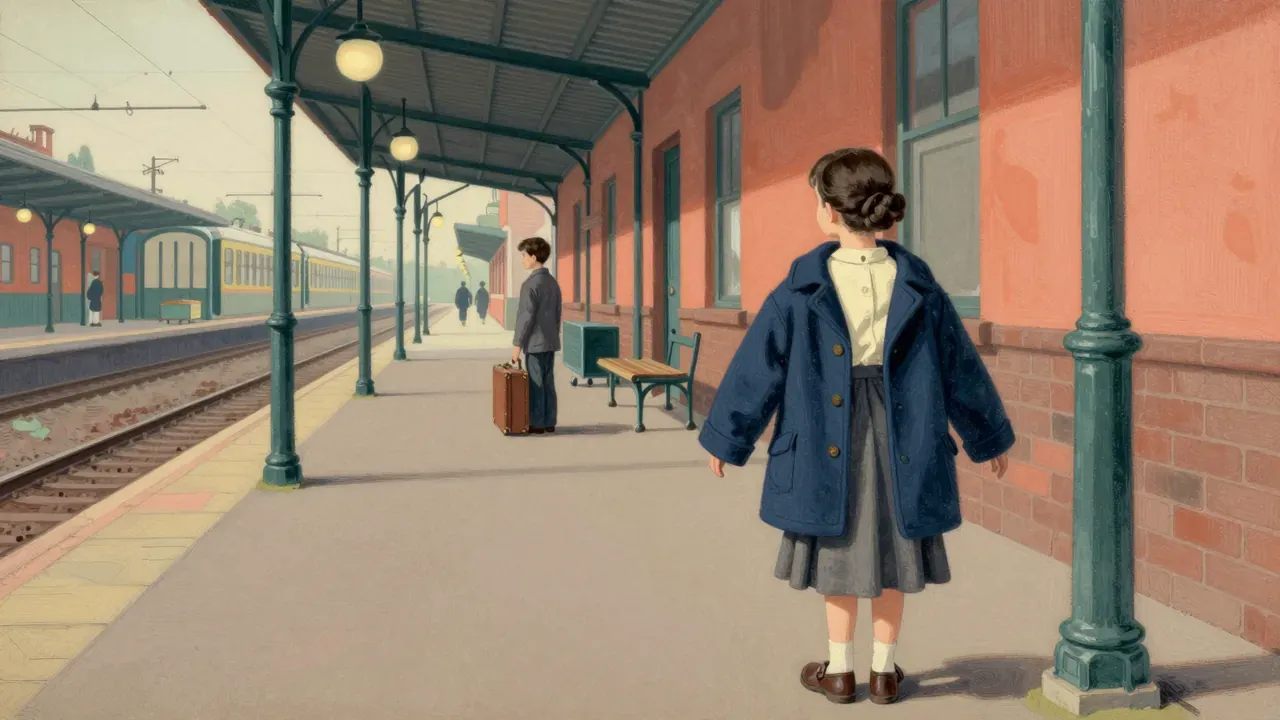
What does not land is the structural reliance on coincidence as narrative engine. Characters repeatedly occupy the same spaces without meeting — a train station, a lawyer’s office, a hospital corridor — not because the film builds suspense around near-encounters, but because the plot requires them to remain apart until the third act. Alberto Farnese’s Poldo functions less as a character than as a plot hinge, his motivations undefined beyond convenience. Enrico Olivieri’s Bruno Carani appears briefly as Guido’s brother, his presence adding thematic resonance about inherited shame but no dramatic friction. The prison sequences, though grounded by Emilio Cigoli’s measured performance as the director, lack texture: uniforms, routines, and hierarchies are implied but never shown. Flora Lillo’s Flora exists largely to voice exposition, and Philippe Hersent’s Mario La Torre — absent from the main cast list in the fact sheet — has no discernible function in the final cut. The film’s refusal to interrogate its own moral premises also limits resonance: there is no counter-voice to the convent’s authority or the law’s inflexibility, no suggestion that alternatives exist beyond endurance or erasure. (159 words)
Time as moral material
The themes that matter are not redemption as triumph, but redemption as reintegration — slow, partial, and contingent on others’ willingness to look again. Class operates quietly but decisively: Guido’s position as employer grants him access to institutions that exclude Lina, yet his privilege does not shield him from error or delay. Motherhood is treated not as biological destiny but as social risk — the film shows how easily maternal identity can be stripped, hidden, or mistaken, and how laboriously it must be reclaimed. Time is a theme in its own right: ten years pass between the first film and this one, and the script treats elapsed time not as backstory but as lived residue — in Sanson’s posture, in the boy’s changed face, in the way certain rooms feel emptier than they did before. Faith appears not as doctrine but as practice: the convent’s rhythm is one of work and waiting, its authority procedural rather than doctrinal. The film resists allegory; its angels are white not because they are pure, but because they are unmarked — provisional, temporary, human. There is no transcendence here, only the fragile, daily renewal of belonging. (156 words)
Who it is for, and who it is not
This film is for viewers who value sustained emotional tone over narrative surprise, and who accept melodrama not as exaggeration but as compression — a way of distilling moral consequence into gesture, glance, and silence. It suits those familiar with mid-century Italian studio production, or with Matarazzo’s earlier work, particularly Nobody’s Children. It will frustrate viewers who require psychological realism, narrative efficiency, or structural irony — the film gives no quarter to ambiguity about right and wrong, nor does it reward close attention to subtext over surface. Those expecting social critique may find its compassion too contained, its institutions too stable. A viewer who values historical specificity over universalism will respond more readily than one seeking timeless parable. It is not for those who need momentum, wit, or visual invention — Delli Colli’s camera moves only when necessary, and Cozzoli’s music rarely rises above conversational volume. To find it inert is reasonable; to call it hollow is not — its emptiness is deliberate, a vessel shaped to hold sorrow without spilling it. (159 words)
An evening well spent
Yes, it is worth your evening — provided you watch it without expectation of novelty, and with willingness to sit inside its tempo. Its power lies in accumulation, not climax: the weight of ten years, of withheld names, of repeated small choices that narrow possibility without ever seeming fated. It rewards patience, not analysis. You would disagree if you believe drama must challenge its own assumptions, or if you find moral certainty artistically limiting. A different verdict would follow if the film had allowed even one character — the lawyer, the nun, the prison director — to articulate doubt about the system that shapes them. But it does not. Instead, it asks whether kindness can persist within rigidity, and answers with quiet insistence. That question remains live, even now. The film does not resolve it, but it holds space for it — fully, soberly, without flourish. That is enough. Not all evenings demand revelation. Some only ask for recognition. (159 words)