The weight of years
Grisbi is a French heist film set in the Parisian underworld of the early 1950s, centred on ageing gangster Max le Menteur and the quiet erosion of his control over both his crew and his life. Jacques Becker does not aim for suspense in the conventional sense, nor does he seek to mythologise crime: instead, he treats the genre as a vessel for observing routine, loyalty under strain, and the physical weight of time on men who have built their identities on discipline and silence. The film’s ambition is modest but precise — to show how a world held together by habit begins to loosen at the seams when one man grows tired, one woman arrives unannounced, and one younger associate starts measuring himself against the boss. It avoids moralising, avoids flashbacks, avoids exposition; it assumes the viewer will follow meaning through gesture, timing, and what is left unsaid. This is not a film about getting away with something, but about what remains once the getaway is over — and whether anything remains at all.
The pace of it
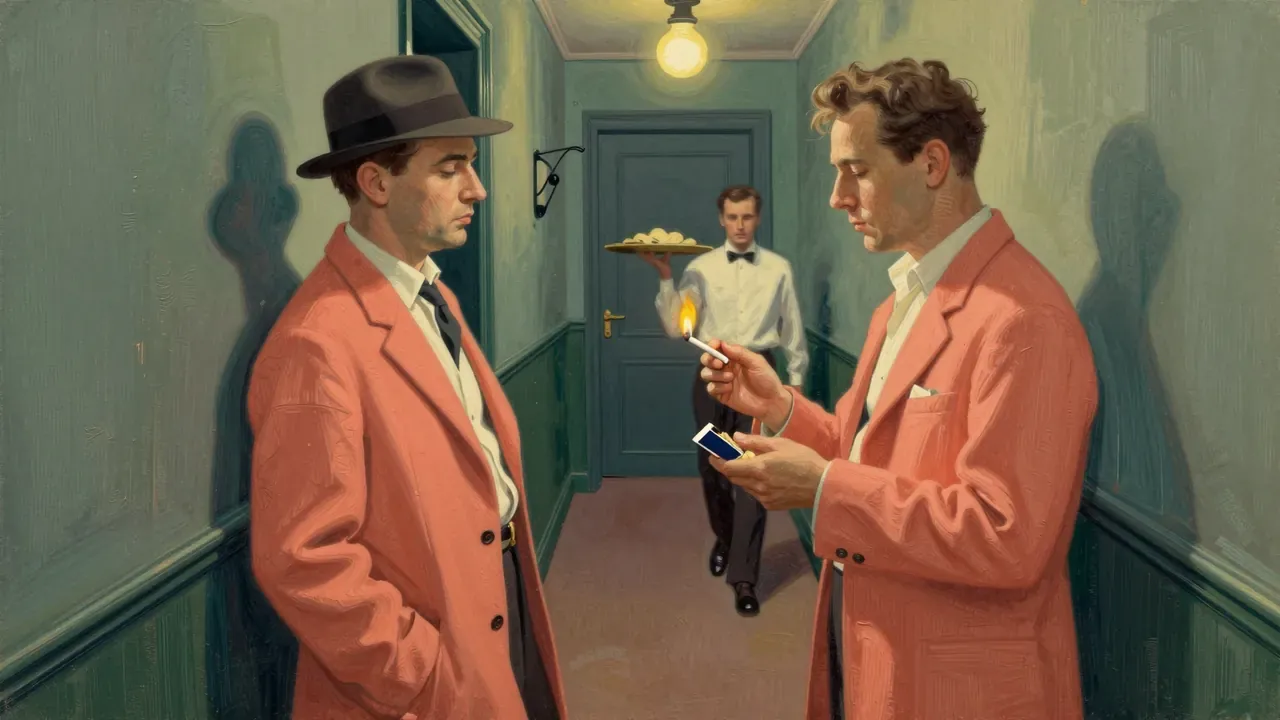
The story unfolds over three days in a series of tightly composed interiors — Max’s apartment, a nightclub, a safehouse — where Pierre Montazel’s cinematography keeps light low and surfaces worn, favouring mid-shots and shallow focus that hold characters in proximity without intimacy. Jean Gabin’s performance anchors the film: he moves slowly, speaks less, lets pauses accumulate like dust. Lino Ventura, as Riton, offers a quieter counterpoint — less volatile than his later roles, more watchful, more contained. Marguerite Renoir’s editing sustains this rhythm: cuts are clean but never hurried, often landing just after a line ends or a glance settles. Jean Wiener’s score is sparse, mostly piano and brushed drums, used only where silence would otherwise stretch too thin. The script, co-written by Becker and Albert Simonin, avoids plot turns in favour of behavioural shifts — a changed tone in a phone call, a delayed response to an order, a cigarette lit too late. Craft here serves restraint, not flourish.
The look of it
What lands is the cumulative effect of small, unemphatic choices: the way Max folds his coat before sitting, the way Riton checks his watch twice in one scene without needing to say he’s waiting, the way Delia Scala’s Lola enters a room and instantly alters its temperature without raising her voice. These are not moments built for applause, but for recognition — of how people signal power, fatigue, or doubt without declaring them. The film’s realism is neither documentary nor naturalistic; it is procedural, almost anthropological, rooted in the logic of its world’s internal rules. Even minor characters — René Dary’s nervous safecracker, Charles Bayard’s weary fence — behave with consistent, unexplained history. The pacing, which some might call slack, becomes persuasive: this is how time passes for men who have stopped believing in tomorrow. The lack of music during key scenes, the refusal to underline emotion with close-ups, the absence of reaction shots after revelations — all these omissions land because they trust the viewer to register consequence in the space between actions.
The gaps in it
What does not land is the film’s occasional drift into inertia — not slowness, but stasis. There are stretches, particularly in the middle third, where narrative momentum dissolves into atmosphere without replenishing it with new psychological information. Jeanne Moreau appears late and briefly as a rival’s mistress, and though her presence sharpens the tension, her function remains opaque: she is neither catalyst nor foil, and her scenes do not accrue meaning beyond their immediate texture. Similarly, the heist itself — the nominal engine of the genre — is treated so peripherally that it risks feeling like a pretext rather than a pivot. Some viewers will find the withholding of explanation frustrating: we are never told why Max trusts Riton, nor why Riton stays, nor why the younger men hesitate. That ambiguity is deliberate, but it can read as evasion when the film offers no compensating insight into those silences. Those expecting structural rigour or moral reckoning may leave unsatisfied.
The air of it
The themes that matter are ageing as occupational hazard, loyalty as habit rather than principle, and authority as performance sustained by consensus. Grisbi treats criminal hierarchy not as ideology but as infrastructure — fragile, patched, dependent on shared assumptions about who does what and when. Max’s exhaustion is not metaphorical: it is visible in his posture, audible in his breath, measurable in the seconds he takes to rise from a chair. The film asks what happens when the body outlives the role, and when the role was never meant to last this long. It also examines the gendered economy of the underworld: women enter as destabilisers — lovers, informants, threats — but are rarely granted agency beyond that function. Lola’s arrival triggers a recalibration, but she is never allowed to speak for herself beyond what the men interpret. There is no nostalgia for the past, only attention to its residue: the outdated suits, the pre-war furniture, the radio playing old songs. This is not a film about decline, but about duration — how long things persist after their purpose has quietly expired.
The audience for it
This film is for viewers who value precision over propulsion, who find tension in stillness and meaning in omission, and who accept that character may be revealed more reliably through repetition than revelation. It rewards patience, familiarity with mid-century French cinema’s grammar, and tolerance for ambiguity that does not resolve. It is not for those who require clear stakes, escalating conflict, or emotional exposition — viewers who expect a heist film to deliver adrenaline, or a drama to offer catharsis, will likely feel short-changed. Those who associate Jean Gabin with fiery defiance (as in Touchez pas au grisbi’s later, more famous successor) may misread his stillness here as passivity. A different edit — tighter, with sharper cause-and-effect — would change the verdict, as would a script that clarified the stakes between Max and Riton. But as it stands, this is a film that asks for surrender to its tempo, not submission to its plot.
The time in it
Yes, it is worth your evening — provided you approach it not as entertainment but as observation. Its ninety-two minutes unfold with the inevitability of weather: slow, unarguable, shaped by forces already in motion. You will not leave exhilarated, but you may leave attentive — to how light falls on a wall, how a man chooses not to react, how silence can carry more weight than dialogue. It is not demanding in the way of complexity or technique, but it is exacting in its refusal to simplify. Those who watch it expecting a thriller will feel cheated; those who watch it as a study in comportment will find it rich. It does not ask for investment in outcome, but in presence — in noticing what the frame holds, and what it leaves out. That is not a universal pleasure, but it is a real one, and it holds up across decades precisely because it makes no concessions to urgency. Time spent here is not recovered, but it is accounted for.