The look of it
The Gleaners and I is a French documentary made in 2000 by Agnès Varda, who wrote, produced, directed, and co-shot it. It follows her travels across rural and suburban France—Beauce, Jura, Provence, the Pyrenees, and Paris’s outskirts—over seven months to observe people who glean: those who collect leftover crops, discarded food, or abandoned objects. Varda does not frame gleaning as poverty alone but as a spectrum of practice—from necessity to ethics to artistry—and includes chefs, lawyers, psychoanalysts, sculptors, and teachers among her subjects. She treats the act as both historical custom and contemporary gesture, anchoring it in French law while letting its meanings drift into questions of value, waste, and survival. The film is not argumentative; it avoids thesis statements, preferring to let encounters accumulate. Varda herself appears throughout—not as authority but as participant, observer, and occasional subject—acknowledging her own role as a gatherer of images, ideas, and moments. Its aim is not to explain gleaning but to hold space for its many contradictions, textures, and quiet intensities. (158 words)
The hand that holds the camera
The film unfolds through loosely linked vignettes, built from interviews, chance encounters, and self-reflective interludes. Varda uses a Sony TRV900 Mini DV camcorder—the first time she shot digitally—allowing mobility, immediacy, and intimacy. Pascal Sautelet and Stéphane Krausz share cinematography credit, but much of the footage bears Varda’s hand-held, searching eye: low angles on potato fields, tight frames on wrinkled hands, long takes of trucks passing as she films from a moving car. Editing by Varda and Laurent Pineau moves with associative logic rather than chronology, cutting between a vineyard owner quoting Étienne-Jules Marey and an artist arranging scrap metal. Joanna Bruzdowicz’s score is sparse, often giving way to ambient sound or silence. Varda’s voiceover is conversational, unpolished, sometimes trailing off; her presence is physical—combing grey hair, examining her palms, filming her lens cap swinging. There are no re-enactments, no scripted dialogue, no professional performers. The craft is artisanal: light, editing, music, and narration all serve proximity over polish, curiosity over control. (159 words)
Who gathers, and why
What lands is the film’s quiet insistence on dignity in marginal acts. A chef retrieving windfall apples, a teacher salvaging supermarket produce, an artist turning rusted iron into sculpture—each is given time, attention, and compositional care. Varda’s camera lingers on textures: dirt under fingernails, the waxy skin of a heart-shaped potato, the cracked face of a clock found on pavement. These details accrue weight without commentary. Her self-portraiture—especially the recurring shots of ageing hands—does not sentimentalise but grounds the film in embodied time: hers, the gleaners’, the land’s. The digital grain becomes part of the aesthetic, not a compromise but a register of presence. The structure feels unhurried yet never slack; digressions—a detour to film a roadside sign, a pause to watch clouds—feel earned because they mirror the rhythm of looking itself. Even the so-called ‘mistakes’, like the dangling lens cap sequence set to jazz, work because they extend the film’s central idea: that meaning gathers in what is overlooked, discarded, or deemed incidental. (157 words)
What is left behind
What does not land is the occasional drift into anecdote without resonance. Some interviews—particularly with legal experts explaining French property statutes—feel dutiful rather than illuminating, their technical precision at odds with the film’s otherwise tactile, intuitive flow. A few urban sequences, filmed in Parisian suburbs, lack the visual cohesion of the rural passages; lighting is flatter, framing less assured, and the subjects’ stories feel abbreviated. The film’s refusal of narrative scaffolding works most of the time, but in two or three stretches—especially mid-section, where several short encounters follow one another without tonal shift—it risks diffusing momentum. Varda’s self-reflexivity, though central to the film’s intelligence, can also narrow focus: when she films her own hands or hair for the third time in ten minutes, the gesture begins to echo rather than deepen. None of this breaks the film, but it marks where the method’s openness meets its limits—not every gleaned moment carries equal charge, and some fragments remain just that: fragments. (156 words)
The tool and the touch
The themes that matter are not abstract but lived: the instability of value, the politics of surplus, the ethics of disposal, and the persistence of older ways within modernity. Gleaning here is neither romanticised nor pitied; it is shown as adaptive, resourceful, and often joyful. Varda links it to artistic practice—not as metaphor but as parallel labour: selecting, assembling, repurposing. Ageing recurs not as decline but as accumulation: wrinkles, grey hair, and slowing movement become surfaces for reflection, not symbols of loss. The film also quietly interrogates authorship: Varda cites her subjects as better expositors of gleaning than she could be, and her use of digital video collapses the distance between impulse and image, making the filmmaker materially present in the act of recording. Sustainability is implied rather than preached; ecology emerges through contact with soil, season, and spoilage, not policy. And legality—what is abandoned versus what is stolen—is treated as porous, shifting with context and power. These themes do not arrive as arguments but as residues, left behind like stalks in a harvested field. (159 words)
How it moves
This film is for viewers who value attention over exposition, texture over plot, and quiet observation over dramatic arc. It suits those accustomed to essay films, reflexive documentaries, or the work of Chris Marker, Jean Rouch, or early Errol Morris—people who find pleasure in the granular, the contingent, and the handmade. It is not for those needing clear stakes, rising action, or resolved conclusions; its pace will frustrate anyone expecting urgency or narrative payoff. Those who dislike visible camera operators, unscripted speech, or extended silences may find it meandering. It also assumes some familiarity with French rural life and legal nuance around property—though these are never prerequisites, just contextual layers. A viewer who values polish, scale, or rhetorical force would likely leave unmoved. Nothing in the film changes if watched on a large screen or small, but its intimacy gains when viewed alone, at one’s own rhythm. (158 words)
What stays
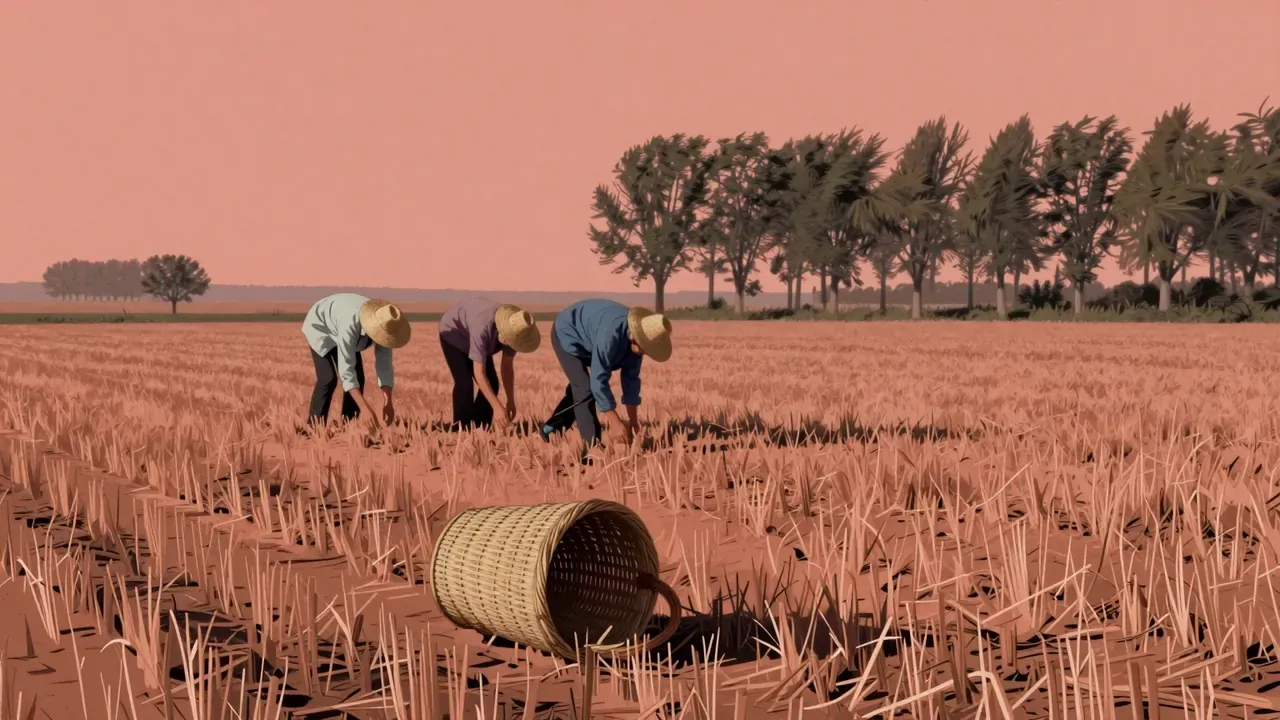
Yes, it is worth your evening—provided you meet it on its terms. It asks ninety minutes of slow, receptive watching, not passive consumption. Its rewards are cumulative: the way a shot of bent backs in a field returns later as a close-up of knotted fingers; how a lawyer’s dry citation of Article 555 of the Civil Code echoes in an artist’s description of junk as ‘a cluster of possibilities’. It is not urgent, but it is sustaining—like finding something useful in what others have cast aside. Those who expect documentaries to advocate, diagnose, or resolve will find it insufficient. But for anyone open to a film that treats curiosity as method and humility as form, it remains singular. Its endurance—ranked in multiple century-best lists since 2014—is not due to prestige but to its stubborn, gentle fidelity to the overlooked. That fidelity is rare, and it holds up. (159 words)