A robbery that fails before it starts
Dog Day Afternoon dramatises the botched robbery of a Chase Manhattan branch in Gravesend, Brooklyn, on 22 August 1972, compressing roughly fourteen hours of hostage standoff into a single sweltering afternoon and night. Sidney Lumet directs from Frank Pierson’s screenplay, itself built from a Life magazine account of the raid carried out by John Wojtowicz and Salvatore Naturile. Al Pacino plays Sonny Wortzik, whose plan to lift $200,000 turns up only $29,000 in the till, with the armoured truck already gone before he arrives. Rather than stage a caper that might still succeed, the film starts from the premise that the job has already failed, and spends its length on what a small, badly planned crime becomes once police, press and a crowd of Brooklyn onlookers turn it into a spectacle nobody inside can control.
Pacino and Cazale inside the branch
The film runs close to real time, with Victor J. Kemper’s camera staying mostly at street level or inside the branch, so information reaches the audience exactly as the crowd, police and Sonny receive it. Pacino moves Sonny from a nervous amateur waving a rifle from under a wrapped box to a man who works the crowd outside like a performer, chanting lines against the police that turn bystanders into an audience on his side. John Cazale, as accomplice Sal, plays the opposite register: flat, watchful, prepared to die rather than return to prison. Dede Allen’s editing holds on reaction shots of hostages and tellers as long as it holds on Pacino, so the standoff plays as an ensemble under pressure rather than a star turn interrupted by everyone else.
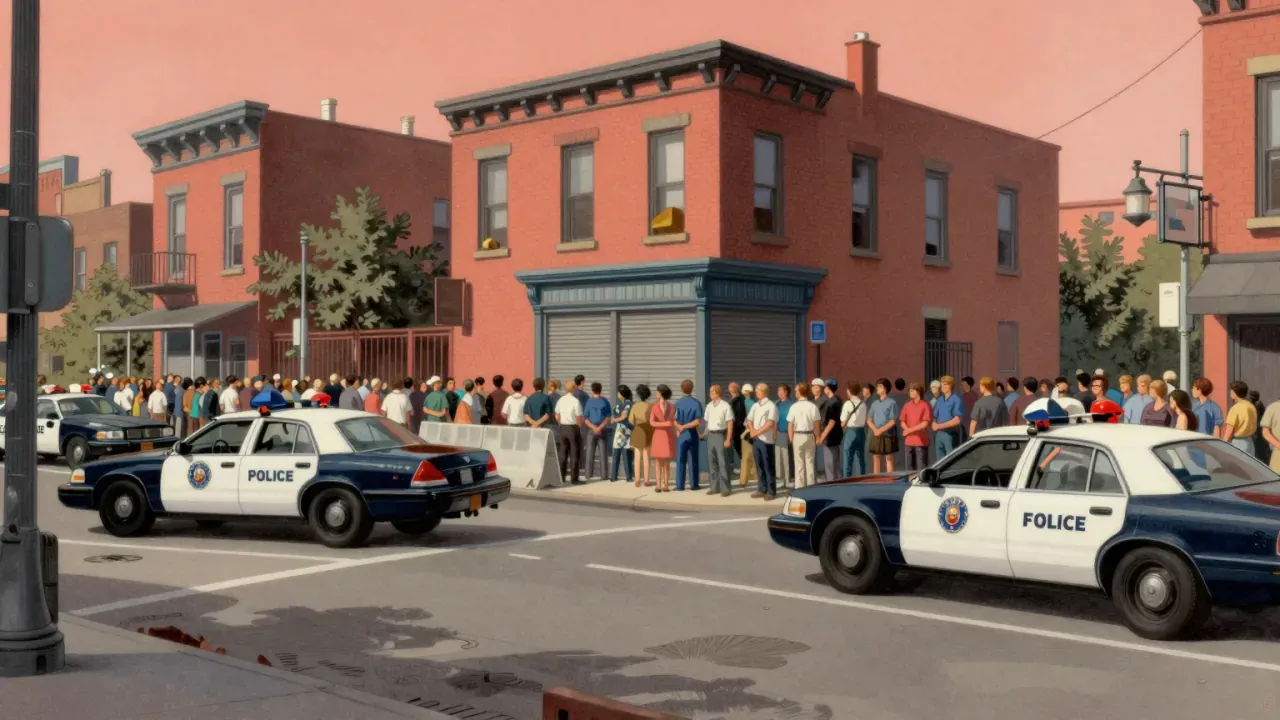
The crowd outside becomes the story
What holds up is the sense of a plan disintegrating in real time inside one small room. Pacino and Cazale’s scenes together carry the friendship of two men who did not expect to still be here after fifteen minutes, and the negotiation calls with Charles Durning’s detective let Sonny’s bravado curdle into fear without the film pausing to explain the shift. The crowd outside, chanting for Sonny against a police cordon, adds a second layer: this is also a film about how quickly a crime becomes entertainment for people with nothing at stake in the hostages’ safety. Lumet lets that turn feel obvious to everyone inside the bank well before anyone says it aloud, which is sharper than stating it outright.
Where the film loses momentum
The middle stretch, largely phone negotiations between Sonny and Durning’s detective, slows the film’s pulse more than the standoff’s actual duration would suggest it should, and a couple of the hostages barely register as people rather than props waiting to be released. The tonal pivot from the outside crowd’s carnival mood to the airport tarmac’s flat violence arrives quickly, almost as an afterthought following the film’s stronger first two acts. Some period detail, including Sonny’s improvised chants against the police, now plays more like a document of one specific afternoon than a scene built for drama, and that documentary flatness is not always to the film’s benefit across a two-hour running time.
A private reason made public
The film’s clearest theme is exposure: Sonny’s reason for the robbery, made public partway through when he tells the crowd the money is meant to pay for his partner’s surgery, turns a stock hostage plot into something 1972 had little public language for outside a crisis. Money and class sit underneath that reveal too, since Sonny is not a career criminal but a man in debt trying to solve a private problem with a public crime he clearly has no aptitude for. The film is just as interested in how fast a crowd and a television camera can turn a hostage-taker into a folk hero without changing a single fact about what he has actually done.
Who the film rewards
This suits anyone drawn to actor-driven 1970s American filmmaking, or to true-crime stories that resist tidying their subject into hero or villain. Viewers who want Pacino at his most controlled, before the style became caricature in his later work, will find an early high point here, and Cazale’s small filmography makes every one of his scenes worth catching. It rewards patience with dialogue-heavy stretches and a plot that barely advances in the conventional sense. It’s a poor fit for anyone wanting a heist film with a competent plan or a clean moral through-line, and the film’s serious, unhurried treatment of Sonny’s private life may surprise viewers expecting a straightforward crime picture from its poster.
An evening with a stalled clock
At just over two hours, the film asks for patience rather than delivering tension, and repays it with a performance from Pacino and a supporting turn from Cazale that still feel unshowy against almost anything else from the decade’s crime cinema. It isn’t built around one big payoff; the disclosure of Sonny’s motive is the closest thing to one, and it lands because two acts of watching him improvise have earned it. Worth the evening for anyone interested in how a crime becomes a media event overnight, considerably less so for anyone wanting forward momentum or a tidy resolution at the end of it.