The shape of memory
David Lynch: The Art Life is a documentary that confines itself to Lynch’s own voice and immediate physical world across four years of filming. It does not seek to explain his films, interpret his symbols, or place him in film history. Instead, it attempts to reconstruct the texture of his early life — not as narrative arc but as remembered sensation: the light in a Montana room, the smell of turpentine, the weight of a baby in his arms. The filmmakers avoid interviews with peers, critics or scholars; there are no talking heads, no contextualising graphics, no voiceover narration. What it tries to do is rare for a biographical documentary: to hold space for an artist’s interiority without translating it into exposition. It treats Lynch not as a subject to be decoded but as a source whose recollections, repetitions and silences are themselves the material. This is not a portrait made from outside in, but one assembled from inside out — built from what Lynch chooses to say, how he says it, and what he does while saying it.
The look of it
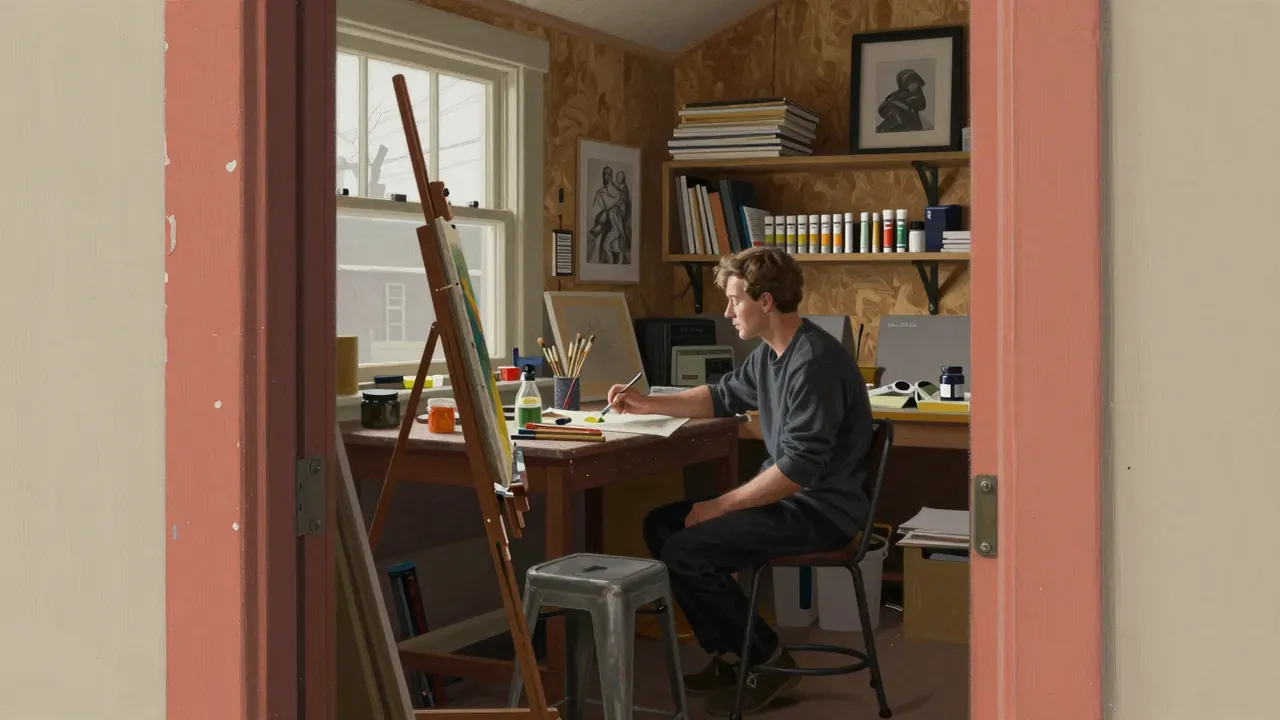
The film works by strict limitation: only Lynch speaks, only Lynch appears on screen in present-day footage, and only his own words — drawn from over twenty recorded conversations — form the audio track. His voice is low, unhurried, often trailing off; the editing by Olivia Neergaard-Holm preserves those hesitations, letting pauses settle like dust. Visually, Jon Nguyen and Rick Barnes keep the camera close and steady — mostly static shots of Lynch painting at his home studio, sketching, mixing pigment, or holding his infant daughter Lula. Intercut are archival photographs: grainy family snapshots, student work from Boston and Philadelphia, early drawings. There is no score beyond ambient sound — the scrape of brush on canvas, distant traffic, a child’s murmur. Gordon Willis is not involved; the cinematography is unshowy, natural-light-led, with muted tones and shallow depth of field. The craft lies in restraint: refusing illustration, refusing emphasis, refusing to cue the viewer how to feel. It trusts the accumulation of detail — a coffee cup, a cracked floorboard, a half-finished canvas — to carry meaning.
What stays with you
What lands is the quiet authority of Lynch’s presence and the cumulative weight of his remembered details. His account of moving to Philadelphia — the damp apartment, the sense of alienation, the shock of urban violence — gains gravity not from dramatic reenactment but from the way he describes the colour of the walls and the sound of rain on the roof. The footage of him painting feels neither performative nor illustrative; it is simply observation of labour, rendered with the same attention he gives to describing his father’s hands or the smell of pine resin in Idaho. The film’s refusal to editorialise allows Lynch’s contradictions — his tenderness alongside his detachment, his curiosity alongside his reserve — to coexist without resolution. Viewers familiar with his work may recognise motifs — the hum of electricity, the fascination with decay, the centrality of domestic space — not as clues but as lived continuities. The effect is less revelation than recognition: this is not where his art began, but where it settled into rhythm.
Where it stalls
What does not land is any sense of critical distance or structural momentum. The film’s commitment to passivity becomes indistinguishable from inertia in its middle stretch: long takes of Lynch mixing paint or staring out a window accumulate without variation in pace or perspective. There is no attempt to interrogate his recollections — no counterpoint from letters, diaries or contemporaries — so anecdotes about his divorce or early failures remain unanchored, emotionally flat rather than enigmatic. The absence of context means certain passages — his time at the Pennsylvania Academy, the genesis of Eraserhead — feel truncated, not elliptical. Some viewers will find the pacing meditative; others will find it monotonous, mistaking stillness for stasis. The film assumes a level of familiarity with Lynch’s work and biography that it does not supply, and offers no bridge for those who lack it. Its resistance to explanation becomes, in places, a resistance to engagement.
What it keeps returning to
The themes that matter are not those usually associated with Lynch — dreams, duality, horror — but quieter, more grounded ones: the continuity between childhood perception and adult making, the physicality of creation, the role of place as memory anchor. The film treats Montana, Washington, Philadelphia and Los Angeles not as backdrops but as sensory registers: each location is defined by light, temperature, sound and smell, all recalled with tactile precision. It also foregrounds time as non-linear — Lynch speaks of his daughter Jennifer and then Lula as if they occupy the same emotional present, and of his teenage self as if he has never quite left that room in Spokane. Another theme is the ordinary labour behind the uncanny: the hours spent grinding pigment, stretching canvas, waiting for film stock to develop. There is no myth of inspiration here, only repetition, doubt, small decisions. The film suggests that Lynch’s strangeness is not a break from reality but an intensification of attention to it — to the grain in wood, the flicker in a bulb, the silence between words.
Who it meets halfway
This film is for viewers who already know Eraserhead, Blue Velvet or Twin Peaks well enough to recognise how its textures echo those of Lynch’s fiction — and who are willing to sit with ambiguity without needing resolution. It suits those who value process over product, listening over interpretation, and who find patience a form of attention. It is not for viewers seeking analysis, historical framing, or insight into Lynch’s later career — there is nothing here on Mulholland Drive, Inland Empire or his commercial work. Nor is it for those who expect documentary to clarify or contextualise; this film deliberately withholds both. A viewer who finds Lynch’s films frustratingly opaque may find this equally impenetrable, mistaking its minimalism for evasion. Someone who values biographical documentaries that weigh evidence, cite sources or confront contradiction will likely leave dissatisfied. The film’s value depends entirely on whether you trust silence, repetition and surface detail as carriers of meaning — and whether you are prepared to meet Lynch on his own terms, not the genre’s.
How long it lasts
Yes, it is worth your evening — but only if you arrive with patience, some prior knowledge of Lynch’s work, and tolerance for long stretches where little changes on screen except light and breath. Ninety minutes passes slowly, but not emptily: the slowness is part of its method, not a flaw. It rewards attention to texture — the way Lynch’s hands move, the cadence of his voice, the shift in shadows across a wall — rather than narrative payoff. Those who expect documentary to inform, persuade or entertain will find it withholding. Those who see it as a chance to inhabit an artist’s rhythm — to watch him mix paint as he recalls his mother’s laugh — may find it unusually intimate. It would not work as a first introduction to Lynch, nor as a substitute for watching his films. But for the right viewer, it deepens understanding not by explaining, but by lingering. Its worth is conditional, not absolute — and that condition is willingness to let the film unfold at its own pace, without demand.