The premise
It’s a Mad, Mad, Mad, Mad World is a studio-era attempt to weaponise comedy as spectacle: a Cinerama-scale farce built around a single premise — four strangers overhear a dying criminal’s confession about $350,000 buried near Santa Rosita, and race across Southern California to claim it first. Stanley Kramer, known for courtroom dramas and moral parables, directed it as a deliberate pivot into pure, unmodulated silliness. The film does not disguise its ambition: it wants to be the biggest, loudest, most densely populated comedy ever made, using Ultra Panavision 70 and one-projector Cinerama to stretch slapstick across a 2.76:1 canvas. Its structure is linear but fractured — less plot than relay race, with characters swapping vehicles, allies, and injuries every fifteen minutes. It treats narrative as scaffolding for set pieces, not as a vessel for character or consequence. The screenplay by William Rose supplies minimal motive beyond greed and panic, and no thematic friction beyond the idea that chaos multiplies when people stop listening. This is not satire, nor parody, nor even caricature — it is arithmetic performed in clown shoes.
The look of it
The story moves by collision: car crashes, plane dives, ladder collapses, fire-engine tumbles, and a zip-line descent into a pet shop. Ernest Laszlo’s cinematography keeps the wide frame busy but legible, tracking movement across vast desert roads and cramped interiors alike; his lighting avoids shadow-play in favour of even, high-key exposure, letting gags register at distance. Editing by Frederic Knudtson sustains pace without rhythmic variation — cuts land on impact, not irony. Performances are calibrated to the format: Spencer Tracy anchors the film with dry authority, but the rest operate in broad, repeatable units — Sid Caesar’s flustered lawyer, Buddy Hackett’s wheezing opportunist, Jonathan Winters’ unhinged mechanic. There is no through-line for any performer beyond their next physical gag. Ernest Gold’s score pulses like a metronome, underscoring action without comment. The Saul Bass animated titles establish tone before a line is spoken: paper dolls spin, doors burst open, crowds trample logic. Craft serves scale, not subtext — every department answers the same brief: make it bigger, faster, louder, and keep it moving.
The stunts
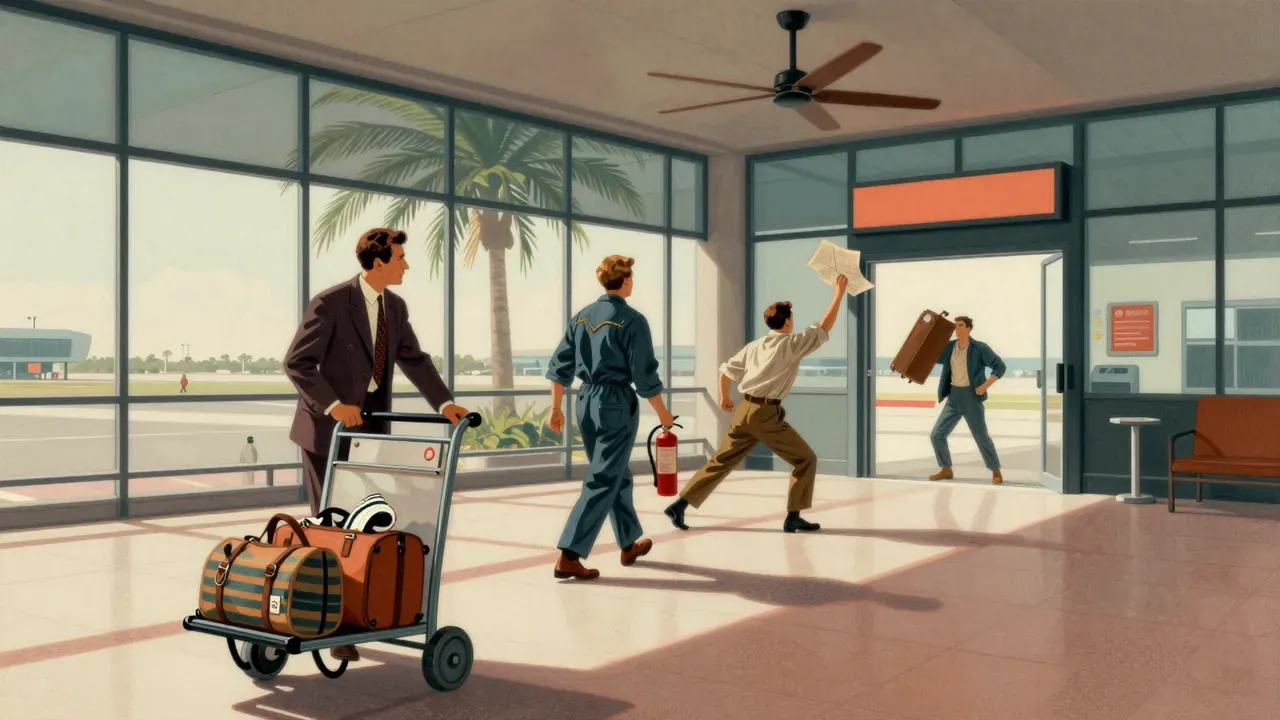
What lands is the sheer logistical audacity of the stunts and the density of comic timing across thirty-odd performers. The airport terminal sequence, with its cascading miscommunications and collapsing luggage carts, works because it commits to cause-and-effect logic within absurdity. The fire-engine chase through Santa Rosita holds up not for realism but for clarity: each vehicle enters frame with purpose, each crash follows a visible trajectory, each reaction is timed to the millisecond. Terry-Thomas’s clipped vowels and Mickey Rooney’s manic energy cut through the noise because they are distinct sonic signatures amid the din. The film’s best moments occur when physical precision overrides narrative — the hangar dive, the billboard strike, the ladder-truck pivot — all filmed in real time, without cutting away. These sequences do not rely on editing tricks or punchlines; they land because they obey gravity, momentum, and the audience’s sense of spatial consequence. Even at 161 minutes, those stretches feel earned, not indulgent.
The rhythm
What does not land is the film’s refusal to modulate. Jokes recur with identical phrasing and rhythm — three characters misread the same map, two cars skid identically on the same curve, a fire hose sprays three different actors in the same framing. The script gives no character arc, no reversal, no quiet beat to reset attention. By the second hour, exhaustion sets in not from length but from repetition: the same escalation pattern — panic, pursuit, crash, regroup, repeat — erodes comedic surprise. Ethel Merman’s musical interlude arrives without tonal warning and halts momentum without payoff. Dorothy Provine’s role exists only to be kidnapped and dropped, twice. The finale’s buried treasure turns out to be a red herring, then a literal pile of cash, then a collapsed tunnel — none of which matters, because the film has spent no time establishing stakes beyond velocity. Kramer’s direction never permits ambiguity, hesitation, or silence; every frame is filled, every pause is undercut, every character’s motivation remains static. It mistakes volume for variety.
The physics
The themes that matter are not stated but enacted: the collapse of social contract under pressure, the illusion of individual agency in group hysteria, and the fragility of systems built on assumption rather than agreement. No character checks a map with another; no one shares information; alliances form and dissolve over split-second misjudgements. The police — represented by Tracy’s Chief Culpepper — are not corrupt or incompetent, but simply irrelevant: their presence does not slow the chase, only redirect it. The film treats infrastructure — roads, airports, fire departments — as scenery to be wrecked, not as shared resources. Money functions not as desire but as MacGuffin: its value is purely kinetic, measured in how fast it can be chased, not what it buys. There is no critique of greed, only demonstration of its physics. The film’s underlying proposition is structural, not moral: given enough people, enough speed, and no rules, coherence dissolves. That is not nihilism — it is engineering. And the film engineers it precisely.
The audience
It is for viewers who value choreographed mayhem over narrative cohesion, who find pleasure in stunt rigging, wide-screen composition, and mid-century studio craft. It rewards attention to process: how a ladder truck pivots, how a Beechcraft hits a billboard, how a Cinerama frame holds twelve actors mid-scream. It is not for viewers who require character development, tonal variation, or thematic resolution — those expecting satire will find only surface, those seeking emotional stakes will find none. Anyone fatigued by repetition, or impatient with 1960s studio pacing, will disengage before the third act. A younger viewer raised on rapid-cut digital comedy may find its long takes and physical continuity alienating. But a film student studying pre-CGI stunt coordination, or a historian tracing the commercial logic of Cinerama revival, will find it indispensable. Its audience is narrow but defined: those who watch films as machines, not mirrors.
The evening
Yes, it is worth your evening — if you approach it as a specimen of industrial comedy, not a story to be followed. Its 161 minutes pass with momentum, not monotony, because its design is relentless and its execution precise. You will not remember dialogue, but you will recall the shape of a collapsing fire escape, the sound of a dozen car horns blaring in unison, the sight of a man tumbling down a hill inside a barrel. It fails as satire and falters as character study, but succeeds as a sustained demonstration of what large-scale physical comedy looked like before digital tools flattened time and space. Those who dismiss it as dated miss its discipline: every crash was rehearsed, every take lit, every edit timed. To call it shallow is to misunderstand its aim — it is not shallow, it is single-depth. Its value lies in that unwavering focus. Anyone who values craft over commentary, or spectacle over sense, will leave satisfied. Anyone who requires either will not.